THE WOMAN THEY TRIED TO TURN AWAY OWNED THE LAND
PART 1 — THE WOMAN AT THE DOOR
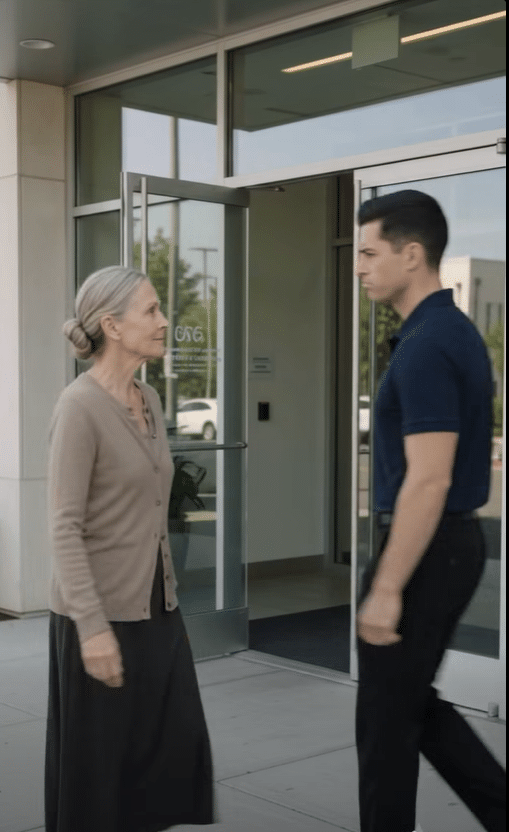
Edith Harlow stepped out of an old silver sedan and looked up at the glass-fronted building across the parking lot.
The place was called Harbor Point Rehabilitation Center, a private facility built on six acres of land her late husband had purchased more than thirty years earlier.
Edith had deliberately arrived without calling ahead.
She wore a plain brown-beige cardigan, a dark skirt, and comfortable shoes. Nothing about her appearance suggested wealth or authority.
That was exactly what she wanted.
As Edith approached the entrance, Nolan Reed stepped away from the door and blocked her path.
“Ma’am, this facility isn’t open for people to just walk into.”
Edith stopped.
“I’m here to take a look at the property.”
Nolan gave her a doubtful glance from head to toe.
“Then you need to arrange that through someone who handles real estate.”
Edith looked past him toward the lobby.
“I only wanted to see how things were being run.”
Nolan’s expression hardened.
“I’m going to need you to leave. Otherwise, I’ll have to call security.”
Edith’s eyes narrowed slightly.
“So you decide how someone deserves to be treated before you even know who they are?”
Before Nolan could answer, hurried footsteps came from inside.
Claire Benson, the facility director, rushed toward the entrance.
The moment she recognized Edith, the color drained from her face.
“Mrs. Harlow? I didn’t know you were coming today.”
Nolan slowly turned toward Claire.
Claire looked at him, then back at Edith.
“Mrs. Harlow owns the land this entire facility stands on.”
Nolan’s confidence disappeared.
Edith looked directly at him.
“A modest appearance doesn’t tell you anything about the life someone has lived.”
She paused.
“And the person you dismiss today may be the very reason you still have somewhere to stand tomorrow.”
Nolan lowered his eyes.
Claire immediately opened the door.
“Mrs. Harlow, please come inside.”
But Edith remained where she was.
“I didn’t come here to be welcomed after someone recognized my name.”
Claire froze.
“I came because I’ve received eleven complaints about this facility in the last four months.”
Nolan looked up sharply.
Claire’s expression changed.
“What complaints?”
Edith reached into her handbag and removed a folded envelope.
“Families saying elderly visitors were ignored. Delivery workers treated like thieves. Applicants turned away before reaching reception. And three former employees saying management cares more about appearances than people.”
Claire stared at the envelope.
“I never saw any of those.”
“That,” Edith replied quietly, “is exactly why I’m here.”
Nolan swallowed.
Claire stepped closer.
“Edith, if something is wrong, I’ll fix it.”
Edith finally walked through the door.
“I hope so.”
She glanced around the polished lobby.
“Because the board meets tomorrow morning.”
Claire stopped walking.
Edith turned back toward her.
“And they’re deciding whether you should continue running this place.”
PART 2 — WHAT THE CAMERAS SHOWED
Claire closed her office door.
“Why didn’t anyone tell me about a board review?”
“Because I asked them not to.”
Edith placed the complaint letters on Claire’s desk.
“I wanted to see this place without everyone preparing for me.”
Claire slowly sat down.
“Then what happened outside must have looked terrible.”
“It didn’t look terrible,” Edith said. “It was terrible.”
Nolan stood near the door, silent.
Claire glanced at him.
“Nolan, you can go.”
“No,” Edith said.
Nolan stopped.
“He stays.”
Claire looked confused.
“Why?”
“Because blaming the lowest-ranking person in the room would be very convenient.”
Nolan looked at Edith for the first time without defensiveness.
Edith turned toward him.
“Were you instructed to stop unannounced visitors?”
“Yes, ma’am.”
“Were you instructed to speak to them the way you spoke to me?”
Nolan hesitated.
“No.”
“Then that part belongs to you.”
He nodded.
“Yes.”
Edith turned to Claire.
“And who created the environment where an employee believes appearance determines who deserves respect?”
Claire’s face tightened.
“That’s not fair.”
“Good,” Edith replied. “Then prove me wrong.”
They entered the security room.
Claire asked the technician to pull footage from the previous month.
Within twenty minutes, the room became painfully quiet.
On one recording, an elderly man carrying grocery bags was left standing outside for seven minutes while employees walked past him.
He had been visiting his wife.
Another clip showed a young delivery driver being questioned repeatedly while a well-dressed salesman was waved through immediately.
Then Edith saw something worse.
A woman in worn clothing entered the lobby holding employment documents.
The receptionist barely looked at them before directing her back outside.
Claire leaned toward the monitor.
“I remember her.”
“What happened?”
“She applied for a housekeeping position.”
“And?”
Claire said nothing.
Nolan spoke quietly.
“She never got an interview.”
Edith turned.
“How do you know?”
“Because I was there.”
Claire looked at him.
Nolan continued.
“The supervisor said she didn’t ‘look right for Harbor Point.’”
Claire’s eyes widened.
“Who said that?”
Nolan named the supervisor.
Claire stood immediately.
“I’ll fire him.”
Edith shook her head.
“You still don’t understand.”
“What am I supposed to do? Keep him?”
“You’re supposed to stop searching for one person to sacrifice and start asking why this happened repeatedly without reaching you.”
Claire slowly sat down again.
For the first time, she had no answer.
Later that afternoon, Edith walked through the rehabilitation wing.
She spoke with nurses, cleaners, cooks, patients, and families.
She introduced herself simply as Edith.
Not Mrs. Harlow.
Not the landowner.
A nurse named Rebecca eventually pulled her aside.
“Can I tell you something without losing my job?”
“If what you tell me is truthful, I’ll protect you.”
Rebecca explained that complaints were routinely redirected before reaching Claire.
Supervisors wanted high satisfaction numbers.
Negative reports disappeared.
Employees who challenged the practice received worse shifts.
Edith listened without interrupting.
Then Rebecca said something unexpected.
“Nolan complained about it.”
Edith looked surprised.
“Nolan?”
“Twice.”
“What happened?”
“Nothing. His supervisor told him to stop creating problems.”
That evening, Edith found Nolan outside near the loading entrance.
“You reported the complaints?”
He looked uncomfortable.
“I tried.”
“Why didn’t you tell me earlier?”
“Would it have changed how I treated you?”
Edith studied him.
“No.”
“Then I didn’t think I deserved to use it as an excuse.”
For the first time that day, Edith smiled slightly.
“That may be the smartest thing you’ve said.”
Nolan looked down.
“I was wrong.”
“Yes.”
“I thought you were someone who didn’t belong here.”
Edith nodded.
“And tomorrow you’re going to tell the board exactly that.”
Nolan looked startled.
“You want me at the board meeting?”
“I want the truth at the board meeting.”
Behind the glass doors, Claire had heard everything.
And for the first time, she realized Edith might not be deciding whether to fire Nolan.
She might be deciding whether to fire her.
PART 3 — THE BOARDROOM DECISION
At nine the next morning, eight board members sat around a long conference table.
Claire sat at one end.
Nolan sat several chairs away, visibly uncomfortable.
Edith entered last.
The chairman began.
“Mrs. Harlow, we understand you requested this emergency review.”
“I did.”
Claire straightened.
Before anyone could speak further, Edith placed the complaint letters on the table.
Then she played the security recordings.
No one interrupted.
When the videos ended, Claire spoke first.
“I accept responsibility.”
Edith looked at her.
“All of it?”
Claire took a breath.
“No.”
Several board members exchanged glances.
Claire continued.
“I didn’t tell Nolan to disrespect Edith. I didn’t tell a supervisor to reject an applicant because of her clothing. And I didn’t personally hide these complaints.”
She paused.
“But I built a management system where numbers mattered so much that people became afraid to bring me bad news.”
Edith listened.
Claire’s voice softened.
“I thought a clean report meant I was running a clean facility.”
She looked down.
“I was wrong.”
Edith turned toward Nolan.
“Your turn.”
Nolan looked around the room.
“When Mrs. Harlow arrived, I judged her before she said ten words.”
He swallowed.
“I treated her differently because of what she was wearing and because I assumed she had no power.”
No one moved.
Nolan continued.
“I can say I was following entrance policy. That’s true. But policy didn’t make me disrespectful. I did that.”
Edith leaned back.
“And what have you learned?”
Nolan looked directly at her.
“That respect shouldn’t begin after you learn someone’s title.”
Silence filled the room.
Finally, Edith stood.
“My husband purchased this land believing Harbor Point would serve people with dignity.”
She walked toward the window.
“He used to say you learn more about an institution by watching how it treats someone who can do nothing for it than by watching how it treats its biggest donor.”
She turned toward Claire.
“I could terminate the lease.”
Claire’s face went pale.
“And within six months this facility would probably close.”
Several board members began whispering.
Edith raised a hand.
“But then hundreds of patients and employees would pay for failures they didn’t create.”
The room became quiet again.
“So that’s not what I’m doing.”
Claire looked up.
Edith placed three documents on the table.
“Claire will remain director for six months under probationary oversight.”
Claire blinked.
“Every employee will receive new conduct training. Complaints will go directly to an independent review system. No supervisor will be able to remove them.”
She placed down the second document.
“The employee who rejected applicants based on appearance is suspended pending investigation.”
Then the third.
“And Nolan will remain employed.”
Nolan stared at her.
“But not at the entrance.”
His expression fell.
Edith continued.
“For the next three months, he’ll work with patient and family services.”
Nolan looked confused.
Edith smiled faintly.
“You need practice seeing people before deciding what they are.”
A few board members smiled.
Six months later, Edith returned to Harbor Point.
Again, she gave no warning.
This time, as she crossed the parking lot, she saw Nolan near the entrance helping an elderly man carry two heavy bags.
The man wore faded clothes and old shoes.
Nolan didn’t ask who he was.
He didn’t ask whether he had an appointment.
He simply opened the door and said, “Let me get that for you, sir.”
Inside, Claire was speaking with a young woman filling out an employment application.
The woman wore a thrift-store jacket and carried her résumé in a wrinkled envelope.
Claire shook her hand.
“Your interview is at two. Take your time.”
Edith stood quietly near the lobby entrance.
Claire eventually noticed her.
For a second, surprise flashed across her face.
Then she smiled.
Not because Edith owned the land.
Not because the board was watching.
Just because she was glad to see her.
Nolan noticed Edith next.
He walked over.
“Good morning, Mrs. Harlow.”
Edith glanced at the elderly man he had helped.
“You didn’t ask him who he was.”
Nolan smiled.
“I figured I could be kind first and find out later.”
Edith laughed softly.
“That sounds like progress.”
She walked toward the lobby.
Nolan opened the door for her, then paused.
“You know something?”
“What?”
“The first day you came here, I thought you were someone who didn’t belong.”
Edith looked back at him.
“And now?”
Nolan shook his head.
“Now I think the real problem was believing anyone had to prove they belonged before they deserved respect.”
Edith smiled.
“That lesson is worth more than this building.”
Then she walked inside.
And from that day forward, Harbor Point placed a simple sentence in every employee handbook:
Never wait to discover who someone is before deciding to treat them like they matter.