Part 1: The Erased Identity
The bright, neutral overhead lighting of the American school gymnasium casts a clinical, almost interrogative glow over what is supposed to be a joyous youth ceremony. The sprawling space smells faintly of floor wax, warm bodies, and the distinct, nervous anticipation of childhood milestones. The polished honey-brown wooden floor gleams flawlessly, marked by crisp white court lines that intersect like a complex geometry of boundaries. In the softly blurred background, massive blue retractable bleachers are packed with families. Their collective presence generates a warm, humming ambiance—a soft crowd chatter punctuated by the occasional squeak of rubber sneakers against the wood and the distant, muffled voice of a school administrator echoing through a crackling PA system.
Arranged with military precision on the floor are rows of white folding chairs. Children, buzzing with nervous energy, sit shoulder-to-shoulder wearing matching black graduation-style robes, their matte-gold V-shaped collars catching the harsh overhead light. Near the main aisle, separated from the seated crowd, sits a small school ceremony table, neatly stacked with printed programs and informational folders. It is a picture of suburban perfection, an everyday milestone meticulously organized. But right beside this table, an invisible shockwave is about to shatter the peace, piece by painstaking piece.
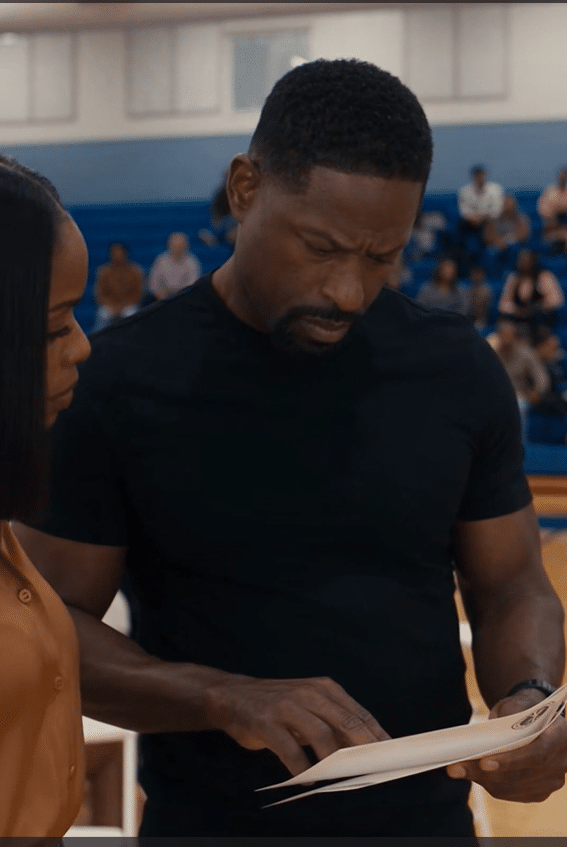
The Dad stands near the aisle, exuding a calm, protective fatherly presence that anchors him to the floor. He is a 38-year-old Black man with deep-brown skin and a solid, athletic build that speaks of quiet discipline. His close-cropped black hair and short, neatly trimmed black beard frame a face that is usually quick to smile, though right now, it is set in a mask of intense concentration. Dressed simply but sharply in a fitted, plain black short-sleeve crew-neck T-shirt, straight dark-charcoal pants, and black low-top shoes, he looks immaculately put together. A heavy black wristwatch rests on his arm as his thumb brushes the edge of the printed ceremony program. He scans the list of names with his index finger, tracing the alphabetical lines, waiting for the familiar surge of pride.
But the pride never comes.
His finger pauses. He blinks, his brow furrowing in genuine, deeply rooted confusion. He checks the page again, his eyes darting back to the top of the column. The name he is looking for—his son’s name, his own legacy, the name he gave his child on the day he was born—is missing.

He looks up, turning his head toward the Mother. She stands a few feet away, entirely aware of his presence but pretending not to be. A 38-year-old Black woman with warm medium-brown skin, she projects an image of flawless control. Her straight, sleek, shoulder-length black bob is parted perfectly down the center, the ends curved slightly inward to frame her face. She wears a warm-brown long-sleeve satin blouse with plain fabric and no pattern, tucked into medium-blue straight-leg jeans, finished with tan low-heel shoes. Small gold hoop earrings sway slightly as she shifts her weight. Her presence is controlled, almost statuesque, but beneath the surface, there is a vibrating, palpable tension.
“Where’s Jayden’s name? It was here yesterday,” the Dad asks, his voice cutting through the soft background noise. It is not an accusation yet; it is a genuine question from a man whose reality has just shifted slightly off its axis.
The Mother stiffens. The micro-expression is instantaneous—a sudden rigidity in her shoulders, a tightening of her jaw. She purposefully avoids his eyes, staring somewhere past his shoulder toward the bleachers, as if the answer lies in the crowd. “It’s under Eric’s last name,” she says, her voice tight, artificially casual, and completely devoid of eye contact.
The Dad stops moving entirely. The ambient noise of the gymnasium seems to fall away. The warmth drains completely from his face, replaced by a chilling, absolute stillness. He slowly, deliberately looks back down at the printed paper in his hands, as if the letters have suddenly rearranged themselves into a foreign language. “What do you mean, under Eric’s last name?”
The Mother leans in slightly, dropping her voice in a desperate bid to contain the fallout, her eyes darting nervously toward the nearby families. “We asked the school to change it.”
Disbelief washes over his features, quickly hardening into a fierce, restrained fury. He locks eyes with her now, and the intensity in his gaze is paralyzing. “You changed my son’s name without telling me?”
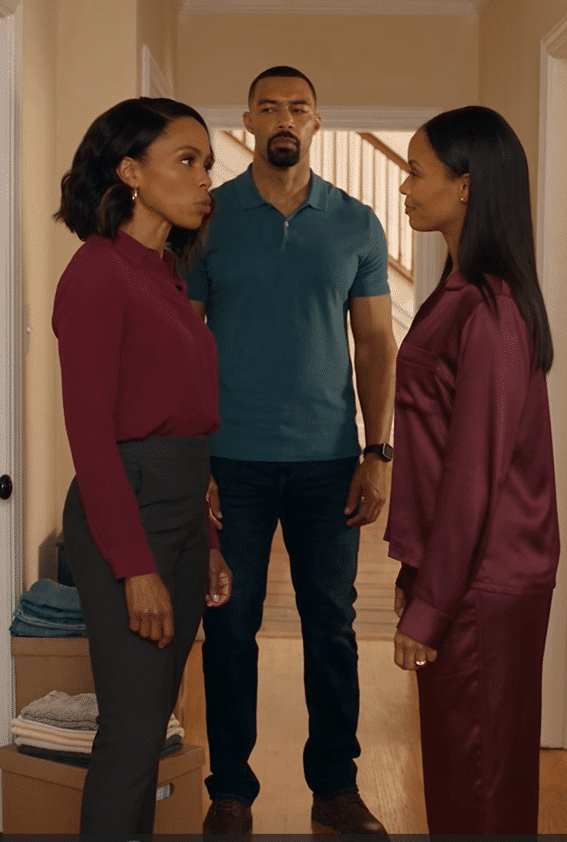
From behind the Mother, the air seems to displace as Eric steps closer. At 42, with dark-brown skin, a completely shaved head, and a full, neatly shaped short black beard, Eric is a mountain of a man. His very tall, heavy, broad build fills the space, making him physically imposing in his plain beige short-sleeve polo shirt and straight khaki pants. His brown casual shoes plant firmly onto the wood. He steps into the invisible boundary between the divorced parents, acting as a self-appointed shield.
“I’m raising him,” Eric says. His tone is calm, firm, and layered with the absolute certainty of a man who believes he possesses the moral high ground. “I thought he should carry the name of the family he lives with.”
The Dad does not flinch at Eric’s massive size. He does not step back. Instead, he looks directly into the larger man’s eyes, every muscle in his jaw tight as he holds back an explosion of protective anger. He refuses to be intimidated. “Did Jayden ask for your name?”
“No,” Eric answers flatly, completely unbothered by the admission.
The Dad’s response is immediate, a verbal strike delivered with surgical precision: “Then why did you need him to have it?”
Sensing the rapidly escalating tension, the microscopic shift from polite disagreement to total warfare, the Mother steps squarely between the two men. “Don’t make a scene here,” she whispers, prioritizing optics over the emotional devastation unraveling in front of her.
The Dad breaks eye contact with Eric, looking down in disgust at the program. But as he glances at the papers in his hand, his eyes catch something else. Clipped just behind the thick cardstock of the ceremony list is another sheet of standard white school paper. His expression shifts instantly from simmering anger to sharp, cold alarm. He slides the second paper out from behind the program. The crisp rustle of the paper sounds deafening to him. He reads the text slowly, his chest rising and falling with heavy, restrained breaths as his eyes track across the official letterhead.
He looks back at the Mother, his voice dropping to a dangerous, quiet register that carries far more threat than a shout ever could. “This isn’t just the ceremony program.”
The Mother freezes. The blood entirely leaves her face.
The Dad lifts the second piece of paper slightly, exposing the lie to the fluorescent lights. “What exactly did you change?”
Eric’s eyes dart toward the document. The Mother’s face is a mask of pure, trapped panic as she realizes her deepest secret has just been unearthed. The invisible clock runs out on her deception.
Part 2: The Collapse of a Mother’s Narrative
The air between the three adults grows heavy, suffocating, as if the oxygen in the vast gymnasium has suddenly been sucked into a vacuum. The distant voice of the ceremony announcer echoes through the PA system, followed by a polite smattering of muffled applause from the blue bleachers, but in this tight, adversarial circle, the silence is deafening. The Dad stands completely still, holding the second school document like a piece of damning evidence, waiting for an explanation that he already knows will be a lie.
The Mother’s survival instinct kicks into overdrive. She speaks quickly, her words tumbling over one another as she tries to shrink the magnitude of her betrayal into something manageable. “Nothing legal. It’s just the school record.”
The Dad’s gaze is piercing. He stares at her, stripping away her weak defense with a single, unyielding look. “That’s not nothing.”
Eric, feeling his authority challenged and his newly constructed household threatened, steps closer. His massive frame towers, but his voice remains measured, listing his daily contributions as if attempting to purchase the rights to a child’s identity through sheer sweat equity. “I’m the one who takes him to school. I’m at practice. I help with homework. I’m there every day.”
The Dad absorbs the words. The pain of missing those mundane, daily moments flashes in his dark eyes—a momentary vulnerability—but it is immediately swallowed by an immovable, bedrock sense of self-worth. He answers calmly, but with a profound, visible ache that commands total respect: “Being there doesn’t give you permission to erase me.”
Eric’s jaw tightens. The muscle pulses visibly beneath his neat black beard. His imposing presence is challenged, and he doubles down. “I’m not erasing you. I’m giving him the name of the family he actually lives with.”
The Dad’s eyes narrow into dark, calculating slits. He sees right through the justification. “Did Jayden ask you for that?”
“No, but he’s a child,” Eric counters, assuming the ultimate, unquestionable authority of adulthood.
“Exactly,” the Dad fires back, his voice vibrating with restrained, righteous power. “So you made the decision for him.”
The Mother, desperate to maintain the illusion of civility in front of the other parents, hisses under her breath, her eyes darting around frantically. “You’re turning this into something ugly.”
The Dad turns his intense, unwavering focus entirely on her, his voice slicing cleanly through her hypocrisy. “You changed his name and hid it from me.”
Behind them, the soft rustle of polyester fabric on wood goes entirely unnoticed until a small, quiet presence makes itself known.
Jayden stands there. The 9-year-old boy, with his medium-brown skin and short, dense curly black hair shaped neatly around his head, looks entirely swallowed by his black knee-length graduation robe. The matte-gold collar hangs loosely around his neck over a crisp white shirt. His normally quiet, observant face is now contorted with a devastating, world-altering realization. He has heard enough. He looks directly at the woman who brought him into the world, the person who was supposed to be his safest harbor.
“Mom… you changed my name?”
The Mother’s confident, controlled presence evaporates into thin air. The sophisticated armor she wore into the gymnasium shatters into a million pieces. She looks at her son, shrinking visibly under his innocent gaze. Her voice softens into a fragile, trembling plea. “Jayden, it was just for school.”
Jayden doesn’t accept the comfort. His dark brows pull together in a heavy, unnatural frown for a boy his age, processing the deep mechanics of betrayal. “You told me the school made a mistake.”
The words drop like lead weights onto the polished floor. The Dad slowly turns his head to look at the Mother. The betrayal is no longer just his; it belongs to his son. The violation is total. Eric, too, shifts his gaze to his wife, a flicker of genuine, uncomfortable surprise crossing his stoic face as he realizes the depth of the lies she spun to orchestrate this moment.
Jayden stares at her, the hurt pooling in his eyes, expanding with every passing millisecond. “You knew?”
The Mother reaches her hand out, an instinctual, desperate move to touch his arm, to pull him back into her orbit and soothe him. But Jayden’s black shoes squeak slightly against the honey-brown wood as he takes a small, deliberate step back. The rejection is subtle, but it echoes louder than a scream in the vast hall.
The Dad watches his son recoil from his own mother. He looks at his ex-wife, his voice barely more than a whisper, yet carrying the crushing weight of total condemnation. “You lied to him too?”
Part 3: The Ugly Truth Exposed
The Mother stands trapped in the exact center of a triangle of judgment. Her ex-husband, her current husband, and her son all wait for an answer she cannot safely give. The ambient room tone of the gym feels suddenly oppressive. The distant PA announcements and the soft shuffling of folding chairs fade into a white noise that only heightens the emotional silence hanging over the family.
Desperate to rebuild the bridge she just watched burn, the Mother crouches slightly, attempting to bring herself closer to Jayden’s physical level, though emotionally, she has never been further away. “I was trying to make things simpler,” she pleads, her voice laced with a panicked urgency.
Jayden looks down at her. His eyes are welling with unshed tears, but his voice is remarkably, painfully steady. “My name wasn’t complicated.”
The restrained low piano notes of realization seem to hang in the air. The Mother freezes entirely. The flawless logic of a nine-year-old completely dismantles her adult rationalizations. She has absolutely no counterargument for the raw truth.
Eric, seeing his wife drowning and feeling the collective foundation of his new family cracking, steps in gently. He attempts to be the benevolent peacekeeper, looking down at the boy with a softer expression. “Nobody is trying to take your dad away.”
Jayden slowly turns his head, fixing his deeply observant gaze on the giant of a man. There is no malice in the boy’s face, only the devastating clarity of childhood innocence. “Then why did you take his name off me?”
Eric’s mouth opens, but not a single sound comes out. The imposing, confident stepfather is entirely paralyzed by a question so direct, so undeniably fair, that it strips him of all his rehearsed defenses. He looks away, his broad shoulders slumping slightly. He has no immediate answer.
The Dad watches the exchange with the quiet, intense vigilance of a protector. He monitors every word spoken to his son, but he deliberately does not interrupt. He is giving Jayden the space to find his own voice, trusting the boy’s profound intelligence.
Humiliated by her husband’s sudden silence and completely cornered by her child’s logic, the Mother’s frustration violently boils over. The remnants of her composure vanish. She stands up abruptly, glaring at her ex-husband, redirecting her guilt into a fiery offensive. “This is exactly why I didn’t want this conversation today.”
“He deserves the truth,” the Dad answers smoothly, completely immovable in the face of her rising hysteria.
“You think this is about you,” she snaps, her eyes flashing with venom.
“No,” the Dad says, his voice grounding the chaotic energy in the room. He looks at his son. “It’s about him.”
The Mother’s composure finally snaps in half. The dam breaks, and the ugly, deeply insecure truth she has been harboring comes flooding out in a vicious, unrestricted rush. “Every time Jayden uses your name, Eric gets reminded that no matter what he does, this will never really be his family.”
The words hit the air and suck the oxygen right out of the gymnasium. A darker, subtle tension settles over the group.
Eric’s face physically changes. The stoic, heavily built man looks deeply, profoundly uncomfortable. Hearing his own quiet, unspoken insecurities weaponized and broadcasted aloud strips him of his dignity. He shifts his weight awkwardly, unable to look the Dad—or worse, Jayden—in the eye.
Jayden stares at his mother. A single tear finally breaches his eyelid, tracking down his cheek, but his posture remains impossibly rigid. He processes the selfish gravity of what she just confessed. “So you changed me to make him feel better?”
The Mother opens her mouth, but the silence that follows is her ultimate admission of guilt. She looks at the floor.
Jayden breaks eye contact with her. He looks down at the printed ceremony program still gripped tightly in his Dad’s hand. The paper is slightly crumpled at the edges from the Dad’s grip. The boy’s mind works rapidly, piecing the puzzle together. He looks back up, his eyes hardening with a frightening maturity. “What does my real school record say?”
The Mother’s eyes immediately dart away. She physically recoils, unable to hold his gaze.
The Dad notices the tell. His protective instincts surge to the forefront. He turns his body entirely toward her, his voice a low, demanding rumble that brooks absolutely no defiance. “Answer him.”
The Mother swallows hard. The muscles in her throat contract as she struggles to force the words past her lips. Jayden’s wide, frightened eyes dart back and forth between the towering adults, sensing the impending catastrophe.
Finally, utterly defeated, the Mother looks up. Her voice trembles. “There’s something else you need to know.”
Part 4: The Final Betrayal and the Shift in Allegiance
The tension in the bright gymnasium corner is now a physical, crushing weight. The Mother looks at her 9-year-old son, then forces herself to look at her ex-husband. The final confession falls from her lips like shattered glass.
“I submitted the surname-change request to the school district. It isn’t final yet.”
The Dad stares at her, his mind struggling to process the sheer audacity of the betrayal. It wasn’t just a display name on a folding table. It was an attempted legal erasure, a bureaucratic assassination of his fatherhood. “You filed paperwork without telling me?”
“I thought Jayden would understand when he was older,” she answers defensively, retreating into her hollow, desperate armor of maternal authority.
Jayden does not look away from her. The betrayal is total and absolute. “You didn’t ask me.”
“You’re nine,” the Mother fires back, her voice tinged with the panicked desperation of a woman who has completely lost control of her family. “Adults make decisions for children.”
Through the profound hurt radiating from his small face, Jayden’s expression hardens into something unbreakable. The quiet, observant boy finds a spine made of absolute steel. “It’s still my name.”
A long, agonizingly heavy silence blankets the group. The surrounding voices of the crowd seem to fade perfectly away, leaving only the sound of restrained, shallow breathing.
Eric stands off to the side, looking down at the boy in the oversized graduation robe. The stepfather’s rigid, imposing certainty is finally, irrevocably weakening. He sees the psychological damage standing right in front of him—the destruction caused by his own unvoiced insecurities and his wife’s catastrophic overreach. He looks at his wife, then back to the boy.
“Maybe we should’ve asked him,” Eric says quietly.
The Mother whips her head around, staring at her massive husband in sheer, unadulterated shock. The ultimate betrayal. “You’re taking his side now?”
Eric does not raise his voice, but his words carry absolute, devastating finality. “I’m taking Jayden’s.”
The Mother is left standing alone. The unified front she tried to build, the reality she tried to violently forge through ink and deception, has completely collapsed around her. She looks abandoned, her anger masking a deep, hollow panic as she realizes both men in her life are now staring at her with identical expressions of disbelief.
Part 5: The Unbreakable Bond
The Dad, seeing the immense emotional toll this battlefield has taken on his son, finally moves. He steps forward, closing the physical distance between them, and smoothly lowers his athletic frame. He kneels on the polished honey-brown wood, bringing himself exactly to Jayden’s eye level. He maintains a respectful distance, not crowding the boy, ensuring Jayden has the agency and space to breathe.
“You don’t have to choose between anybody today,” the Dad says, his voice a steady, infinitely comforting anchor in a violently turbulent sea.
Jayden looks deep into his father’s eyes, his chest heaving slightly under the black robe.
“Whatever name you choose when you’re old enough,” the Dad continues, his voice thick with unconditional love, stripped of all ego and pride, “I’ll still be your father.”
Jayden’s eyes completely fill. The immense pressure of the last few minutes, the crushing weight of the adult politics forced onto his small shoulders, begins to lift. He looks toward Eric for a brief, fleeting moment—acknowledging the man who lives in his house, the man who just defended him—but his gaze snaps fiercely back to the man kneeling before him on the gym floor.
“I never asked anyone to replace you,” Jayden says, his voice ringing with crystal-clear purity.
The Dad’s stoic expression violently breaks. The calm protector fractures for just a second, entirely overwhelmed by the profound purity of his son’s loyalty.
Jayden takes one step closer. The fabric of the black graduation robe swishes around his ankles. “I already have a dad.”
The Dad reaches out, pulling his son into a fierce, desperate, all-encompassing embrace. He wraps his strong arms around the boy’s small frame, holding him tightly but calmly, a physical, unbreakable vow that he is not going anywhere. Jayden buries his face into his father’s black T-shirt, his small hands gripping the fabric as he finally relaxes, surrendering to the safety of the hold.
In the background, Eric watches in total, respectful silence. His imposing frame looks somehow softer, humbled by the scene. His expression has shifted entirely from defensiveness to a reluctant, profound understanding. He realizes now, definitively, that fatherhood cannot be legislated on a school form or demanded through a title.
Off to the side, the Mother stands completely still. She watches the embrace, forced to witness the undeniable, unbreakable bond between the father and son. She is isolated, separated from them by the vast magnitude of her own deceit, slowly realizing that in her desperate attempt to force a new family together, she has deeply, perhaps permanently, wounded everyone.
The scene holds on the tight, desperate embrace of the father and son. The emotional conflict is resolved in the warmth of their arms, but in the background, Eric and the Mother remain physically and emotionally separated, a haunting testament to the lingering, highly visible consequences of a lie.