Part 1: The Mausoleum and the Blue Coat
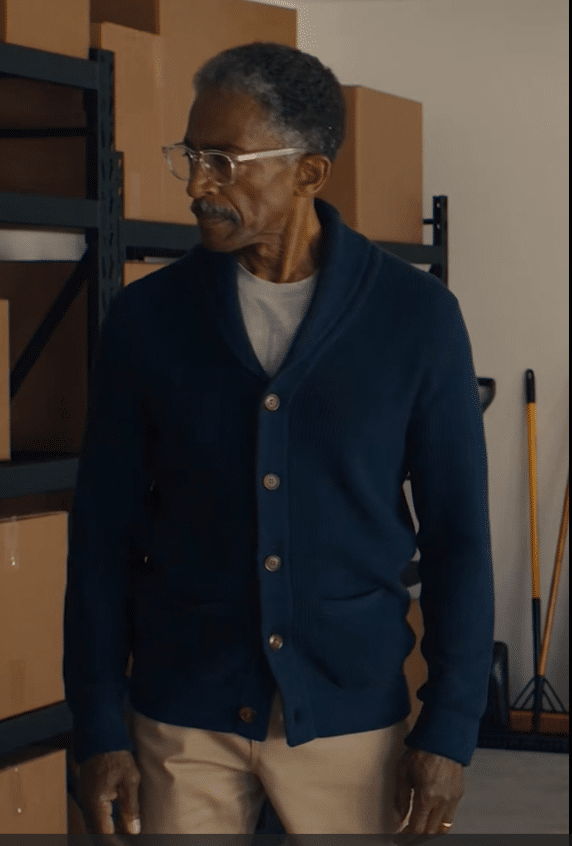
The open door of the suburban two-car garage framed the bright, unforgiving light of a Tuesday afternoon, but inside, the air was heavy with the stagnant breath of the past four years. For Samuel Brooks, a quiet man of seventy-six whose deeply lined face bore the dignified architecture of a lifetime of quiet resilience, this concrete space was not a garage. It was a mausoleum.
Dust motes danced lazily in the shafts of sunlight that slanted across the smooth gray floor, illuminating the dark metal storage shelves fixed against the left wall. For four years, those shelves had been sacred ground. They held the medium-brown cardboard boxes containing the remnants of his late wife, Elaine. Samuel stood at the threshold, his slim, slightly stooped frame clad in a navy cardigan and a light-gray shirt. Behind his clear rectangular glasses, his dark-brown eyes instantly registered a profound, violent violation.
Spaces. Gaping, terrifying empty spaces on the shelves.
Several familiar boxes were simply gone, leaving behind perfectly clean rectangular outlines in the four-year-old dust. Samuel’s heart seized, a phantom pain radiating through his chest, but his face remained a mask of practiced, stoic control. He stepped further into the garage, his leather loafers making barely a whisper on the concrete, and stopped beside the desecrated shelves.
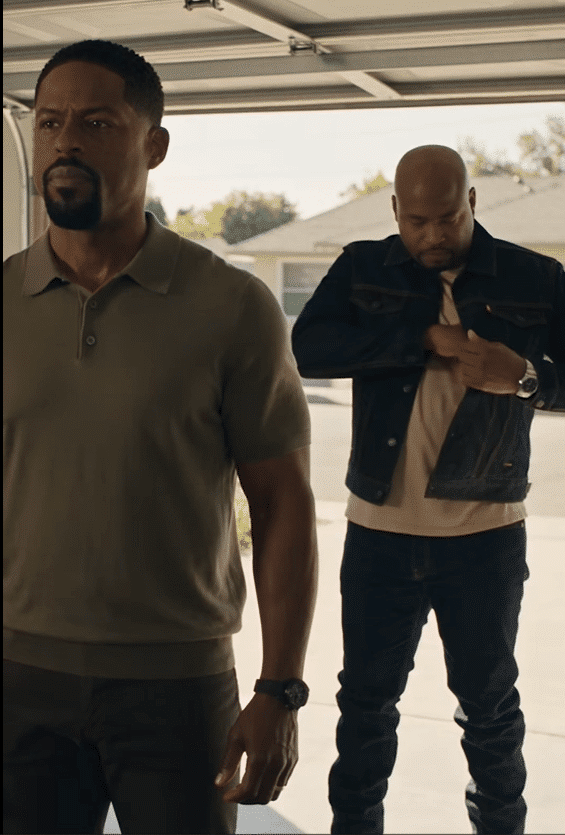
Standing near a waist-high wooden workbench, flanked by a massive black donation bag, was his son, Dante. At forty-one, Dante was a physical force—tall, broad-shouldered, and athletic. Dressed in a fitted olive-green polo that gripped his biceps and dark-charcoal pants, he exuded a practical, commanding confidence. Dante was a man of action, a man who believed that movement equated to healing, totally fundamentally oblivious to his father’s paralyzing grief.
Samuel stared at the empty spaces. When he spoke, his voice was barely more than a murmur, yet it carried the terrifying weight of an approaching storm. “Dante, where are your mother’s things?”
Dante didn’t flinch. He tied off the heavy black plastic bag with a sharp, efficient snap of his wrists. He looked at his father with the grounded, unshakeable certainty of a son who believed he was doing the difficult, necessary thing. “I cleared some of it out. Caleb helped me donate it.”
Samuel’s head turned slowly. The name Caleb felt like ash in his mouth, but it was the action itself that shattered him. “Without asking me?”
Dante let out a breath, a short huff of exasperated affection. He crossed his arms, his thick, dark eyebrows drawing together over his sharp, boxed beard. “Dad, it’s been four years. You haven’t touched any of it.”
“That did not make it yours,” Samuel replied, his voice dropping an octave, settling into a low, controlled register that demanded absolute attention. There was no shouting. There was no frantic waving of hands. The sheer stillness of Samuel’s grief was infinitely more intimidating than rage.
Dante, feeling the sudden, suffocating pressure of his father’s presence, gestured defensively toward the remaining boxes. “I thought keeping everything was keeping you stuck.”
It was a modern, therapeutic excuse, one that meant absolutely nothing to a man who had lost his soulmate. Samuel’s gaze drifted back to the shelves, scanning the remaining cardboard structures, mentally inventorying a lifetime of memories. Suddenly, his breath hitched. He looked at Dante, his dark eyes brimming with a sudden, unshed wetness. “Her blue coat too?”
Dante’s confident posture cracked. The armor of his practicality fractured just a fraction. He shifted his weight, his eyes dropping briefly to the concrete. He hesitated, the air thick with sudden regret. “Yeah.”
Samuel’s jaw tightened. The muscles ticked beneath his clean-shaven chin. The silence stretched, tight and excruciating, before he spoke. “She wore that coat the night we brought you home from the hospital.”
The words struck Dante like a physical blow. His broad shoulders visibly softened, the defensive tension draining out of his athletic frame. He suddenly saw not boxes of junk, but a frozen history he had carelessly discarded.
But Samuel was no longer looking at him. Samuel’s eyes were locked on the upper shelf. Among the remaining dusty boxes, there was a small, distinct gap. It wasn’t a large space, just enough for a single, specific object.
Samuel’s expression shifted instantly. The sorrow vanished, replaced by an icy, terrifying stillness. “Where is the small cedar box?”
Dante blinked, thrown off balance by the sudden shift in his father’s demeanor. “Caleb took everything from that shelf.”
Samuel stopped breathing. He became a statue carved from dark wood, absolutely motionless. The ambient sounds of the neighborhood—the distant chirp of birds, the hum of a lawnmower—seemed to instantly vanish.
Dante felt a cold spike of adrenaline. He took a half-step forward, his voice losing all its prior certainty. “Dad?”
Samuel turned his head very slowly. His eyes locked onto Dante’s, holding a depth of pain that was unfathomable. “Your mother’s last letter to you was inside that box.”
Dante’s mind went blank. The world seemed to tilt on its axis. “What letter?”
Samuel’s voice cracked, a beautiful, agonizing fracture in his dignified facade. “The one she wrote three days before she passed away.”
Dante stared, utterly paralyzed, his face a portrait of stunned devastation. The air in the garage grew thick and unbreatheable. No apologies were offered. No comfort was given. There was only the ringing, deafening silence of a stolen goodbye.
Part 2: The Smiling Thief
The heavy silence in the garage was suddenly broken by the crunch of casual boots on the concrete driveway. The afternoon sun cast a long shadow through the open doorway as Caleb Reed stepped into the garage.
At forty-three, Caleb possessed a solid, broad build and a smooth, completely shaved head that gleamed faintly in the light. Dressed in a dark denim jacket over a beige tee and dark-indigo jeans, he carried himself with an effortless, almost arrogant swagger. His neat black goatee framed a mouth that habitually rested in a faint, one-corner smile. It was the smile of a man who believed he was the smartest person in any room, a subtly patronizing expression of total self-assurance.
He held a folded white piece of paper in his right hand. He glanced around the tense space, seemingly oblivious to the emotional crater smoking between father and son.
“I told Dante this place was becoming a shrine, not a garage,” Caleb remarked calmly, his deep voice rolling with easy confidence.
Samuel did not look at the receipt. He did not look at the donation bags. He looked directly into Caleb’s dark-brown eyes, his stare piercing through the younger man’s relaxed facade. “Did you take a small cedar box from that shelf?”
Caleb didn’t miss a beat. He gave a casual, dismissive wave of the paper. “I took what was with the donations.”
Dante, whose mind was still reeling from the revelation of the letter, whipped his head around. His broad face hardened, the protective son instantly surfacing. “I never told you to take that box.”
Caleb met Dante’s aggression with a small, infuriating shrug, his half-smile never wavering. “Then it got mixed in.”
Samuel stepped forward. He did not yell. He did not accuse. He simply extended one steady, deeply lined hand, palm up. The quiet authority of the gesture was absolute. Caleb, feeling a slight prick of unease beneath his bravado, handed over the folded paper.
Samuel opened the receipt. His eyes scanned the ink with surgical precision. It was a brief, brutal inspection. He looked back up. “This lists clothes and household items. No box.”
“Then they probably didn’t log it,” Caleb answered. His voice was still relaxed, still coated in that infuriatingly calm confidence. He was playing a game of plausible deniability, confident that an old, grieving man would simply accept the bureaucracy of a charity center.
But Samuel Brooks was not just an old, grieving man. He was a husband who had watched the love of his life slip away, and he knew every secret she had left behind.
Samuel watched Caleb’s face. He watched the micro-expressions, the slight tension at the corners of Caleb’s eyes. “There was something else in that box.”
For a fraction of a second, Caleb’s trademark one-corner smile became just a little bit smaller. The edges of his confidence began to fray. Dante, standing a few feet away, caught the micro-expression. Dante was a practical man, but he was not stupid. The pieces were beginning to shift in his mind, aligning into a very ugly, very sinister picture.
Samuel’s voice lowered, taking on a cold, metallic edge that cut through the warm afternoon air. “Your mother kept a signed loan paper inside.”
Dante’s brow furrowed in genuine confusion. He looked from his father to Caleb. “Whose loan?”
Samuel didn’t look at his son. He kept his eyes locked on Caleb, pinning the man to the concrete floor with his gaze. “His.”
The word hung in the air, heavy and lethal.
Caleb became perfectly still. The easy movement of his shoulders vanished. The relaxed tilt of his head froze. His dark eyes widened a fraction of an inch, the patronizing confidence instantly evaporating.
Samuel didn’t let him breathe. He didn’t give Caleb a moment to construct a lie or formulate an alibi. With absolute, devastating precision, Samuel delivered the final blow. “Forty thousand dollars.”
Dante’s head snapped toward Caleb. His strong, square jaw clenched so tight the muscles bulged beneath his beard. The pieces hadn’t just aligned; they had slammed together. The “help” with the garage. The missing box. The missing letter. Dante realized, with a sickening twist in his gut, that he hadn’t been clearing out his mother’s memory. He had been an accomplice to a crime.
Part 3: The Empty Vessel and the Venom
The garage felt like a pressure cooker, the bright daylight outside mocking the suffocating, dark tension inside. The air was so thick it was hard to draw into the lungs.
Dante stepped toward Caleb, his tall, athletic frame suddenly menacing. The brotherhood, the camaraderie they had shared earlier that afternoon, was dead and rotting on the floor between them. “You owed my mother forty thousand dollars?”
Caleb’s throat bobbed. He tried to reclaim his smooth composure, forcing a mask of calm rationality back onto his round-square face. “Elaine helped me when my business was failing. I was going to repay her.”
It was a weak, pathetic excuse, spoken by a man who knew he was cornered.
Samuel’s voice cut through the excuse like a scalpel. “Then where is the box?”
Caleb stared at the older man. The silence stretched, tight as a piano wire, until it finally snapped. Caleb knew he had been caught in the lie of the donation center. Slowly, deliberately, he unzipped the interior pocket of his black denim jacket. He reached in, and when his hand emerged, it was holding the object of devastation.
He walked slowly to the waist-high wooden workbench and placed it down.
It was a small, rectangular cedar box, stained a deep, rich dark-brown, its smooth wooden sides gleaming slightly in the light. On the front sat a single, simple brass latch.
The moment the wood touched the workbench, Samuel moved. He stepped forward, his aging hands remarkably steady as his fingers found the cool brass. Click.
He threw the lid back.
The box was completely, painfully empty.
Dante leaned over the bench, his dark eyes scanning the hollow wooden interior, desperate to see a sliver of white paper, a corner of an envelope. Nothing. “Where are the papers?” Dante demanded, his voice rising, a tremor of panic and rage bleeding into his tone.
Caleb took a step back, crossing his arms defensively. “I got rid of old paperwork.”
Samuel looked up from the empty box, and for the first time, his expression was utterly cold. The warmth, the grief, the fatherly patience—all of it was gone, replaced by a glacial, terrifying wrath. “You knew what that paper was.”
Caleb couldn’t hold the stare. He broke eye contact, looking away toward the driveway, his jaw tight. He was a man drowning, thrashing violently for a lifeline.
But Dante was putting the rest of the puzzle together, and the final picture was monstrous. His eyes widened as the ultimate betrayal dawned on him. “You were the one telling me Dad needed to clear this garage.”
Caleb tried to maintain his defensive posture. “He did.”
Dante took another step forward, his broad chest rising and falling rapidly, his voice thick with disgust. “And you insisted on taking the last load yourself.”
Caleb said absolutely nothing. The silence was an admission of total guilt. He had engineered this entire afternoon. He had used Dante’s pragmatic desire to help his father as a smokescreen to infiltrate the garage, dig through Elaine’s sacred possessions, and steal the evidence of his own financial ruin.
Samuel reached out and carefully, with painful reverence, closed the lid of the empty cedar box. Click. “You were not helping my son move on.”
The words struck Caleb, stripping away the last remnants of his patronizing confidence. He was exposed as a parasite, a thief who had preyed on a grieving family. But a cornered animal is a dangerous animal. If Caleb was going to burn, he was going to take Samuel Brooks down into the fire with him.
Caleb’s posture stiffened. A dark, bitter energy flooded his eyes. He looked at Dante, bypassing Samuel entirely, aiming for the son’s heart.
“If you want the whole truth,” Caleb sneered, his voice laced with poison, “ask him why your mother never gave you her last letter.”
Dante froze. The rage in his veins turned to ice water. He slowly turned his head away from Caleb, the gears in his mind grinding to a violent halt. He looked at the old man in the cardigan, the man who had raised him, the man who was currently standing beside an empty wooden box.
“Dad?” Dante whispered. The single word hung in the air, fragile and terrified, begging for the nightmare to stop.
Part 4: The Blood and the Bluff
The word “Dad” echoed in the silence, an anchor that Dante suddenly felt slipping through his fingers. He looked desperately from the venomous, cornered expression on Caleb’s face to the quiet, heartbreaking stillness of Samuel Brooks.
“What was in Mom’s letter?” Dante asked, his voice rough, scraping against his throat.
Samuel did not look at his son. His dark-brown eyes remained fixed on Caleb with a ferocious, protective intensity. “Her last words were not his to read.”
Caleb let out a short, breathy scoff. A faint, bitter half-smile twisted his neatly trimmed goatee. It was an ugly expression, born of pure malice. “I’m not the one who kept Dante in the dark.”
Dante turned his entire body toward Caleb, his tall frame rigid with tension. “You read it?”
Caleb held his ground, feeding on the chaos he was creating. “Enough of it.”
Samuel’s jaw clamped shut, the muscles jumping visibly beneath his skin. The violation was absolute. His wife’s dying words, her most private confession to her son, had been opened and consumed by a thief in a denim jacket looking to save his own skin. “It was written to my son.”
Dante couldn’t take the crossfire anymore. He spun back to Samuel, his eyes wide, pleading and demanding all at once. “What didn’t you tell me?”
Samuel’s shoulders slumped the tiniest fraction. He looked at Dante, his deep-brown eyes swimming with decades of unshed tears and buried secrets. He spoke quietly, a man carrying a crushing weight. “This should have come from us.”
Before Samuel could say another word, Caleb interrupted. His voice dripped with a calm, arrogant invasion, twisting the knife deep into the family’s heart. “The first line said she wanted him to know the truth about his father.”
Dante stopped breathing. The garage around him seemed to warp and bend. His strong square jaw went slack. Forty-one years of identity, of knowing exactly who he was and where he came from, shattered into a million unrecognizable pieces. He looked at the man standing before him, the man who had taught him how to ride a bike, who had tied his ties, who was grieving the same woman he was.
“Dad?” Dante’s voice was hollow, the voice of a lost child in a dark woods.
Samuel held his son’s gaze. He did not look away. He did not show shame. He showed only a terrifying, infinite love. “I am your father.”
Dante waited in the suffocating silence, his chest barely moving.
Samuel took one slow, meticulously controlled breath. “But I am not your biological father.”
The world stopped. There was no explosion, no melodramatic scream. There was only the visceral, agonizing shock of a reality being rewritten in real-time. Dante went completely, physically still, his dark eyes staring through Samuel as his brain desperately tried to compute the impossible data.
For a moment, Caleb looked triumphant. He had dropped the bomb. He had deflected the attention from his theft to Samuel’s lie.
But Samuel Brooks was not finished.
Samuel looked Dante in the eyes, his voice steady, anchoring his son in the storm. “No. Your mother was already pregnant when I met her. Your biological father left before you were born.”
Dante’s voice was barely a whisper. “And you never told me?”
“We should have,” Samuel admitted, his tone laced with heavy, undeniable regret. “Your mother wanted to tell you herself, but then she became ill, and we kept waiting.” Samuel’s eyes darted momentarily to the empty shelves, thinking of the blue coat Dante had casually given away. A profound softness washed over Samuel’s lined face. “She wore it the night we brought you home. I had already chosen you as my son.”
Dante squeezed his eyes shut, fighting a violent wave of emotion. He struggled to process the hurt of the lie against the overwhelming, blinding light of Samuel’s choice. He was not an accident to this man. He was a choice.
Dante opened his eyes, the tears brimming over, and slowly turned his gaze toward Caleb. The realization of what Caleb had done hit him with renewed, devastating clarity. “And you read this before I did?”
Caleb, for the very first time since stepping into the garage, avoided Dante’s eyes. The sheer emotional weight of the moment was crushing his smug facade. “I read enough.”
Samuel stepped away from the workbench, inserting himself between Dante and Caleb. The softness vanished. The patriarch returned. “You also read the part about the forty thousand dollars.”
Caleb froze, a deer caught in the headlights of an oncoming train.
“Elaine wrote that it was a loan, not a gift,” Samuel stated, his voice ringing with absolute, terrifying authority.
Dante stared at Caleb, his disgust radiating in waves.
And then, with the precision of a master executioner, Samuel added the final, lethal line. “And that paper was not the only copy.”
Caleb’s face physically collapsed. The color drained from his medium-dark brown skin. The muscles in his broad face went completely slack. The realization of his absolute, catastrophic defeat slammed into him. He had burned this family to the ground, he had exposed their deepest secrets, all to destroy a piece of paper that didn’t matter.
Part 5: The Words Left Behind
The afternoon light in the garage seemed to shift, casting long, somber shadows across the concrete floor.
Dante stepped aggressively toward Caleb, his tall frame looming over the defeated man. The revelation of his paternity was a massive, bleeding wound in his chest, but the immediate, burning fury was directed entirely at the parasite in front of him.
“You pushed me to clean this garage because you wanted the loan paper gone?” Dante’s voice was a low growl, vibrating with absolute disgust.
Caleb’s smugness was entirely eradicated. He looked down at the concrete floor, his broad shoulders hunched, completely stripped of his armor. When he spoke, it was the pathetic, desperate voice of a broken man. “I was desperate. I thought if the original disappeared, the problem would disappear with it.”
Samuel stood tall, an immovable pillar of quiet strength. “Elaine’s attorney has another copy.”
Caleb flinched as if he had been struck. He was trapped. The debt remained, but the bridge he had burned to escape it was gone forever.
Dante’s expression morphed from profound shock into a deep, sickening revulsion. “So you used me.”
Caleb raised his hands in a weak, pathetic gesture of appeasement, finally looking up. “Dante—”
“You used my father’s grief and my mother’s things to protect yourself,” Dante cut him off, his voice echoing off the corrugated metal of the garage door. Each word was a nail in the coffin of their relationship.
Caleb lowered his eyes again. The air was thick with his shame. After a long, painful pause, Caleb reached a trembling hand slowly inside the breast pocket of his denim jacket. He hesitated for a fraction of a second before pulling out a sealed, plain cream-colored envelope. There was no writing on the outside. It was pristine, heavy, and held the last echoes of a ghost.
Without looking at either of them, Caleb held the envelope out toward Dante. “I kept the letter.”
Dante stared at the cream paper. It was the missing piece of his soul, held in the hands of a traitor. He reached out and snatched the envelope, his fingers deliberately avoiding making any physical contact with Caleb’s skin. He held the letter to his chest.
“We’re done,” Dante said. The finality in his voice was absolute.
Caleb didn’t argue. He didn’t apologize. He simply turned around and walked slowly toward the bright daylight of the driveway. The soft, rhythmic sound of his boots on the concrete faded into the distance until there was nothing left but the quiet ambient hum of the neighborhood.
In the garage, father and son remained. They stood several steps apart, an invisible chasm of a forty-one-year-old secret stretching between them. The missing boxes, the empty cedar box on the workbench, and the sealed envelope in Dante’s hands were the only witnesses to the wreckage.
Samuel looked at his son, his dark eyes filled with a vulnerable, aching regret. He made no move to bridge the physical distance. He did not demand forgiveness or understanding. “I should have told you the truth years ago.”
Dante looked at the man who had raised him. The anger was fading, leaving behind a raw, tender exhaustion. “You should have.”
Dante’s gaze drifted slowly to the left, staring at the half-empty metal shelves. He saw the space where the blue coat used to be, the space where his mother’s memory had been carelessly packed away. His chest hitched. “And I should have asked before touching Mom’s things.”
Samuel gave a small, restrained nod. A silent, mutual acknowledgment of their shared failures in grief.
With trembling fingers, Dante broke the seal of the cream envelope. He slid the folded paper out. The rustle of the paper seemed deafening in the quiet garage. He unfolded it, his eyes scanning the familiar, elegant handwriting of a woman who had been gone for four years.
He read in silence for a moment, his broad chest rising and falling unsteadily. Then, he read one short line aloud, his voice cracking, tearing at the edges.
“The man who raised you chose you before you could ever choose him.”
Dante’s eyes filled instantly. The tears he had been fighting finally broke, spilling over his thick eyelashes and tracking down into his dark beard. The DNA didn’t matter. The bloodline didn’t matter. He looked across the concrete floor at the seventy-six-year-old man who had stood by him, protected him, and loved him without condition.
“Dad,” Dante said softly. It wasn’t a question anymore. It was an absolute truth.
Samuel did not rush forward for a dramatic embrace. He remained exactly where he was, standing tall, his own eyes wet behind his clear glasses. He simply held his son’s gaze, offering the steady, unwavering presence he had provided for forty-one years. The reconciliation was quiet, heavy, and deeply earned.
Dante wiped a tear from his cheek and gestured gently toward the workbench and the remaining cardboard boxes. “Can I help with what’s left?”
Samuel looked at the empty cedar box, then back to his son. A faint, genuine warmth finally returned to his deeply lined face.
“This time,” Samuel answered, his voice thick with emotion and restored peace, “we decide together.”
The afternoon sun continued to pour into the garage, no longer illuminating a mausoleum of grief, but lighting a space where two men could finally begin to heal.