Part One
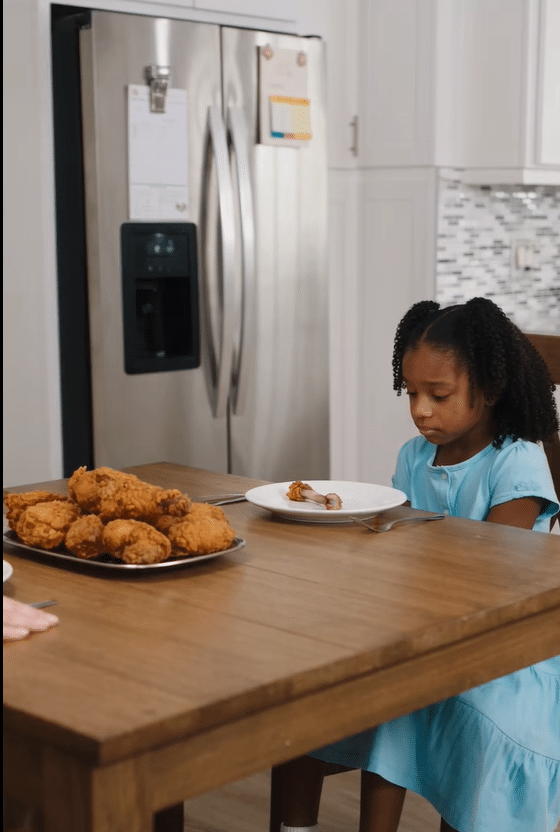
The kitchen was a masterclass in suburban perfection, a magazine spread rendered in bright, sterile reality. Crisp white cabinets lined the walls, reflecting the overhead recessed lighting, while a massive stainless-steel refrigerator hummed a low, constant note of domestic prosperity. In the center of this pristine architecture sat a heavy, warm wooden dining table. Upon it rested a magnificent family serving platter, piled high with golden, crispy fried chicken and an array of steaming, simple side dishes. The aroma was rich, heavy with salt and fat and comfort, filling the room with a scent that should have signified a home wrapped in warmth. Instead, the air in the room was thick with a suffocating, agonizing tension.
Fernanda sat at the head of the table, perfectly composed, radiating a chilling kind of vanity. She was twenty-nine, her fair skin flawless beneath a heavy, meticulously polished layer of makeup. Her long, dark-brown hair was parted precisely down the middle, falling straight and loose over her shoulders. She wore a fitted, knee-length brown latex dress that clung to her slim, curvy frame like a second skin, paired with immaculate nude high heels. She looked less like a mother preparing to share a family meal and more like a predator reigning over a conquered territory. She ate with deliberate, agonizing slowness. She chewed her chicken with a quiet confidence, her eyes entirely devoid of warmth.
Across from her sat Nia. The eight-year-old girl was small for her age, her slim build lost in the simple sky-blue cotton dress she wore. Her medium-brown skin caught the high-contrast shadows of the kitchen lighting, emphasizing the hollows of her cheeks. Her natural black curls were gathered neatly into two low puffs. Her feet, clad in worn white sneakers and white ankle socks, barely brushed the floor. She sat with her shoulders drawn sharply inward, making herself as small as humanly possible, a child who had learned the hard way that invisibility was survival. In front of her was a plate. It was pure white, spotlessly clean, and entirely empty.
Nia did not cry. She did not beg. She merely sat in the heavy silence, her large eyes quietly tracking the movement of Fernanda’s hands, watching the food she was not allowed to touch.
Fernanda elegantly picked the last morsel of meat from her piece of chicken. She did not look at the serving platter, which was still overflowing with food. Instead, she locked her gaze onto the little girl. With a cold, contemptuous stare that carried the weight of a physical blow, Fernanda leaned forward and placed the bare, glistening chicken bone directly onto Nia’s empty white plate. The ceramic let out a sharp, pathetic clink.

“Hungry?” Fernanda’s voice was low, laced with a dark, mocking amusement. “Here. That’s all you deserve.”
Nia stared down at the gnawed bone. She pressed her lips together so tightly they turned pale. Her eyes slowly began to fill with tears, pooling at the brims, but she held them back with a terrifying, practiced discipline. There was no dramatic sobbing, no outward rebellion—only the silent, crushing resignation of a child who knew the rules of her imprisonment.
Fernanda’s patience evaporated. She slammed one palm firmly onto the wooden table, the crack echoing off the white cabinets. She did not reach for the girl, but her voice was a whip. “Eat it. Or go to bed hungry.”
The sharp sound of the slap against the wood covered the quiet turn of the front door. Marcus walked naturally from the hallway into the kitchen, carrying his heavy brown leather work bag. He was thirty-eight, a man of solid, muscular build, his deep-brown skin glowing faintly with the sweat of a long shift. His close-cropped black hair and neatly trimmed beard framed a face etched with the exhaustion of providing for his family. He wore a fitted dark-olive short-sleeve T-shirt and black pants, a black watch strapped securely to his wrist.
He stepped into the bright light of the kitchen, ready to exhale the stress of the day. But the words hung in the air. Eat it. Or go to bed hungry.
Marcus slowed to an immediate halt. The tired slump in his shoulders vanished, replaced by a rigid, electric stillness. His eyes darted across the scene in front of him, processing the visual evidence like a detective arriving at a crime scene. He saw the overflowing serving platter of fresh food in the center of the table. He saw Nia’s empty white plate. He saw the single, bare chicken bone resting in its center. And then, he looked at Fernanda.
Moving with a calm that was far more terrifying than anger, Marcus set his heavy leather work bag onto a nearby chair. His jaw tightened, the muscles ticking faintly beneath his beard. He did not shout. He did not lose his temper. When he finally spoke, his voice was a deep, restrained rumble that vibrated in the quiet room.
“Is that what you give my daughter?”
Fernanda’s spine snapped straight. The cruel arrogance on her face vanished in a fraction of a second, instantly replaced by a tightly controlled, weaponized defensiveness. “She already ate,” Fernanda lied smoothly, her tone dripping with exasperation. “She’s doing this for attention.”
Marcus did not even look at his wife. He walked directly to Nia’s side, his massive frame towering over the small table. He lowered himself slightly, bending at the knees so he could look directly into his daughter’s face. He kept his hands carefully by his sides, sensing the fragile, vibrating fear in the girl.
“Nia,” Marcus asked softly, his deep voice cracking with a desperate need for the truth. “Did you eat?”
Nia did not look at him at first. She stared down at the bare bone on her plate for one long, excruciating beat. The refrigerator hummed in the background, filling the unbearable silence. Finally, she parted her lips. Her voice was barely a whisper, frail and broken.
“Only when you’re home.”
Marcus froze. The air in his lungs seemed to turn to lead. The words did not make sense. They could not make sense. He stared at his tiny, beautiful daughter, waiting for a punchline that would never come.
“What?” he breathed.
Nia finally raised her wet eyes to meet her father’s gaze. She fought desperately against her own tears, her small chest rising and falling.
“She feeds me,” Nia whispered, the absolute innocence in her voice slicing through the room like a scalpel, “when you’re here.”
Fernanda went completely, totally still. The high-contrast shadows seemed to deepen around her eyes.
Marcus slowly, methodically turned his head away from his daughter and locked his eyes onto his wife. The shock on his face was violently melting away, hardening into a cold, terrifying suspicion. The massive platter of uneaten food sat between them, a grotesque monument to a cruelty he was only just beginning to understand. No one moved. No one spoke. The hum of the refrigerator felt like a ticking bomb.
Part Two
The silence that followed was heavy enough to crush bone. Marcus remained anchored beside Nia’s chair, his massive frame hovering in a state of stunned, tightly coiled control. The revelation hung in the bright, sterile air of the kitchen, recontextualizing the entire room. The white cabinets no longer looked clean; they looked like the walls of an asylum. The warm wooden table was no longer a place of family gathering; it was an altar of deprivation.
Marcus did not take his eyes off Fernanda. The woman sitting across the table in her expensive latex dress and heavy makeup felt like a stranger, an intruder who had infiltrated his life while he was out breaking his back to pay for it all.
“How long?” Marcus’s voice was barely louder than the hum of the refrigerator, yet it carried a devastating, absolute authority. It was a demand, not a question.
Before Nia could even draw a breath to answer, Fernanda launched her counter-offensive. She kept her posture impeccably straight, her face a mask of controlled, dismissive exhaustion. She spoke over the child, aiming her words directly at Marcus’s lingering guilt over his work hours.
“She refuses everything I make,” Fernanda stated, her voice perfectly modulated, entirely devoid of panic. It was the voice of a reasonable parent dealing with a difficult, stubborn child.
Nia did not argue. She did not raise her voice to fight back. Instead, she gave one tiny, microscopic shake of her head. The movement was so small, so deeply rooted in learned helplessness, that it shattered whatever was left of Marcus’s heart.
“I stopped asking,” Nia whispered to her empty plate.
Marcus turned his head slowly back to his daughter. The confusion in his eyes was rapidly being swallowed by a suffocating tide of guilt. He had been away. He had taken the double shifts, the overtime, the late nights, all to build this beautiful house, to buy the food that sat rotting on the table while his little girl starved in silence.
As he watched her, he saw Nia’s large, dark eyes slowly drift away from the table. She looked past him, past the overflowing platter of chicken, and fixed her gaze on the side of the towering stainless-steel refrigerator.
Marcus followed her eyes. Hanging perfectly straight beside the glowing digital display of the fridge was a simple, ordinary paper calendar. It was a cheap, functional thing, the kind families use to track dentist appointments and school holidays. Marcus walked naturally toward it, his heavy boots making no sound on the polished floor. As he got closer, his eyes narrowed.
The calendar was covered in small, precise pencil marks. There were no words written, no readable text at all—just a relentless, systematic series of dark slashes occupying random date squares throughout the month.
Marcus reached out and pulled the paper calendar free from its magnetic clip. He held it in his large hands, staring at the graphite scars marring the paper.
“What are these?” he asked, the dread rising thick in his throat.
Nia remained standing near the wooden table. She did not look at Fernanda. She kept her eyes glued to the floor, her worn white sneakers shifting slightly against the wood.
“Your late shifts,” she answered.
Marcus slowly lowered the calendar and looked over his shoulder at his eight-year-old daughter. The math was doing itself in his head, but his heart violently rejected the sum. “Why did you mark them?”
The silence returned, longer and more agonizing than before. The room felt entirely devoid of oxygen. Nia looked down at her spotless white plate, at the chewed, jagged edge of the bare chicken bone resting in the center.
“So I know when not to ask for dinner,” she said softly.
The words physically hit him. Marcus’s chest hitched. His expression collapsed inward, the deep confusion mutating instantly into a toxic, agonizing guilt, and then, just as rapidly, expanding into a contained, blinding rage. He stood completely frozen by the refrigerator. He looked from Nia’s empty plate, to the single bone, to the massive, untouched mound of fried chicken in the center of the table, and finally to the pencil marks in his hand.
From across the room, Fernanda saw the shift in his posture. She felt the control slipping from her grasp. She offered a small, dismissive roll of her eyes, a masterclass in gaslighting.
“Marcus, she knows exactly how to make you feel sorry for her,” Fernanda said, her voice laced with a poisonous kind of pity.
Marcus did not acknowledge her. It was as if she had ceased to exist in the physical plane. He gripped the edges of the calendar. The paper let out a dry, crisp rustle in the dead air of the kitchen as he slowly, deliberately flipped the top page backward.
August. Covered in pencil marks. July. Covered in pencil marks. June. Covered in pencil marks.
The dry rustle of the paper was the only sound in the house, a terrifying countdown measuring the depth of his failure.
“How far back does this go?” Marcus’s voice was no longer a rumble. It was absolute zero. It was the sound of a man looking at the ashes of his life.
Nia stepped away from the table. She walked slowly across the bright floor, her small, frail frame approaching her towering father. She reached out with one tiny, trembling finger and touched the corner of a page deep in the stack.
“My birthday,” Nia said.
Marcus stopped breathing. His body turned to stone. His eyes lifted painfully from the cheap paper calendar and locked onto his little girl. His mind raced backward, counting the months, counting the weeks, counting the hundreds of nights he had walked through the door thinking his family was safe. This had not been a single moment of cruelty. This was an institution. This was a slow, deliberate starvation orchestrated under his own roof.
Across the room, sitting at the table, Fernanda’s mask of supreme confidence finally flickered. A microscopic twitch tightened her jaw. The absolute power she had wielded for months was evaporating into the bright kitchen lights. Marcus stood motionless, clutching the documented history of his daughter’s suffering, while Nia stood silently in his shadow, and the ghost of his dead marriage filled the room.
Part Three
Marcus stared at the page. The pencil marks on that specific square seemed to burn into his retinas. He looked from the graphite slash up to Nia’s face, tracing the delicate, hollowed lines of her cheeks, realizing with a sickening wave of nausea that she looked thinner than he remembered. The guilt was a physical weight, pressing down on his broad shoulders.
“This started on your birthday?” Marcus asked, his voice cracking, entirely stripped of its protective bass.
Nia did not want to say it again. She offered one tiny, devastating nod.
The silence stretched, pulling taut like a wire about to snap. Nia looked at the calendar, her mind involuntarily pulling up the memories she had been forced to bury to survive the daylight.
“The night before my school trip,” Nia said softly, her voice barely carrying over the hum of the refrigerator.
Another beat of agonizing silence.
“Every Sunday you worked,” she added.
Marcus felt his hands begin to tremble. He slowly lowered the calendar. With deliberate, excruciating care, he walked back to the wooden dining table. He placed the heavy stack of paper flat against the wood, sliding it right beside Nia’s empty plate and the bare chicken bone. He kept his hand resting on the calendar for a moment, grounding himself, preventing the violence in his chest from spilling out into his hands.
Nia turned her body to face her father fully. She looked directly into his eyes, stripping away the silence she had worn like armor for half a year.
“When you’re home, I’m your daughter,” Nia said, her voice carrying a quiet, piercing hurt that no eight-year-old should possess.
Marcus held his breath.
“When you leave…” Nia’s eyes flickered toward the woman in the latex dress, just for a fraction of a second. “…I’m in her way.”
Fernanda’s pristine posture stiffened. The accusation hit her directly, cracking the veneer of the sophisticated, put-upon stepmother. Her jaw set, her chin lifting in a sharp, defiant angle. She refused to be judged by a child.
“Stop making yourself the victim,” Fernanda spat coldly, the malice finally bleeding openly into her tone.
Nia looked at Fernanda. The little girl’s eyes were glassy with unshed tears, but she did not break down. She looked at the woman who had systematically denied her food for months, and she spoke with the simple, devastating honesty of a child who did not understand the cruelties of the adult world.
“I was just hungry.”
The words hung in the air, absolute and undeniable.
Marcus looked down at the table. He stared at the empty white plate. He stared at the jagged, bare bone. He stared at the massive, steaming platter of food that sat just inches out of his daughter’s reach. The reality of what had occurred in his home, in his sanctuary, crashed over him in a freezing wave. He took one long, slow breath, his massive chest expanding, locking the trauma away behind a wall of pure, crystalline resolve.
He lifted his eyes and looked at Fernanda.
“How many times?” His voice was dead. It was the voice of a judge reading a final sentence.
Fernanda’s controlled mask shattered entirely. The resentment she had harbored, the jealousy of the child who held her husband’s heart, the bitterness of the long nights alone—it all boiled over in a toxic eruption.
“I’m tired of raising another woman’s child every time you disappear to work,” Fernanda hissed, her voice vibrating with a bitter, ugly certainty. She did not stand up. She did not move closer. She sat upright in her chair, wearing her latex dress like armor, demanding her husband bow to her reality.
“So choose, Marcus,” Fernanda demanded, her eyes flashing with a dangerous, absolute confidence. “Your marriage… or her accusations.”
Nia flinched. The quiet strength she had mustered evaporated in an instant. Her expression morphed violently from profound hurt to raw, unadulterated fear. The crushing guilt of a child returned, the terrifying realization that she had broken the family. She shrank back, terrified that she was the reason her father’s marriage was about to end.
Marcus did not answer. He did not yell. He did not argue.
He slowly reached his large hand into the front pocket of his dark pants. He pulled out a heavy metal key ring. It jingled faintly in the oppressive silence of the room. He held it in front of him, looking down at the cluster of metal. Methodically, he thumbed through the keys until he found the shiny, single brass house key that belonged to Fernanda.
With absolute, terrifying calmness, Marcus gripped the brass key and began to slide it backward along the metal spiral of the ring.
Fernanda’s eyes dropped to his hands. The breath caught in her throat. The supreme, bitter confidence that had anchored her to the chair suddenly vanished. Her eyes widened, the reality of her ultimatum collapsing on top of her. Marcus stood cold, towering, and completely resolved, the brass key stuck halfway off the ring, while his daughter watched in silent, terrified awe.
Part Four
The faint, metallic scraping of the key moving against the ring was the only sound in the world. Marcus’s large thumbs worked with mechanical precision. He did not rush. He did not fumble. He forced Fernanda to sit in the suffocating silence and watch the physical dismantling of her place in his life.
With a final, sharp snap, the brass house key popped free from the steel ring.
Marcus held the single key between his fingers for a fraction of a second. Then, he leaned over the wooden dining table. He bypassed the family platter. He bypassed the calendar. He placed the shiny brass house key directly onto the wood, right beside the jagged, chewed edge of the bare chicken bone.
The metal hit the wood with a small, sharp click.
Fernanda stared at the key resting next to the garbage she had offered a starving child. She looked up at Marcus, her perfectly manicured face twisting in genuine, unadulterated disbelief.
“You’re throwing me out over one dinner?” she asked, her voice cracking, desperate to minimize the atrocity, desperate to shrink the timeline back down to a single mistake.
Marcus looked directly into her eyes. The fire was gone from his gaze, replaced by a cold, impenetrable steel.
“No,” Marcus said, his deep voice rolling through the kitchen without a single tremor of doubt. “Over every night you made my daughter earn a meal.”
Fernanda’s eyes narrowed into dangerous slits. Panic began to claw at the edges of her mind, and she instinctively reached for her favorite weapon: manipulation.
“She’s manipulating you,” Fernanda spat, pointing a perfectly manicured finger at the trembling eight-year-old girl.
Marcus did not raise his voice. He did not need to. The quiet gravity of his response crushed her defense into dust.
“She’s eight.”
A heavy, agonizing beat of silence descended on the room. Marcus looked down at the shiny brass key resting on the table. He looked at the woman he had loved, the woman he had trusted to protect the most precious thing in his world. He felt nothing but a profound, sickening emptiness.
“Pack a bag,” Marcus ordered.
The panic in Fernanda’s chest mutated violently into toxic resentment. She realized she had lost the war. She had played her final card, and it had resulted in her own eviction. Humiliated and furious, she turned her venom directly toward the weakest target in the room. She locked her eyes onto Nia, her gaze dripping with pure, unmasked hatred.
“Look what you did,” Fernanda hissed at the little girl.
Nia flinched as if she had been struck. She immediately shrank down in her chair, her small shoulders rolling inward, trying to fold herself into nothingness. The crushing, suffocating guilt of a child who believes she has destroyed her own home washed over her face. She stared at her worn white sneakers, the trauma taking root deep in her chest.
Marcus saw the physical collapse of his daughter. The cold restraint vanished. He turned sharply, violently toward his wife, stepping into her line of sight, physically blocking her from looking at Nia.
“No,” Marcus snapped, his voice sharp and commanding.
He held her gaze for one long, terrifying second, daring her to speak another word to his child. When he spoke again, the temperature in the room dropped to freezing.
“Look what you did.”
Fernanda’s mouth closed. The absolute, unyielding authority in his voice stripped her of her power. She pressed her lips together, her heavy makeup suddenly looking like a clownish mask, and faded into the background of the bright kitchen, silenced and defeated.
Marcus turned his back on her entirely. He looked down at the table. He reached past the bare bone, past the key, and picked up a clean, untouched white plate from an empty place setting. He moved to the massive family serving platter that had sat like a mocking monument in the center of the table.
With quiet, deliberate movements, Marcus picked up the serving tongs. He lifted a large, golden, steaming piece of fried chicken and placed it gently onto the clean ceramic. He scooped a generous portion of mashed potatoes. He added the sweet corn. He built a plate of food that looked like love, that looked like safety, that looked like an apology he didn’t know how to voice.
He turned and placed the heavy, warm plate gently onto the table directly in front of Nia. Without a word, he reached out and slid the plate with the bare bone and the shiny brass key far to the side, pushing the cruelty out of her immediate space. Every action was continuous, visible, and deeply intentional.
But Marcus did not tell her to eat. He did not touch her shoulder.
Nia sat perfectly still. She stared down at the mountain of fresh, steaming food. The golden crust of the chicken was inches from her face. The smell was overpowering. Yet, she did not reach for it. Her small hands remained locked together in her lap, her knuckles white. Her eyes darted nervously around the table, her body braced and waiting for the trick. She was waiting for the plate to be snatched away. She was waiting for the punishment for looking at it too long.
Marcus noticed the paralyzed stillness of his daughter. The righteous anger that had fueled him moments ago melted entirely, leaving behind a devastating, profound heartbreak.
Part Five
Marcus slowly lowered his massive frame. He dropped to a crouch beside Nia’s chair, bringing his eyes level with hers. He kept a careful, respectful distance, ensuring he did not crowd her, instinctively understanding that the air around her was currently laced with invisible tripwires of trauma. The exhaustion of his workday, the shock of his ruined marriage, all of it faded away until there was nothing left in the universe but the terrified little girl sitting in the chair.
“You don’t have to earn a place at this table,” Marcus whispered softly, his deep voice vibrating with a desperate, crushing gentleness.
Nia kept her hands locked in her lap. She slowly turned her head to look at her father. Her dark eyes were wide, swirling with a mixture of desperate hope and a deeply ingrained, paralyzing fear. The rules of her survival had been rewritten too many times. She didn’t know which reality was safe to believe in.
“Even when you’re not home?” Nia asked. Her voice was so quiet, so fragile, it felt like it might shatter in the air before it reached his ears.
Marcus swallowed hard. His throat tightened painfully, a thick, choking knot forming behind his Adam’s apple. The edges of his eyes grew wet, glistening slightly in the bright kitchen lights, but he maintained absolute, unwavering control. He could not break down now. She needed him to be the anchor.
“Especially then,” Marcus answered, his voice thick with a promise he intended to keep for the rest of his life.
A heavy, profound silence settled over the room. The hum of the stainless-steel refrigerator droned on, a constant background note to the tragedy that had just unfolded.
Nia looked back down at the plate. The steam curled gently off the hot food, dissipating into the cool air of the kitchen. Slowly, agonizingly, her grip on her own hands loosened. She raised one small, trembling hand from her lap. She reached out toward the heavy silver fork resting beside the plate.
Her fingers hovered in the air. She hesitated. Her hand froze just an inch above the metal, her muscle memory fighting against the permission she had just been granted. She braced herself, waiting for a voice to snap at her, waiting for a hand to slam against the table.
Marcus stayed crouched beside her. He did not push the fork closer. He did not offer words of encouragement. He did not try to rush the healing process. He simply stayed there, a steady, immovable mountain of safety, watching his broken daughter try to relearn how to survive in the light.
Farther back in the kitchen, separated from the warmth of the table and the bond of the bloodline, Fernanda stood in total silence. The bright, high-contrast lighting cast long, harsh shadows across her face. She was a ghost in a house she no longer belonged to, watching the foundation of her control crumble into dust.
On the far end of the wooden table, pushed away and discarded, the shiny brass house key rested silently against the jagged, chewed edge of the bare chicken bone.
Nia’s small hand remained suspended over the silver fork. The food sat waiting. The father knelt watching. The stepmother stood banished. But the damage—the deep, invisible scars carved into the mind of an eight-year-old child over months of silent starvation—did not magically disappear. The terror still lived in the hesitation of her fingers, hanging unresolved in the bright, sterile air of the perfect suburban kitchen.