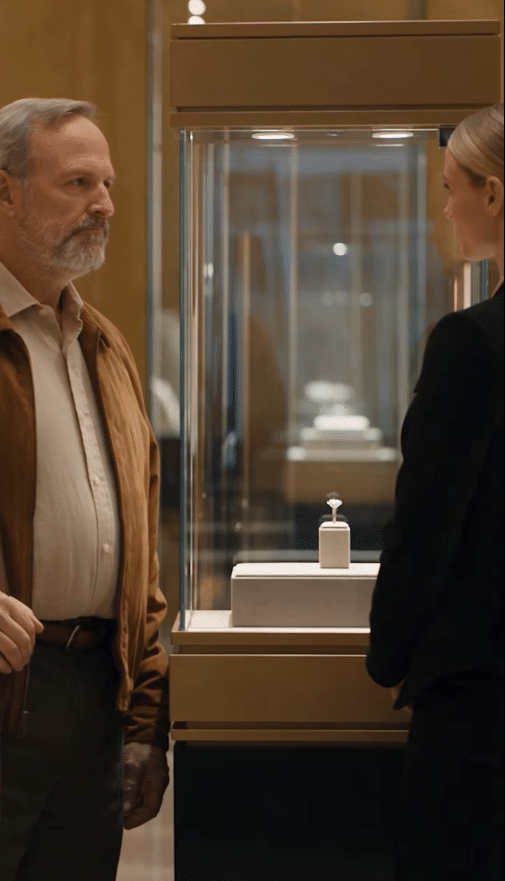
SHE REFUSED TO SHOW HIM A $60,000 RING — THEN HIS SON WALKED INTO THE STORE
The old man had been standing in front of the same glass display for almost twenty minutes when he finally decided to ask. The boutique was the kind of place designed to make people speak more softly the moment they walked inside: warm golden lighting, polished stone counters, velvet trays, diamond cases illuminated like museum pieces, and sales associates who seemed to glide instead of walk. The seventy-two-year-old man looked completely ordinary among the wealthy couples and sharply dressed customers around him. His brown jacket was clean but old, his beige shirt carefully pressed, his dark trousers plain, and his brown leather shoes polished so many times that the creases had become permanent. He carried a worn leather bag in one hand and studied a diamond ring displayed at the center of the store. When the manager finally came near, he gave her a polite smile and asked, “Could I see that ring?” She did not reach for the key. Instead, she looked him slowly from head to toe and replied, “You can see it from there.” He blinked, unsure whether he had heard correctly. “I’d like to hold it.” Her eyes moved toward his coat and shoes again. “That one is sixty thousand.” The old man held her gaze. “I didn’t ask the price.” She rested one hand on the display lock but made no attempt to open it. “I’m trying to save you some embarrassment.” His expression tightened slightly. “By refusing to sell me something?” She gave the smallest smile. “By being realistic.” For a moment, he said nothing. Then he quietly replied, “You haven’t asked me one question.” The manager turned the lock firmly back into place and walked away to greet a well-dressed couple who had just entered.
The old man might have left then, but he wanted to be certain he had not misunderstood her. He waited until she returned to the counter, took a credit card from his wallet, and placed it gently on the glass. “Run my card.” She did not touch it. “No.” This time he looked genuinely confused. “Why not?” She pushed the card back toward him with one finger. “Because we both know how this ends.” Then, without another question, she signaled to security. “Walk him out.” Even the security guard looked uncomfortable. The old man picked up his bag, glanced once more at the ring, and walked toward the entrance without arguing. Outside beneath the store canopy, he took out his phone and called his son. “Ethan, I need you for a minute.” Ethan was in the middle of an executive meeting when he saw his father’s name and answered immediately. “What happened, Dad?” His father looked through the boutique’s glass front at the manager, who had already returned to smiling at another customer. “They won’t even let me see the ring.” Ethan’s face went cold. He closed the folder in front of him, stood, and picked up his car keys. “Stay there. I’m coming.”
Less than twenty minutes later, a luxury sedan stopped in front of the boutique. Ethan entered in a tailored navy suit and immediately found his father near the door. He barely paused before walking straight to the manager. “You had my father removed?” She folded her arms, completely unbothered. “He was wasting everyone’s time.” His father stayed beside him and said calmly, “I asked to see one ring.” The manager glanced again at the old jacket. “One he obviously couldn’t afford.” Ethan tilted his head. “You ran his card?” She laughed lightly. “I didn’t have to.” Ethan looked at her for a long second. “So you guessed.” She shrugged. “I know my customers.” His voice remained perfectly level. “Apparently not.” Nearby shoppers had started to notice the tension, but the manager still believed she was in control. “Take your father somewhere else,” she said. Ethan took out his phone. Her expression turned mocking again. “Who are you calling?” “Daniel.” That made her hesitate. “Our regional director?” Ethan lifted the phone to his ear. “Come to the flagship floor.” Upstairs, Daniel answered almost instantly. “Ethan? What happened?” Ethan never looked away from the manager. “Come down. Your manager can explain it herself.”
Daniel arrived within minutes. The manager hurried toward him with visible relief. “Daniel, thank God. These two refuse to leave.” Daniel looked past her at Ethan and his father. “These two?” She pointed toward the diamond case. “He wanted a sixty-thousand-dollar ring.” Daniel’s face remained unreadable. “Did you run his card?” She shrugged. “Why would I?” Something in Daniel’s expression changed. “Because he funded our first store.” The manager went completely still. “What?” Daniel turned slightly toward Ethan. “And his son owns half this company.” Every trace of confidence disappeared from her face. The customers around them began whispering, and the old man simply stood beside his son, not looking pleased or vindicated, only disappointed. “I didn’t know who they were,” the manager finally said. Ethan’s answer came immediately. “That’s the problem.” She stepped closer. “I can fix this.” Ethan shook his head. “You had every chance.” His father looked through the glass at the ring and said quietly, “That ring was for your sister’s wedding.” Ethan looked at him for a moment, then turned back to the manager. “Claire, you’re done.”
For several seconds, Claire said nothing. Then something unexpected happened. Instead of panicking, she reached into her pocket and took out her phone. A strange confidence returned to her face. “You may want to wait.” Daniel’s expression changed instantly. “Who are you calling?” Claire selected a contact and raised the phone to her ear while looking directly at Ethan. “Dad… Ethan just fired me.” The line remained connected, but no one heard the response. Ethan noticed that Daniel no longer looked calm. “Who is her father?” he asked. Daniel hesitated. Before he could answer, the staff elevator opened. A silver-haired man in his early sixties stepped onto the sales floor wearing a dark gray suit. Ethan recognized him immediately. Martin Hale was not simply Claire’s father. He was the company’s co-founder and the owner of the other half of the jewelry group.
Claire hurried toward him. “Dad.” Martin looked at his daughter, then at Ethan, Daniel, and the older man standing near the display case. “What happened?” Claire began quickly. “Ethan fired me because his father came in looking like that, demanded to see a sixty-thousand-dollar ring, and I refused.” Martin’s eyes shifted to Ethan. “You fired her?” Ethan nodded. “She refused to open the case. Dad offered his card. She refused to process it. Then she had security escort him out.” Claire immediately interrupted. “He didn’t look like a real customer.” Her father slowly turned toward her. “Did you run the card?” She hesitated. “No.” “Did you check whether he could afford the ring?” “No, but—” “Did he threaten you?” Claire went quiet. “Did he damage anything?” Silence again. Martin looked toward the security guard. “Tell me exactly what happened.” The guard swallowed, clearly uncomfortable, but answered honestly. “The gentleman was polite the whole time. He asked to see the ring, offered his card, and Ms. Claire refused. She then asked me to escort him out.”
Claire’s face hardened. “I was protecting the store.” Martin stared at her. “From what?” She opened her mouth, but no answer came. He looked toward Ethan’s father. “Sir, I’m sorry.” The old man nodded politely. Martin turned back to his daughter. “When I started this company, I wore the same jacket to investor meetings for nearly three years because we couldn’t afford anything better. Your grandfather used to repair his own shoes. We had customers who looked wealthy and couldn’t pay for a thing, and customers who arrived in work clothes and bought anniversary pieces worth more than my car. I thought you understood that.” Claire’s voice softened. “Dad, I made a mistake.” Ethan stepped in. “A mistake would’ve been one bad judgment. My father asked to see the ring and you refused. He offered a card and you refused again. I came in and you still doubled down. Daniel came down and you still defended it.” Martin looked at his daughter. “Is that true?” Daniel nodded. “Every word.”
Claire’s confidence finally broke. “You’re really going to let him fire me?” she asked her father. Martin’s answer was quiet. “Yes.” She stared at him as if he had betrayed her. “I’m your daughter.” “And I love you,” he said. “But loving you does not mean pretending this was acceptable.” Claire looked around at the customers who were pretending not to watch. Her face flushed with humiliation. Ethan noticed and stepped closer. “You won’t be marched out through the showroom. Daniel will take you upstairs. HR will handle the rest privately.” Claire looked surprised. After everything she had done, Ethan was still protecting her dignity. Her eyes shifted toward the old man. “I’m sorry.” He studied her for a moment before asking, “Are you sorry because you know who I am now?” The question landed harder than anything Ethan could have said. Claire looked down. Finally, she answered, “No. I’m sorry because I shouldn’t have needed to know.” The old man nodded once. “That’s a better place to start.”
After Claire left, Martin and Ethan stayed on the sales floor with Daniel and Ethan’s father. Martin looked toward the diamond case. “You still want the ring?” The old man smiled faintly. “The ring didn’t do anything wrong.” Ethan laughed for the first time that afternoon. His father explained that the diamond was intended as a wedding gift for Ethan’s sister, who was getting married in two months. He had come to the boutique alone because he wanted to choose something himself. Martin personally opened the case and placed the ring on a velvet tray, but Ethan’s father shook his head. “No special treatment.” Martin looked confused. “Excuse me?” “I want to buy it the way any customer should be able to buy it. Show it to me, let me decide, run my card.” Martin understood. He stepped back and asked another associate to complete the transaction normally. The card went through without issue.
The incident did not end there. Over the next week, Ethan and Martin ordered a review of customer complaints across the entire jewelry group. What they found made both men uncomfortable. Claire’s behavior had been the most obvious example, but several stores had received complaints from customers who felt ignored because of their clothing, age, or appearance. Some associates had even been trained informally to focus on customers who “looked valuable.” Ethan removed that language from every training guide. From then on, employees were told something simple: behavior could justify concern; appearance could not. A person entering in an old coat was still a customer. A person wearing a luxury watch was not automatically more important than anyone else.
Two months later, Ethan’s sister stood in a quiet room before her wedding ceremony while their father fastened the diamond bracelet that matched the ring he had purchased that day. She looked at the jewelry and shook her head. “Dad, this is way too much.” He smiled. “I know.” She laughed and hugged him. He was wearing the same old brown jacket over his dress shirt because he refused to replace it before the wedding. Ethan stood nearby and smiled when he saw it. His sister noticed. “What?” Ethan shook his head. “Nothing. Just thinking about that jacket.” Their father glanced down at it. “Still works.” Ethan laughed.
Later, after the ceremony, Ethan asked his father why he had not simply told Claire who he was when she first refused to open the case. The old man thought about the question for a moment before answering. “Because the moment you tell someone you have money or influence, you stop learning how they would treat you without it.” Ethan looked across the reception hall at his sister laughing with her new husband. His father continued, “That manager thought she was saving me from embarrassment. That’s the dangerous part. People can convince themselves disrespect is kindness when they never bother to listen.”
Ethan nodded slowly. The ring had cost sixty thousand dollars, but the lesson it forced the company to learn was worth far more. Clothing could tell you what someone had chosen to wear that morning. It could not tell you what was in their bank account, what they had built, who they loved, or what they deserved.
Most importantly, it could never tell you whether they were worthy of respect.
THE END