SHE LAUGHED AT THEIR 35-YEAR-OLD VOUCHER — THEN THE HOTEL CHAIRMAN RECOGNIZED THE NAME
George and Helen Carter had driven six hours for a promise made thirty-five years earlier. It was their fiftieth wedding anniversary, and neither of them wanted a party. Their children had offered to send them on a cruise, but Helen had found an old envelope while cleaning a drawer in their bedroom and immediately knew where she wanted to go. Inside was a cream-colored voucher, yellowed slightly at the edges but carefully preserved. Across the top were the handwritten words Lifetime Complimentary Stay, followed by the signature of Arthur Whitmore, founder of what had since become one of the country’s most respected hotel groups. George had laughed when Helen suggested they use it. “That thing is older than half the employees who’ll be working there.” Helen had smiled. “Arthur told us to come back someday. Fifty years married sounds like someday.”
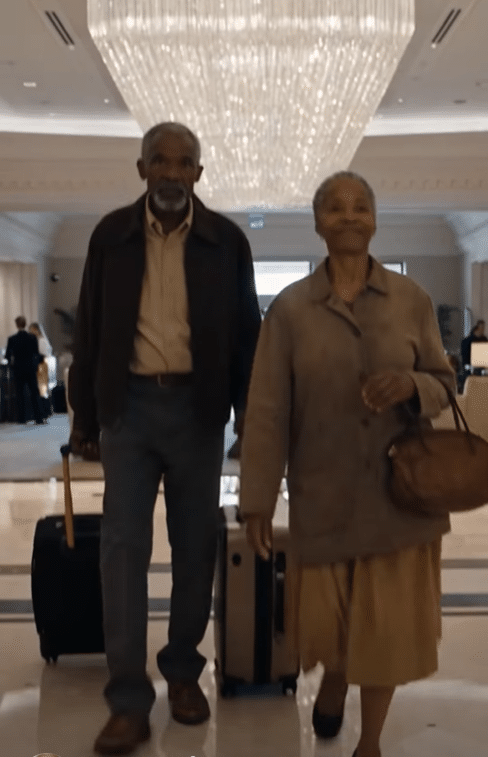
They arrived at the flagship hotel in simple clothes, carrying two small suitcases. Helen wore an old camel coat over a brown dress. George’s dark wool coat and polished brown shoes had been with him for years. Nothing about them suggested wealth, influence, or importance. At the marble reception desk, Helen smiled at the head receptionist. “We’re checking in for our fiftieth anniversary.” The woman smiled professionally and asked for the reservation. Helen carefully removed the old envelope from her handbag and handed it over. “We were given this many years ago.” The receptionist opened it, read the words, and raised an eyebrow. “Lifetime complimentary stay? You’re serious?” George’s expression cooled. “The man who signed it was very serious.” Instead of entering anything into the computer, the receptionist looked at their coats, shoes, and luggage. “You expect us to honor a thirty-five-year-old piece of paper?” Helen met her eyes. “I expect you to verify it before judging it.” The receptionist slid the voucher back toward them. “Nothing in this hotel is free for life.” Helen glanced at the computer sitting directly in front of her. “Then check it and prove me wrong.”
The receptionist refused. When George asked her to call someone who would verify it, she dismissed him. “My managers have better things to do.” Helen tried one last time. “Arthur Whitmore handed that voucher to my husband himself.” The woman laughed. “Of course the founder personally gave it to you.” George’s jaw tightened. “He gave it to us after his accident.” That only seemed to amuse her more. “And now there’s an accident story too?” Helen’s disappointment was more visible than her anger. “We drove six hours because he asked us to come back someday.” The receptionist turned toward security. “Please escort them out.”
Two guards approached but had not touched them when a younger receptionist at the next station leaned forward. She had been studying the old embossed seal in the corner of the voucher. “Wait. That seal belongs to the founder’s old guest program.” Her supervisor shot her a warning look, but the young woman ignored it long enough to type the small identification number into the hotel system. The screen loaded. An alert sounded. Her eyes widened. “Natalie… you need to see this.”
The head receptionist stepped closer. The screen displayed only a restricted legacy file tied to the founder’s office. The younger receptionist pointed at it. “It’s in the system. This isn’t random paper.” Natalie immediately became defensive. “It says restricted. That proves nothing about them.” George stared at her. “You keep moving the line every time we prove something.” “Because stories don’t make someone a guest.” At that point, George stopped trying to protect her from the truth. “Arthur’s car went off the road thirty-five years ago.” Natalie smirked. “And I suppose you rescued him?” George answered without emotion. “I pulled him out before the car caught fire.”
The young receptionist turned toward him in shock. “You saved Arthur Whitmore’s life?” George shrugged. “I was there.” Natalie cut in. “That story still doesn’t give you a free suite.” Helen had heard enough. She took out her phone and found a number she had not used in years. “Daniel? It’s Helen Carter.”
In the back seat of a sedan only minutes from the hotel, Daniel Whitmore straightened the moment he saw the name. He was Arthur’s son and now chairman of the hotel group. “Mrs. Carter? Is George with you?” Helen looked at her husband. “Yes. We finally came back for our anniversary.” Daniel immediately heard something in her voice. “You’re at the hotel right now?” Helen looked directly at Natalie. “Yes. Your staff says your father’s voucher is fake.” Daniel’s expression hardened. “Stay there. I’m coming in.”
When he arrived several minutes later, Natalie rushed toward him as if rescue had arrived. “Mr. Whitmore, perfect timing. I have a possible fraud situation.” She pointed toward the couple. “They brought in a fake lifetime voucher.” Daniel followed her gesture and saw George. He stopped in the middle of the lobby. “George…?” Natalie’s confidence disappeared. “You know him?” Daniel did not answer. He walked straight to the counter, took the voucher, and studied the signature. His face changed immediately. “This is my father’s handwriting.”
Natalie began to panic. “Sir, I had no way of knowing.” The younger receptionist finally spoke with more confidence. “You did. You just wouldn’t check.” Daniel looked toward George. “My father would’ve died that night without you.” George shook his head. “Anyone there would’ve helped him.” Daniel smiled sadly. “He never believed that.” He looked at Helen and George. “He offered you money. You refused every dollar. So he gave both of you hospitality for life.” Natalie stepped forward. “Mr. Whitmore, I made a terrible mistake.” Daniel looked at her coldly. “Your mistake was deciding they weren’t worth checking.” Without another argument, he asked her to surrender her badge.
Before anyone could move on, the younger receptionist returned from the archive room carrying another old envelope. On the front, in Arthur Whitmore’s handwriting, were the words: For George and Helen — If They Ever Return. Daniel stared at it. “Where did you find this?” “It was sealed inside their original file.” Helen shook her head. “We’ve never seen that before.” Daniel opened the envelope and began reading. At first he smiled, but only for a moment. His expression quickly became serious. “Daniel,” Helen asked, “what does it say?” He looked at George. “My father left something else for both of you.” George frowned. “What kind of thing?” Daniel folded the letter and glanced toward the executive elevator. “Something that isn’t in this lobby. You both need to come upstairs with me.”
As the elevator doors opened, Daniel removed an old brass key from the envelope. George’s eyes widened. He recognized it immediately. “That key…” The doors closed before he finished.
Daniel noticed. “You know it?”
George looked at the key again. “That was from your father’s first motel.”
Helen turned toward him. “The little place outside Mill Creek?”
George nodded. “Room Eight.”
Thirty-five years earlier, after George had dragged Arthur from his wrecked car, Arthur had refused to go home until he knew George and Helen were safe too. Their own car had been damaged while George stopped to help, so Arthur took them to the small roadside motel he owned at the time. It had only twelve rooms, a flickering sign, and a tiny office where Arthur slept whenever money was tight. He had given George the brass key to Room Eight. George remembered joking that Arthur should invest in plastic keycards someday.
Daniel smiled faintly. “My father kept that motel key his entire life.”
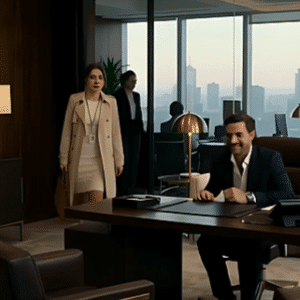
The executive floor contained a private office that had once belonged to Arthur. Daniel rarely entered it. Most of the furniture remained exactly as his father had left it: dark wood desk, old photographs, the first hotel license framed on the wall, and a glass display containing artifacts from the original roadside property. In the corner stood a narrow wooden cabinet with a brass lock.
Daniel handed George the key.
George hesitated before inserting it.
The lock turned.
Inside was a metal document box and another letter.
Helen whispered, “Arthur planned all this?”
Daniel nodded. “Apparently.”
George opened the letter first.
Arthur had written it nearly twenty years after the accident. He explained that he had never forgotten George’s refusal to accept a reward. At the time, Arthur had been wealthy enough to pay him, but George had simply said, “You don’t owe me for staying alive.” Those words had stayed with him. Over the years, Arthur had quietly tried to locate the Carters several times but lost contact after they moved states.
The lifetime hotel voucher had been his first attempt to repay them. The box represented the second.
Inside were documents establishing a charitable fund created in George and Helen’s names. Arthur had funded it gradually over many years. Its purpose was simple: provide emergency lodging for families stranded by accidents, medical crises, house fires, or other circumstances that left them temporarily without somewhere safe to stay.
Helen read the first page twice.
“He named this after us?”
Daniel nodded. “The George and Helen Carter Hospitality Fund.”
George sat down slowly.
“He never told us.”
“He says why in the letter.”
Daniel handed him the final page.
Arthur had written that George would never have accepted money for himself, so he decided to use the money to help strangers instead. The fund had quietly paid for thousands of hotel nights over the years. Until now, the source had been listed internally only as the Founder Emergency Program.
George’s eyes filled, though he quickly looked away.
Helen took his hand.
“All those people?”
Daniel nodded. “Families who couldn’t afford rooms. Travelers stuck after emergencies. Parents near hospitals. People who needed somewhere safe for a night.”
George laughed softly through his emotion. “All because I pulled one stubborn man out of a car.”
Daniel shook his head. “No. Because afterward, you refused to let him turn gratitude into a transaction.”
For the first time since arriving, George seemed unable to answer.
That evening, Daniel personally escorted the couple to the founder’s suite. It was far more luxurious than either of them wanted, but Helen decided that for one night, they would stop arguing with Arthur’s generosity. Champagne, flowers, and a handwritten anniversary note were waiting inside.
Before Daniel left, Helen asked about the young receptionist downstairs.
“What’s her name?”
“Rachel.”
“She tried to help us before she knew who we were.”
“I noticed.”
“And Natalie threatened her for it.”
Daniel understood what Helen was asking without being told. “She’ll be protected. And she’ll be considered for the open supervisory position on merit.”
Helen smiled. “Good.”
The next morning, George and Helen returned to the lobby. Rachel was working at the front desk. She looked nervous when she saw them, but Helen walked over and hugged her.
“Thank you for checking when everyone else had already decided.”
Rachel smiled. “I just thought the voucher deserved a second look.”
George shook her hand. “Sometimes that’s all fairness is. Taking a second look.”
Months later, Daniel expanded the Carter Hospitality Fund across every property in the group. He also introduced a new policy inspired by what happened that anniversary night: no legacy document, unusual reservation, or questionable booking could be rejected solely on an employee’s assumption. Verification came first.
George and Helen never cared about the policy named after them.
They cared about something else.
Every year afterward, Daniel sent them a simple report showing how many families the fund had helped. George kept those reports in the same drawer where Helen had once stored the old voucher.
The voucher itself was framed.
So was the brass key.
And on their fifty-first anniversary, George looked at Helen and asked, “Want to go back?”
She smiled.
“Only if you promise not to rescue the owner again.”
George laughed.
“No promises.”
THE END