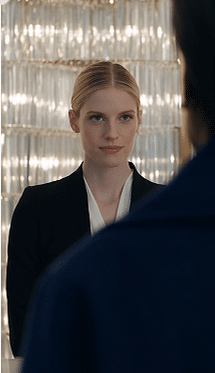
SHE REFUSED TO VERIFY THE PRESIDENTIAL SUITE — THEN THE GOVERNOR’S MOTORCADE ARRIVED
Governor Denise Walker had deliberately arrived at the hotel alone. No motorcade, no state security beside her, no assistant carrying folders, and no one announcing her name at the door. She had finished an event earlier than expected and decided to go directly to the hotel rather than wait for her official party. Dressed in a simple navy wool coat, cream blouse, black trousers, and low leather shoes, she looked like any well-dressed older traveler arriving with a single carry-on. That was exactly how she preferred it. At sixty-four, Denise had spent enough years in public office to know how quickly people changed their behavior when they recognized power. She approached the marble front desk, placed one hand beside her suitcase, and said, “I’m checking in. The Presidential Suite is under Walker.”
The head receptionist looked up, then glanced at Denise’s small suitcase before returning to her face. “The Presidential Suite?” Denise opened the confirmation on her phone. “Yes. I have the confirmation code.” The receptionist did not take the phone. “That suite costs nearly ten thousand a night.” Denise’s expression barely changed. “Then whoever booked it probably knew that.” She moved the phone slightly closer. “Just enter the code.” Instead, the receptionist folded her hands. “Confirmation codes get forwarded all the time.” Denise lowered the phone. “My name is attached to this one.” The woman studied her clothes again. “I think you’ve misunderstood what kind of hotel this is.”
Denise looked at the computer sitting directly in front of the receptionist. That was when she realized the problem was not confusion. The woman had decided not to check.
Before Denise could respond, another guest approached the desk. She was elegantly dressed in a burgundy designer coat, accompanied by an assistant, and carried the effortless confidence of someone accustomed to luxury service. “Do you have anything larger than the executive suite?” she asked. The receptionist’s entire demeanor changed. “I may have the Presidential Suite available.”
Denise turned her head. “No, you don’t. I’m holding that reservation.”
“Your reservation hasn’t been verified.”
“Because you refuse to enter the code.”
Denise kept her voice even. “Call your manager before you give away my room.”
The receptionist straightened. “I’m not disturbing management over an invalid booking.” She then looked toward security. “Please escort her away from the desk.”
One of the guards approached politely and gestured toward the lounge near the entrance. Denise did not argue. She took her carry-on and walked several steps away. At the neighboring terminal, a younger receptionist named Anna had been listening. She had seen enough of Denise’s confirmation code to enter it discreetly. A soft alert sounded from the computer. Anna’s eyes widened.
“Rebecca… stop.”
The head receptionist looked over sharply.
Anna stared at the screen. “You need to see this.”
The record displayed an executive hold with instructions not to release the suite. Rebecca read it, hesitated, then recovered almost immediately. “That still doesn’t prove the code belongs to her.”
From the lounge, Denise raised an eyebrow. “You trust the system until it proves me right.”
Rebecca’s mouth tightened. “I trust experience.”
“No,” Denise replied. “You trust appearances.”
Rebecca pointed toward the seating area as though the matter were settled. “Wait over there while we sort this out.”
Denise sat down beside her suitcase. Her phone rang.
Her chief of staff’s voice came through. “Governor, we’re about five minutes out.”
Rebecca heard the word but did not seem to process it.
“Come as scheduled,” Denise replied. “I’m already inside.”
Rebecca gave her a faint, mocking smile. “Still trying to convince someone you belong here?”
Denise said nothing.
Outside, several black SUVs and state security vehicles began turning into the driveway.
Rebecca finally saw them. Her posture changed instantly. She straightened her jacket and motioned toward Anna. “Straighten the desk. Someone important is arriving.”
Anna looked from the convoy to Denise, then back to Rebecca. “I think they may already be here.”
Rebecca ignored her.
The lobby doors opened and Denise’s chief of staff entered with two state security officers. Rebecca hurried forward with a broad professional smile. “Governor Walker, welcome. We’ve been expecting you.”
The chief of staff stopped.
“I’m not Governor Walker.”
Rebecca’s smile froze. “Then where is she?”
“She told me she was already inside.”
“That can’t be right.”
The chief of staff looked past Rebecca toward the lounge and immediately spotted Denise beside her carry-on. “Governor?”
Rebecca turned slowly.
Denise stood.
For the first time, Rebecca had nothing to say.
The chief of staff walked quickly toward Denise. “Governor, why are you sitting by the entrance?”
Denise looked directly at Rebecca. “Apparently I didn’t qualify for my own reservation.”
At that moment, the hotel chairman, Charles Bennett, stepped out of the executive elevator after being alerted that the governor’s motorcade had arrived. He heard Denise’s last sentence and immediately approached.
“Governor Walker, what happened?”
Denise did not give him a speech. She simply looked at Rebecca. “Ask your receptionist whether she entered my confirmation code.”
Charles turned. “Did you?”
Rebecca’s confidence was gone. “No. It didn’t look legitimate.”
Anna stepped closer to the computer. “I checked it. It matched the executive hold.”
Rebecca immediately defended herself. “I was trying to protect the hotel.”
Charles’s jaw tightened, but before he could respond, Denise raised one hand. “Before you fire her, check something for me.”
Everyone looked at her.
“How many guests has she treated this way before me?”
Anna immediately opened the complaint history. The list was longer than expected. She scrolled once, then again, her expression changing.
“Sir… there are twelve closed complaints under her name.”
Charles looked at Rebecca. “You personally closed all twelve?”
Rebecca folded her arms. “Those guests misunderstood our standards.”
Denise stared at her. “Twelve people didn’t all misunderstand you.”
Charles did not hesitate. “Turn in your badge. You’re finished here.”
Rebecca removed it with trembling fingers, then turned bitterly toward Denise. “You’re ruining my career over one mistake.”
“Twelve complaints aren’t one mistake,” Denise replied.
Rebecca went silent.
Then Denise turned toward Charles.
“This visit was never just about a room.”
He looked confused.
Denise’s chief of staff stepped forward and handed her a tablet.
“Your hotel is a finalist for the State Leadership Summit.”
The entire mood of the lobby changed.
The summit was one of the largest government and business events in the region. Winning it would mean thousands of room nights, national attention, and contracts worth millions.
Charles looked at Denise, visibly tense. “Governor… what are you going to recommend?”
Denise looked at the tablet, then at Anna.
“That depends on one thing.”
Charles followed her gaze.
Anna looked startled.
Denise continued, “I need to know whether what happened tonight was one bad manager—or whether the entire hotel operates this way.”
Charles answered immediately. “It does not.”
“I’m not asking what the policy manual says.”
He fell silent.
“I want to know what happens when no one important is watching.”
Denise gestured toward Anna.
“She had no idea who I was when she checked that code. She didn’t know the motorcade was coming. She didn’t know I could affect this hotel’s future.”
Anna looked uncomfortable with the attention.
Denise continued, “And yet she still did the right thing.”
Charles nodded slowly.
“That matters.”
Denise handed the tablet back to her chief of staff. “I’m not approving or rejecting this hotel tonight.”
Rebecca, still standing several feet away, looked almost hopeful.
Denise noticed.
“This also does not change your termination.”
The hope vanished.
Charles asked, “Then what happens now?”
“For the next thirty days, my office will review your guest-service procedures, prior complaints, staff training, and how supervisors handle disputes.”
Charles nodded. “That’s fair.”
“And I want those twelve complaints reopened.”
“They will be.”
“I want the people involved contacted personally. Not with marketing language. Not with coupons. With real apologies and an explanation of what changed.”
Charles nodded again.
Denise looked at Anna.
“And I want people like her protected when they speak up.”
Anna’s eyes widened.
Rebecca looked away.
Charles turned toward Anna. “Did you believe helping her could get you in trouble?”
Anna hesitated, then answered honestly. “Yes.”
“Why did you do it?”
“Because the code should’ve been checked.”
Denise smiled faintly.
“That’s the whole issue.”
The official review began the next morning.
What the hotel found was uncomfortable. Rebecca had not created every problem, but she had helped shape a culture where junior employees were afraid to question supervisors. Several staff members admitted they had seen guests judged by clothes, luggage, age, or perceived wealth. Some complaints had been quietly closed because managers preferred avoiding difficult conversations.
Charles did not try to hide the findings from the governor’s office.
Instead, he sent everything.
That decision mattered.
Over the following month, the hotel changed its complaint system so no manager could close repeated complaints involving themselves. Staff were trained to verify reservations before making assumptions. Security was instructed that unusual clothing, luggage, or behavior that was merely unfamiliar did not constitute a threat. Junior employees were also given a protected channel to report concerns without going through their direct supervisor.
Anna was offered a promotion.
She initially refused.
“I don’t want it because of what happened with the governor.”
Charles smiled. “Good. Neither do I.”
He placed a performance file in front of her. Her evaluations had already ranked among the best on the team. She had been recommended twice for additional responsibility but had never been promoted.
“Why not?” she asked.
Charles sighed.
“Rebecca blocked both recommendations.”
Anna stared at him.
“So no,” he said, “you’re not being promoted because you helped the governor. You’re being promoted because you should’ve been promoted months ago.”
This time, she accepted.
Thirty days later, Denise returned to the hotel.
Again, she arrived before her staff.
Again, she carried one small suitcase.
But this time, Anna was supervising the front desk.
Denise walked up.
“I’m checking in.”
Anna smiled. “Name, please?”
“Walker.”
Anna entered it immediately.
“Presidential Suite. Two nights.”
Denise gave her the confirmation code anyway.
Anna laughed. “You know I already found it.”
“I know.”
“Then why give me the code?”
Denise leaned slightly closer.
“Because I wanted to see whether you’d still check.”
Anna smiled and entered it.
“Confirmed.”
Denise nodded approvingly.
A few minutes later, Charles joined them in the lobby. Denise’s chief of staff handed him a sealed envelope.
He looked at Denise.
“What’s this?”
“The final recommendation.”
Charles opened it.
The State Leadership Summit had selected his hotel.
He looked stunned.
Denise raised a hand before he could thank her.
“You didn’t get it because you impressed me.”
He smiled cautiously. “I assumed there was more.”
“You got it because when your system failed, you didn’t hide it.”
Charles nodded.
“And because when I came back today,” Denise added, “I watched your staff treat every guest exactly the same way.”
Near the entrance, an elderly couple in simple clothing was being helped with their luggage. At another station, a young man in work boots was checking in without anyone giving him a second glance.
Denise looked toward Anna.
“And because the person who had the least power that night showed the most leadership.”
Anna blushed.
Charles smiled. “That sounds like something that belongs in a speech.”
“It probably will.”
Months later, when Denise addressed the summit from the hotel ballroom, she told the audience a story without naming Rebecca.
She spoke about arriving alone, being judged by appearances, and watching a junior employee choose fairness when it might have cost her job.
Then she said something that became the most quoted line of the event:
“Leadership is easiest when everyone knows your title. Character is what remains when they don’t.”
Anna heard it from the back of the ballroom.
Charles heard it from the front row.
And somewhere in the hotel lobby, another ordinary-looking traveler approached the desk with a reservation.
This time, no one asked whether they looked like they belonged.
They simply checked.
THE END