Part 1: The Echoes of a Supermarket and the Price of a Life
The fluorescent lights of the Lekki Supermarket flickered with a sterile, unforgiving glare, casting long, exhausted shadows across the linoleum floor. It was late, the kind of hour where only the desperate, the overworked, and the lonely roamed the aisles. Amara stood in the checkout line, her eyes glazed over as she stared at the crumpled shopping list in her hand. Her purse felt impossibly light. Inside, there was exactly 5,000 Naira. That was all that stood between her and absolute destitution for the next two weeks. She had carefully calculated every kobo: a loaf of day-old bread, some cheap margarine, a few packets of instant noodles. It was a diet of survival, the grim reality of a brilliant but unemployed graduate in the unforgiving city of Lagos.
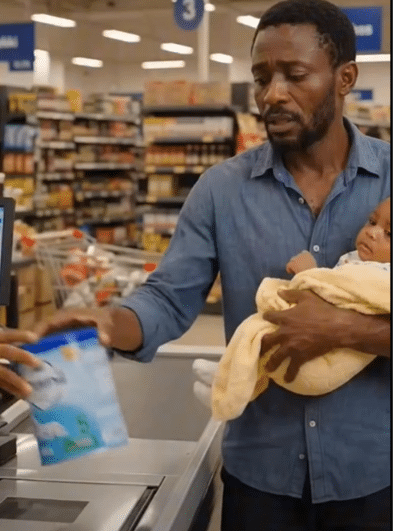
The air in the store was thick with a palpable tension, emanating directly from the man in front of her. He looked to be in his mid-thirties, though the deep creases of worry etched into his forehead made him appear a decade older. His faded blue shirt clung to his shoulders, damp with the sweat of a man who had been running a race against time and losing. In his arms, he held a fragile, squirming bundle—a newborn baby, swaddled in a faded yellow blanket. The infant was wailing, a high-pitched, jagged sound that cut through the mundane hum of the supermarket refrigerators. It was the unmistakable, gut-wrenching cry of pure hunger.
“Sir, the total is 10,000 Naira,” the cashier said, her voice a mix of professional detachment and quiet pity. Her hands rested on a large tin of baby formula—Aptamil. It was the only item on the counter. “You still need 3,500 Naira.”
David Adeyemi’s hands shook violently as he dug into his worn leather wallet. He pulled out the crumpled notes, smoothing them out on the counter with frantic, trembling fingers. He counted them once. Twice. He knew the math wouldn’t change, but desperation is the enemy of logic.
“I have 6,500,” David’s voice cracked, dropping to a desperate whisper. His eyes, rimmed with the red of sleepless nights, darted wildly between the cashier, the formula, and his crying child. “I… I thought it would be enough. Please.”
Tears, hot and unbidden, spilled over his lower lashes, carving tracks through the dust on his cheeks. A grown man, broken and weeping in the middle of a grocery store, crushed by the agonizing realization that he could not provide the most basic necessity for his own flesh and blood.
Amara felt a physical ache in her chest. She looked at her own meager basket, then at the 5,000 Naira in her hand. If she gave him the money, she would have a mere 1,500 Naira left. She would starve. She would have to walk miles in the blistering sun because she couldn’t afford bus fare. Her mind screamed at her to look away, to preserve her own fragile existence. But the baby’s cries were tearing her soul apart.
Before her mind could construct another rational defense, her body moved. She stepped forward, her voice steady despite the hurricane in her chest.
“How much is remaining?” Amara asked the cashier, her tone authoritative, slicing through the heavy atmosphere.
“3,500 Naira,” the cashier replied, looking surprised.
David turned, his face a portrait of shock and humiliation. “No, please,” he stammered, stepping back. “Don’t worry about me.”
Amara looked him dead in the eye, her gaze softening. “Your baby deserves to eat, even if you’re short on money.” She reached into her purse, pulling out her crisp notes, and handed them to the cashier. “Please add this to his payment.”
David stared at the money as if it were a mirage. He clutched his baby closer to his chest, his voice choked with overwhelming gratitude. “I’ll pay you back. I promise. I swear to you, I will find a way.”
Amara offered a gentle, sad smile. “You don’t have to promise me anything,” she said softly. “Just take care of your child.”
David clutched the tin of milk, bowing his head in silent prayer, before rushing out into the night to feed his starving son. The cashier looked at Amara, then at the few items left in her basket. Amara quietly removed the bread and the margarine, paying only for a single packet of noodles with her remaining change.
She walked out into the humid Lagos night, her stomach rumbling fiercely, yet her spirit feeling strangely buoyant. She thought it was the end of a brief, tragic encounter. She had no idea that from the shadowed aisles behind the dairy section, a pair of sharp, calculating eyes had watched the entire transaction. Chukwuemeka Nwosu, a titan of industry, stepped out of the shadows, staring at the automatic doors Amara had just walked through. The wheels of a massive, terrifying machine had just begun to turn.
Part 2: The Golden Cage and the Puppet Master
The next morning, Amara awoke to the harsh reality of her hunger and a ringing cell phone. The caller ID was unknown. When she answered, a polished voice on the other end delivered a message that seemed to belong to someone else’s life.
“Miss Amara? I am calling from the HR department of the Nwosu Group. We received your name through a highly confidential, executive recommendation. We would like to invite you for an interview for a directorial position. Today.”
The Nwosu Group. It was an empire—a behemoth of logistics, real estate, and finance that practically owned half of the city’s infrastructure. Amara had never dared to apply there; her resume would have been laughed out of the lobby. Yet, hours later, she found herself walking across the marble floors of the Nwosu Tower, her worn-out flats squeaking against the polished stone.
She was ushered past the waiting rooms, past the mid-level managers, straight to the penthouse executive suite. The double doors opened to reveal an office that looked more like a museum. Behind a massive mahogany desk stood a distinguished man in a bespoke suit. He turned around, and the air in the room seemed to freeze.
“I am Chukwuemeka Nwosu, CEO of Nwosu Logistics,” the man said, his voice a deep, resonant baritone. He gestured for her to sit. “You look confused, Amara. You don’t remember me?”
Amara shook her head, her heart hammering against her ribs.
“I was there that day. At the Lekki Supermarket,” Nwosu said, leaning forward, his eyes locking onto hers. “I watched you give away the money you desperately needed for yourself to a total stranger. I watched you sacrifice your own sustenance for a crying child. In my world, Amara, kindness is a myth. People are driven by greed, by leverage, by blood. I didn’t know anyone was still capable of what you did. And that is exactly why I needed to find you.”
He slid a thick, leather-bound folder across the desk. “We are launching the ‘Nwosu Hope Foundation,’ a multi-million dollar charity campaign designed to eradicate child poverty and rebuild struggling communities across the state. I have a board full of sharks who would use this money to line their own pockets if given the chance. I need someone with an incorruptible heart to lead it. I want you to be the Director of this foundation.”
Amara was paralyzed. The salary printed on the first page of the contract was a number she hadn’t thought she would earn in a lifetime. It came with a luxury apartment, a driver, and the power to change thousands of lives.
“I… I don’t know what to say,” Amara breathed out. “I don’t have the executive experience for this.”
“I don’t want a corporate executive,” Nwosu interrupted sharply. “I want you. Just take care of the people, the way you took care of that child. Do we have a deal?”
Amara signed the papers. She stepped out of the building feeling like she had been touched by a divine miracle. But in the corporate world, there are no miracles. There are only investments. And Amara had just sold her soul without reading the fine print.
Part 3: The Illusion of Benevolence and the Rot Beneath
Six months later, Amara’s face was plastered across billboards and glossy magazines. She was the “Angel of Lagos,” the poster child for corporate social responsibility. Under her leadership, the Nwosu Hope Foundation had purportedly distributed thousands of meals, funded orphanages, and launched healthcare initiatives. Her life was a whirlwind of gala dinners, press conferences, and ribbon-cutting ceremonies.
But Amara was no fool. Behind her soft demeanor was a sharp, analytical mind, and as the months wore on, she began to notice the discrepancies.
The crown jewel of the foundation’s efforts was the “Oki Medical Complex”—a $50 million project meant to bring state-of-the-art healthcare to the Oki slum, one of the most impoverished districts in the region. The PR machinery was working in overdrive, but whenever Amara requested progress reports or site visit authorizations, she was met with bureaucratic walls erected by the Vice Chairman of the Board, Victor.
Victor was a man with a smile like a razor blade. He constantly undermined her authority in subtle ways, insisting that the “financial complexities” of the construction were better left to the accountants.
One night, unable to shake a creeping sense of dread, Amara stayed in the office long after the building had emptied. Using a backdoor administrative login she had quietly acquired from a sympathetic IT intern, she bypassed Victor’s firewalls and accessed the foundation’s raw financial ledgers.
What she found made her blood run cold.
The $50 million wasn’t going to construction firms or medical suppliers. It was being fractured into thousands of micro-transactions, funneled through dummy corporations in Cyprus, the Cayman Islands, and Panama. The companies were registered under the names of deceased individuals or untraceable proxies. The foundation was charging exorbitant “consulting fees” to shadow entities that provided no actual services.
The Nwosu Hope Foundation was a ghost. It was a massive, sophisticated money-laundering syndicate.
Amara sat in the glow of her monitor, trembling uncontrollably. She realized the horrifying truth of her recruitment. They hadn’t hired her for her incorruptibility; they had hired her for her innocence. Her genuine, viral act of kindness at the supermarket had provided the perfect, unassailable PR shield. While she was busy handing out bags of rice for the cameras, Victor and his cronies were washing hundreds of millions of dollars of illicit cartel and political money through her foundation.
If this blew up, the board would walk away clean. Amara’s signature was on every single disbursement document. She had been perfectly positioned as the fall guy.
Part 4: The Ghost of Oki and the Pact of Vengeance
Desperate for tangible proof, Amara disguised herself the next day—stripping off her designer clothes for a simple ankara dress and a headwrap—and took a rickety bus down to the Oki slums.
The reality on the ground was a nightmare. There was no medical complex. The site where the grand hospital was supposed to stand was a toxic wasteland of rusted corrugated iron and stagnant, mosquito-infested water. The foundation’s faded billboard, bearing Amara’s smiling face, stood mocking the squalor around it.
Worse still, to clear the land for the “new complex,” the foundation’s contractors had demolished the slum’s only existing, rudimentary clinic. Now, the people had nothing.
As Amara walked through the muddy alleys, bile rising in her throat, she heard a sound that froze the blood in her veins. It was a low, guttural wail of absolute, unadulterated agony. She followed the sound to a small, dilapidated shack at the edge of the swamp.
Kneeling in the mud, digging at the earth with his bare, bleeding hands, was a man. Next to him lay a tiny body wrapped in a familiar, faded yellow blanket. It was David.
Amara rushed forward, her disguise forgotten. “David? Oh my god… David, what happened?”
David turned slowly. His face was hollowed out, his eyes sunken and completely devoid of light. When he recognized Amara, a flicker of something terrifying ignited in his gaze. Not gratitude. Pure, concentrated hatred.
“You,” he croaked, his voice raw. He lunged forward, grabbing her by the collar, dragging her down into the mud next to the tiny, lifeless bundle. “Look at him! Look at what your ‘charity’ did!”
“I… I don’t understand,” Amara sobbed, terror and heartbreak tearing her apart.
“When you bought that milk, you gave my son life,” David screamed, tears of rage pouring down his face. “But then your foundation came. You brought the bulldozers. You tore down the old clinic, promising a palace of healing. You promised medicines! When the malaria outbreak hit last week, there was nowhere to go. No doctors. No drugs. My boy… my beautiful boy burned alive in my arms from a fever that a five-dollar pill could have cured. You destroyed our only shelter, and left us to die in the dirt!”
Amara fell to her knees, burying her face in her hands, her screams merging with David’s. The sheer scale of the evil she had been an unwitting part of was too much to bear. She had saved this child with her last pennies, only to be used as the instrument of his murder by the men in the glass tower.
“David, listen to me,” Amara said, grabbing his muddy hands, her eyes burning with a fierce, terrifying resolve. “I didn’t know. They used me. They are stealing the money. But I swear on my life, and I swear on the soul of your son, I will tear their empire to the ground. I will make them bleed. But I need your help.”
That night, Amara returned to the Nwosu Tower. She bypassed security and slipped into the CEO’s office. She waited in the dark until Chukwuemeka Nwosu walked in. When she turned on the desk lamp, he didn’t jump. He just looked incredibly tired.
Amara threw a printed stack of the offshore ledgers onto his desk, a sleek black pistol she had bought from the slums resting on top of the papers.
“Did you know?” she asked, her voice deadly calm.
Nwosu sighed, sinking into his chair, suddenly looking like a very old, broken man. “I knew,” he whispered. “Victor and the board… they have leverage on me. Decades of corporate espionage, illegal dumping, tax evasion. If I don’t play along, I spend the rest of my life in a maximum-security prison, and my family loses everything. They forced me to create the foundation to wash their dirty money.”
“Then why hire me?” Amara spat.
“Because I am a coward,” Nwosu said, a tear escaping his eye. “I knew if I hired a shark, the theft would go on forever. But when I saw you in that supermarket… I saw a spark of genuine goodness. A fire that couldn’t be bought. I hired you because I hoped—no, I prayed—that you would be smart enough to figure it out, and brave enough to burn it all down. Because I couldn’t.”
He opened a hidden compartment in his desk and pulled out a silver USB drive. “This is the master ledger. It has all the routing numbers, the shell company details, and encrypted audio of Victor ordering hits on journalists who got too close. Tomorrow night is the Global Charity Gala. Victor is going to announce a $200 million funding round. All the international press will be there. If you plug this into the main server during the broadcast, it goes live to the world. But Amara… if you do this, they will kill you. There is no coming back from this.”
Amara took the drive, her grip tight. “I died today in the mud of Oki. Tomorrow, it’s their turn.”
Part 5: The House of Cards and the Final Reckoning
The Grand Pearl Hotel was a vision of opulence. Chandeliers dripping with crystals illuminated a sea of bespoke tuxedos, silk gowns, and the glittering jewels of Lagos’s elite. Waiters carried trays of champagne that cost more than a year’s rent in Oki. On the grand stage, Victor stood behind a podium, a charismatic smile plastered across his face.
Behind the stage, in the labyrinth of the hotel’s service corridors, Amara was dressed in the black uniform of the catering staff. Beside her was David, his face set in stone, clutching a heavy metal wrench.
They reached the server control room. Two armed private security guards stood outside. Amara nodded at David.
With the silence of a ghost, David stepped out of the shadows, swinging the wrench in a brutal, calculated arc. The first guard dropped like a stone. Before the second could draw his weapon, Amara lunged, driving a taser into his neck. The crackle of electricity echoed in the hallway as the guard collapsed.
They breached the server room. The hum of the massive computers was deafening. Amara scrambled to the master terminal, her fingers flying across the keyboard to bypass the firewall using the access codes Nwosu had provided.
“Sixty seconds,” Amara breathed, sweat stinging her eyes. “If they detect the breach before I upload, the system automatically fries the ports.”
In the ballroom, Victor’s voice boomed through the speakers. “We are not just a foundation. We are a family. We are the promise of a brighter tomorrow for every child in this nation. And today, I am proud to announce the next phase of the Oki Medical Complex!”
The crowd erupted into thunderous applause.
In the server room, Amara slammed the Enter key. “Upload complete. Execution in 3… 2… 1.”
Back in the ballroom, the massive screens behind Victor flickered and died. The applause tapered off into confused murmurs. Suddenly, the screens roared back to life, but it wasn’t the slick PR video of the hospital.
It was a spreadsheet. Red text highlighted massive wire transfers from the Nwosu Hope Foundation to offshore accounts labeled ‘Victor Holdings’ and ‘Board Cayman Trust’.
Victor turned around, his charismatic smile freezing into a mask of sheer panic. “Turn it off! Cut the power!” he screamed into his earpiece.
But it was too late. The audio began to play over the state-of-the-art sound system. It was Victor’s voice, crystal clear and dripping with malice: “Let the rats in Oki rot. Demolish the clinic. The longer they look sick, the more the UN and the wealthy idiots in the West will donate. Just make sure the money routes through Panama before the auditors see it.”
The silence in the ballroom was absolute, heavy, and lethal. Hundreds of smartphones were suddenly raised, recording the screens, live-streaming the audio to millions across the globe. The journalists in the room, smelling blood in the water, began shouting questions, their camera flashes strobing like lightning.
Victor tried to run, but the doors burst open. The Economic and Financial Crimes Commission (EFCC), tipped off by an anonymous package Amara had sent hours earlier, swarmed the room. Heavily armed officers tackled Victor to the ground, slapping handcuffs on the wrists of the city’s most powerful men. It was a massacre of the elite.
From a catwalk high above the ballroom, Amara and David looked down at the chaos. The empire was burning. The men who had traded the lives of children for sports cars and offshore bank accounts were being dragged out in disgrace.
David looked at Amara, the heavy burden of hatred lifting slightly from his tired shoulders. He didn’t smile, but for the first time since his son died, he looked at peace. He turned and disappeared into the shadows of the hotel, a ghost returning to the night.
Months later, the dust settled. The Nwosu Group was dismantled, its assets seized and liquidated by the international courts. The stolen funds were recovered. Under the strict supervision of the UN, the Oki Medical Complex was finally built. Over its main entrance, a small brass plaque read: Dedicated to the memory of the Adeyemi child, and all those who suffered in the dark.
Amara did not take a position in the new administration. She gave away the luxury apartment, the clothes, the car.
On a quiet Tuesday evening, at a small, independent grocery store on the outskirts of Lagos, a young mother stood at the checkout counter, nervously counting a handful of coins to pay for a bag of rice. She was short by a few hundred Naira. She looked ready to cry.
The cashier, a young woman in a simple uniform, gently pushed the coins back to the mother.
“Don’t worry,” Amara smiled, a true, bright smile that reached her eyes. “I’ve got it. Just take care of your family.”
Because Amara knew now, more than ever, that true kindness was not found in billion-dollar galas or corporate press releases. It was found in the quiet, desperate moments between ordinary people, in the willingness to bleed a little so that someone else might live. And that was a currency that could never be corrupted.