Part 1: The Cold Night of Rejection
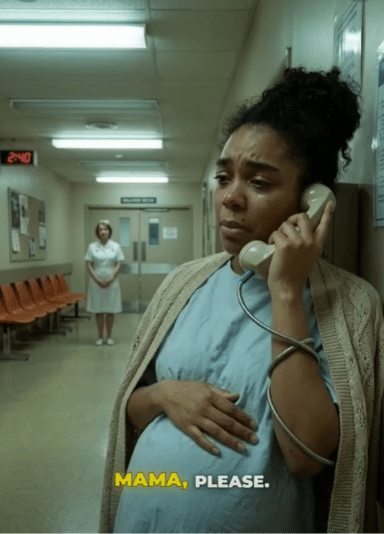
The harsh, sterile scent of bleach and rubbing alcohol hung heavy in the midnight air of the maternity ward, a scent that nineteen-year-old Renee Pruitt would associate with absolute heartbreak for the rest of her life. The flickering fluorescent lights overhead cast long, ghostly shadows against the peeling linoleum floor. She was completely alone. Her body was racked with violent, breath-stealing contractions, but the physical agony pale in comparison to the terror gripping her chest. She stood hunched over a payphone bolted to the cinderblock wall of the hospital corridor, one hand white-knuckling the receiver, the other protectively cradling her swollen belly.
She dialed the familiar number of her childhood home, her fingers trembling so violently she almost dropped the coins. When the line connected, she didn’t wait for a greeting. Her voice broke into a desperate, breathless plea. “Mama, please. The baby’s coming tonight. I’m alone in this hospital. Just come.”
But it wasn’t the soft, comforting voice of her mother that answered. It was the deep, resonant, and unforgiving baritone of her father, Deacon Harold Pruitt. Standing in his warm, middle-class home, likely beneath the framed portrait of a compassionate Jesus Christ that hung in their hallway, Harold’s heart held no such divine mercy. His voice was a blade of ice cutting through the telephone wire. “Your mother’s asleep. You chose that boy over this family. Don’t call this house again.”
The words were a physical blow. Renee gasped, tears hot and fast spilling over her pale cheeks, blurring her vision. She was a child about to have a child, begging for the fundamental right of a parent’s love. “Daddy,” she sobbed, her voice echoing in the empty hallway, “he’s your grandson. He doesn’t even have a name yet.”
There was a pause on the line. For a fraction of a second, Renee held onto a foolish, desperate hope that the weight of the word ‘grandson’ would crack her father’s self-righteous armor. Instead, Harold delivered his final judgment with a chilling, detached finality. “Then give him to a family that wants him. We’re done praying over you.”
The dial tone that followed was the loudest sound Renee had ever heard. It was the sound of a door being slammed shut on her existence. She slowly lowered the receiver. An older nurse, her face etched with profound sympathy and years of witnessing the quiet tragedies of the hospital night shift, approached her gently. “Sweetheart,” the nurse asked softly, her eyes scanning the empty corridor behind Renee, “is anybody coming for you? Anybody at all?”
Renee wiped her face. The trembling in her jaw stopped. A sudden, fierce hardening took place behind her tear-filled eyes—the birth of a mother’s relentless resolve. “No ma’am,” she replied, her voice eerily calm despite the pain ripping through her abdomen. “It’s just me and him. And one day, that’s gonna be enough.”
That night, at exactly twelve minutes past four in the morning, Renee pushed a screaming baby boy into a cold world. The only hand she held during the excruciating hours of labor was that of the nurse she had met just three hours prior. She was nineteen, exhausted, and officially an outcast. Her father’s ultimatum echoed in the dark hospital room: give the baby up for adoption, or never return home.
When she was discharged, Renee packed a single, frayed suitcase. With a newborn swaddled in cheap hospital blankets and exactly fifty dollars to her name, she walked out into the unforgiving chill of a new reality. She didn’t look back. She had a son to raise.
Part 2: Eighteen Years and a Shoebox of Pain
Survival as a teenage single mother in a massive, indifferent city was a daily war of attrition. The years that followed were painted in the neon reds and blues of a 24-hour laundromat on Lamar Avenue, where Renee worked grueling, back-breaking double shifts. The heavy, suffocating humidity of industrial dryers and the constant hum of washing machines became the soundtrack of her youth. But every time she looked at her baby, the exhaustion melted into a fierce, protective love.
She named him Elijah—the name of Harold’s own father, the boy’s great-grandfather. She kept the family name in the middle: Elijah Pruitt. It was a defiant choice, a permanent tether to a bloodline that had discarded them, a silent vow that her son would never be erased from the family tree, whether they liked it or not.
Despite the cruelty of her father, a tiny, fractured piece of Renee still harbored the delusion that time could erode a mountain of pride. Surely, she thought, they would want to see him. Surely, the anger would eventually give way to curiosity, and then to love. And so began a ritual born of trauma and desperate hope.
For eighteen consecutive years, on every single one of Elijah’s birthdays, Renee would sit at the small, wobbly wooden table in the back room of the laundromat after her shift. Under the harsh glare of a bare lightbulb, she would carefully place a new photograph of Elijah into a crisp white envelope. At one year old, taking his first steps. At five, missing his front teeth. At ten, holding a science fair trophy. She would seal it, write her parents’ address with painstaking care, and drop it in the mailbox, sending a piece of her heart back to the very place that had broken it.
And every single year, without fail, the universe delivered a fresh, brutal reminder of her worthlessness in her parents’ eyes.
All eighteen letters came back unopened. Scrawled across the front of each envelope in Harold’s unmistakable, aggressive handwriting were three devastating words in thick red ink: RETURN TO SENDER.
Each returned letter was a knife twisting in an old wound. She would trace the red letters with trembling fingers, her tears staining the paper, mourning the grandparents her son would never know. She never threw them away. She kept every single rejected envelope in a battered cardboard shoebox, hiding her grief in the bottom of her closet, ensuring Elijah never saw the tears she shed for a family that didn’t want him.
But destiny has a strange way of balancing the scales of suffering. When Elijah was six years old, a gentle, broad-shouldered city bus driver named Walter Langford walked into the laundromat. Walter was a man of modest means but infinite emotional wealth. He saw Renee not as damaged goods, but as a warrior; he saw Elijah not as a burden, but as a blessing. They married quietly. Walter gave the boy the one thing Harold Pruitt had tried to deny him: a father’s unconditional love. And he gave him his last name. Elijah Pruitt Langford.
Under Walter’s guidance, Elijah learned how to tie a bowtie, how to throw a baseball, and most importantly, how a real man stands by his family. The boy thrived, his brilliance shining through the cracks of their working-class life.
Part 3: Secrets Beneath the Dust of Time
Elijah Langford grew up completely ignorant of the shoebox in the closet and the red-inked rejection it contained. He was a boy fueled by his mother’s tireless work ethic and his adopted father’s steady warmth. Gifted with an eidetic memory and hands that were incredibly steady, he breezed through high school at the top of his class and earned a full-ride scholarship to one of the most prestigious medical schools in the country. He wanted to be a cardiothoracic surgeon. He wanted to fix broken hearts—a poetic irony that the universe seemed to have explicitly designed.
But tragedy struck during his surgical residency. Walter, the only father Elijah had ever known, was diagnosed with aggressive pancreatic cancer. Within six months, the gentle bus driver was gone, leaving a massive, gaping hole in the lives of Renee and Elijah.
It was during the painful, suffocating process of clearing out the attic of their family home that the past finally caught up with the present. Elijah, sorting through dusty boxes of old clothes, accidentally knocked a heavy plastic bin off a shelf. When it crashed to the floor, a faded, taped-up shoebox spilled out.
The lid popped off, scattering dozens of yellowed, unopened envelopes across the floorboards.
Elijah knelt, dusting off his jeans, and reached for one. He noticed his mother’s neat handwriting on the center, addressing it to a Mr. and Mrs. Harold Pruitt. But it was the thick, angry red letters stamped and handwritten across the front of every single envelope that made his blood run cold: RETURN TO SENDER.
Curiosity overriding his respect for his mother’s privacy, Elijah carefully tore open the first envelope. A baby picture of himself fell out. He opened the next—himself at seven, holding a spelling bee certificate. Envelope after envelope, year after year of his life, returned unseen. At the bottom of the box, he found a small, worn leather journal.
Sitting in the dim light of the dusty attic, Elijah read his mother’s tear-stained entries. He read about the night of his birth. He read the exact words his grandfather had spoken over the phone. Give him to a family that wants him. We’re done praying over you. He read about the agonizing hope his mother felt every time she mailed a photo, and the crushing despair she endured every time it came back.
A profound, suffocating silence descended over the attic. Elijah didn’t cry. Instead, a dark, terrifyingly cold fury took root in his soul. He stared at the picture of himself as a smiling child, blissfully unaware that a man sharing his blood had deemed him entirely disposable. His mother had absorbed this venom for nearly two decades to protect him.
Right then and there, the young, empathetic doctor died, and a man fueled by a terrifying, patient vengeance was born. He didn’t want to hurt Harold Pruitt. He wanted to destroy him. He wanted to dismantle the man’s pride piece by piece, not with violence, but with the undeniable, crushing weight of success. He packed the envelopes back into the shoebox, slid it into his duffel bag, and never mentioned a word of it to his mother.
Part 4: The Verdict of Destiny
A decade passed. Dr. Elijah Langford was no longer just a resident; he was the Chief of Cardiothoracic Surgery at the largest metropolitan hospital in the state. At thirty-eight, he was a legend in the operating room, renowned for taking on the most complex, high-risk cases that other surgeons wouldn’t touch. He walked the halls with an aura of absolute authority, a man in complete control of life and death.
Miles away, on the other side of the city, Deacon Harold Pruitt was rapidly losing control of both. The years had not been kind to the prideful man. His wife had passed away from a stroke years earlier. The congregation that once hung on his every judgmental word had dwindled. He lived in a massive, hollow house, suffocating in a prison of his own isolation. And his heart, the very organ that had been so devoid of empathy, was failing him.
On a brutal, storm-ravaged Tuesday night, Harold collapsed in his hallway, clutching his chest in blinding agony. A massive myocardial infarction—a widow-maker heart attack. Paramedics broke down his door and rushed his dying, frail body through the torrential rain to the only trauma center equipped to handle a case this severe.
The emergency room was a scene of controlled chaos. The attending ER physician took one look at the EKG readouts and paled. “His left anterior descending artery is completely blocked, and he’s going into cardiogenic shock. The tissue is dying fast. Page Dr. Langford. Now. If he doesn’t crack this guy’s chest open in the next ten minutes, he’s dead.”
Elijah, asleep in the on-call room, was paged. He sprinted down the hallway, throwing on his scrubs. He practically kicked the door to the surgical prep room open and snatched the patient chart from the terrified nurse.
His eyes scanned the top line. The world around him seemed to slow to an agonizing crawl. The screeching monitors, the shouting nurses, the frantic beeping of the defibrillator—it all faded into dead silence.
Patient Name: Harold Pruitt.Age: 82.Emergency Contact: None listed. Next of kin: None.
Elijah looked through the glass window into Trauma Bay 1. There, lying naked and vulnerable under the blinding surgical lights, was the man who had ordered his mother into the streets. The man who had stamped ‘Return to Sender’ on his entire existence.
The clock on the wall read exactly 4:12 AM. The precise minute of Elijah’s birth.
The irony was so thick it was choking him. Destiny had literally placed his executioner’s life into his surgically scrubbed hands. The dark, vengeful entity that had lived inside Elijah since the day in the attic whispered a seductive proposition: Walk away. Just claim the case is too advanced. Delay the bypass by just five minutes. Let nature take its course. It would be a clean, undetectable murder by omission. The ultimate revenge.
He stared at his hands—hands that Walter Langford had taught to grip a steering wheel, hands that his mother had kissed when she bandaged his scraped knees. Give him to a family that wants him, Harold’s voice echoed in his mind.
Elijah’s jaw clenched so hard his teeth ached. He looked at the frail, pathetic old man thrashing on the table. To let him die would be to validate Harold’s cruelty. To let him die would mean the venom had won.
“Prep the OR,” Elijah barked, his voice echoing with terrifying authority, startling the medical team. “We’re doing an emergency CABG. Move him now!”
For the next six hours, Dr. Elijah Langford fought a war inside the chest cavity of a man he despised. He navigated the necrotic tissue and failing arteries with the precision of a master artist. He didn’t save Harold Pruitt out of familial love. He saved him out of pure, unadulterated dominance. He saved him because he wanted the man to wake up and look his absolute failure in the eye.
Part 5: Return to Sender
Three days later, the sterile silence of the Intensive Care Unit was broken only by the rhythmic whoosh of a ventilator. Harold Pruitt fluttered his eyes open. The heavy haze of anesthesia slowly lifted, replaced by a dull, throbbing pain in his sternum. He was alive.
He weakly turned his head. The room was empty. No flowers. No get-well cards. No family holding his hand. Just the cold, mechanical hum of medical equipment keeping him tethered to the earth.
The heavy wooden door to the ICU room pushed open. Dr. Elijah Langford walked in. He wore a perfectly tailored suit under a pristine white lab coat, his stethoscope draped over his broad shoulders. He looked every bit a king in his domain.
“You’ve survived the worst of it, Mr. Pruitt,” Elijah said, his voice smooth, professional, and entirely devoid of warmth. He picked up the chart at the end of the bed, scribbling a note.
Harold’s voice was a weak, raspy croak. “Thank you… Doctor. They told me… I was gone. You saved my life. I owe you everything.”
Elijah stopped writing. He slowly closed the metal clipboard and set it down. He walked to the side of the bed, towering over the frail old man.
“You don’t owe me anything,” Elijah said, his dark eyes locking onto Harold’s terrified gaze. “But there is a debt to be settled. Something that belongs to you.”
From the deep pocket of his lab coat, Elijah pulled out an object that violently contrasted with the sterile environment of the hospital. It was a faded, battered cardboard shoebox. He placed it gently on the tray table across Harold’s lap.
Harold frowned, confused. With trembling, IV-bruised hands, he slowly lifted the lid.
The old man’s breath hitched in his throat. His newly repaired heart began to hammer wildly against his ribs, triggering the monitors to beep in alarm. Lying inside the box were eighteen yellowed envelopes. And blazing across the front of each one, in his own vicious red handwriting, were the words: RETURN TO SENDER.
Harold’s shaking hands picked up the first envelope. He pulled out the photograph of a smiling one-year-old boy. He pulled out the next—a teenager in a graduation gown. He pulled out the last one, a photo of a young, handsome man in a medical school coat.
Harold looked at the photo, and then slowly looked up at the towering, formidable surgeon standing over him. The resemblance was undeniable. The realization crashed into the old man with the force of a freight train.
“Eighteen years,” Elijah’s voice was a low, dangerous rumble that filled the room. “My mother, Renee Pruitt, stood at a mailbox for eighteen years, offering you the only thing she had to give. Her pride and joy. And for eighteen years, you sent her love back as trash.”
Harold’s mouth opened and closed like a dying fish. Hot, pathetic tears began to spill from his clouded eyes, rolling down his wrinkled cheeks. “You… you are…”
“Do not call me your grandson,” Elijah interrupted, his tone cutting through the air like a scalpel. There was no rage left in him, only a chilling, absolute superiority. “My name is Dr. Elijah Pruitt Langford. I kept your family name in the middle only to remind me of what I survived. The last name belongs to the man who actually raised me, while you left us to rot in the streets.”
Harold let out a gutted, agonizing sob, clutching the photograph of the baby to his chest. The spiritual and emotional devastation was absolute. He had thrown away his only daughter. He had discarded a brilliant, world-class surgeon who had just literally held his heart in his hands.
“You pushed a terrified nineteen-year-old girl out into the freezing cold with fifty dollars,” Elijah continued mercilessly, leaning in closer. “You told her to give me away because you were done praying for her. Well, Mr. Pruitt, it seems God wasn’t listening to your prayers anyway. He was listening to hers.”
Elijah stood up straight, adjusting his cuffs. The heavy weight that he had carried since that day in the attic suddenly lifted off his shoulders. The monster was dead. The debt was paid.
“The bypass was a complete success. Your heart is strong now. You are going to live for a very, very long time, Mr. Pruitt,” Elijah said, walking toward the door. He paused with his hand on the doorknob, looking back at the weeping, shattered old man surrounded by his own rejected mail.
“I want you to sit in your big, empty house. I want you to live another twenty years in absolute silence. And I want you to look at those eighteen photographs every single day, and know that the trash you threw away is the only reason you are still breathing.”
Elijah opened the door. “Goodbye, Mr. Pruitt. And… return to sender.”
As the heavy door clicked shut behind him, sealing Harold in a tomb of his own making, Elijah walked down the bright hospital corridor. At the end of the hall, sitting in the waiting area, was an older woman with tired but beautiful eyes. Renee stood up as her son approached.
Elijah pulled his mother into a tight, fierce hug. For the first time in his life, the ghost of the grandfather he never knew was finally gone. He had fixed the broken heart in the operating room, but more importantly, he had just permanently healed the one standing right in front of him.