CHAPTER ONE: THE INCIDENT
The morning rush at The Roasted Bean was a chaotic symphony of hissing espresso machines, clinking ceramic mugs, and the dull, rhythmic hum of a bustling downtown crowd. Located right in the heart of the city’s financial district, the cafe was a sanctuary for exhausted professionals seeking their morning caffeine fix. The air was thick with the rich aroma of dark roast and the frantic energy of people who were already late for their nine-to-five grinds.
In the corner booth, bathed in the soft, diffused light of the frosted window, sat a Black woman. She was dressed impeccably in a tailored charcoal blazer, her demeanor quiet and intensely focused as her fingers danced across the keyboard of a sleek silver laptop. She wasn’t bothering anyone. She was simply existing, taking up exactly one seat at a two-person table, sipping a black tea.
Suddenly, the ambient noise of the cafe was shattered by a violent, jarring impact.
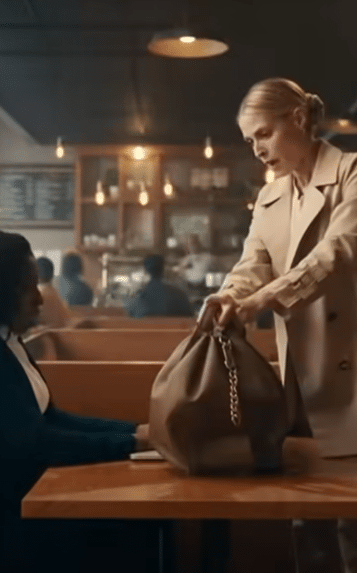
A heavy, oxblood-red designer leather bag slammed down onto the small wooden table with the force of a wrecking ball. The impact was catastrophic. The Black woman’s large ceramic mug toppled over instantly, sending a tidal wave of scalding hot coffee directly across the table. The dark liquid cascaded over the keyboard of her open laptop, immediately seeping into the delicate electronics. The screen flickered wildly, short-circuited with a sharp sizzle, and died.
Standing above the table was a White businesswoman, her face a mask of unapologetic arrogance. She wore a sharp cream-colored trench coat, her blonde hair pulled back tightly. Without an ounce of hesitation or remorse for the destruction she had just caused, she leaned forward, her eyes narrowing with intense entitlement.
“Move your trash off my table,” she snapped, her voice cutting through the suddenly silent cafe like a razor blade. “I need this booth now.”
Around them, the background murmurs of the cafe instantly died down. Customers turned their heads, gasping in shock. A barista near the register paused mid-pour, his eyes wide. Whispers began to ripple through the room. Oh my god, watch out. Who is she? This is insane.
The Black woman slowly blinked, looking down at her ruined computer, then back up at the aggressive intruder. She didn’t say a word. Her lips remained tightly sealed, but her eyes were cold, radiating a terrifying, unshakeable authority.
Misinterpreting the silence as submission, the blonde businesswoman scoffed, waving a manicured hand dismissively toward the front glass doors of the shop. “Go sit at the bus stop.”
Before the Black woman could even stand, the heavy glass doors of the cafe burst open with a commanding force. The crowd physically parted as the City Police Chief, flanked by two uniformed officers, marched straight into the establishment. The heavy thud of their tactical boots against the hardwood floor silenced whatever murmurs were left in the room.
The Police Chief stopped dead in his tracks right in front of the corner booth. He snapped to strict attention, ignoring the blonde woman entirely, and delivered a crisp, formal salute to the Black woman sitting quietly at the table.
“Chief Judge Carter!” the Police Chief announced, his voice booming with absolute respect. “Your private conference room at the station is ready.”
The cafe erupted. The patrons, previously frozen in shock, let out collective gasps of disbelief. Oh my god! A Judge?! The arrogant face of the blonde businesswoman froze. The blood drained entirely from her cheeks, leaving her looking sickly and pale. The sheer, catastrophic dread washed over her features as her eyes darted from the heavy brass badge on the Chief’s chest to the calm, piercing eyes of the woman she had just assaulted.
Her lips trembled, barely able to form the word as her entire world seemed to collapse inward. “J-Judge…?”
CHAPTER TWO: THE FALLOUT
Judge Sarah Carter slowly stood up from the booth. She reached into her blazer pocket, pulled out a monogrammed handkerchief, and calmly wiped a few stray drops of coffee from her cuff. She didn’t look angry. She looked incredibly, painfully disappointed.
“Yes,” Judge Carter said, her voice smooth, deep, and echoing with the same resonance she used in her courtroom. “And you are?”
The blonde woman took a clumsy step backward, bumping into a nearby chair. “I… I’m Eleanor. Eleanor Sterling. I am the Vice President of Development at Sterling Real Estate… I didn’t… I didn’t know who you were.”
“Does my identity dictate whether or not I deserve basic human decency, Ms. Sterling?” Judge Carter asked lightly. She gestured down to the flooded table. “Does a person at a bus stop deserve to have their personal property destroyed simply because you desire their seat?”
Eleanor stammered, frantically reaching into her designer bag to pull out a thick wad of cash. “Listen, I am so sorry. It was a mistake. I’m just incredibly stressed this morning. Here, let me pay for the laptop. Name your price. Two thousand? Three thousand? We can handle this right now without any fuss.”
Chief Davis stepped forward, his hand resting casually on his utility belt. He looked down at the ruined, sizzling laptop, then back up at Eleanor. “Ma’am, that laptop contains highly sensitive municipal court documents. You’ve just deliberately destroyed government property, intimidated a sitting judicial official, and caused a public disturbance.”
Eleanor’s breath hitched. “Government… government property?”
“Chief,” Judge Carter intervened softly, raising a single hand to stop the officer. “There is no need to escalate this to a federal property dispute. It is merely a piece of hardware. However, I do believe a standard police report for willful destruction of private property is warranted. I will file it down at the precinct. Let us not disrupt these good people’s morning any further.”
Judge Carter picked up her ruined laptop, letting the last few drops of coffee fall onto the floor, and tucked it under her arm. She didn’t spare Eleanor another glance. She simply walked past her, the crowd parting for her with reverent respect, and exited the cafe with the Chief of Police following closely behind.
Left alone in the center of the cafe, Eleanor Sterling stood frozen. The barista cleared his throat loudly.
“Ma’am?” the barista said, his tone dripping with disdain. “You’re going to have to clean up that mess. Or you can leave. Now.”
CHAPTER THREE: THE BOARDROOM PANIC
Three weeks later, the incident at the cafe had faded into a lingering, nauseating knot in Eleanor’s stomach. She sat at the head of a massive mahogany conference table on the top floor of the Sterling Enterprises skyscraper. The panoramic windows offered a sweeping view of the city skyline, a skyline her family’s company was desperately trying to alter.
“The situation is critical, Eleanor,” said Marcus, the company’s lead legal counsel, pacing the length of the boardroom. “The downtown commercial plaza project is hemorrhaging money. The city council has blocked our demolition permits due to the historical preservation injunction filed by the local community board. We are losing fifty thousand dollars a day on standby contractor fees.”
Eleanor rubbed her temples, fighting off a migraine. “So what is the solution, Marcus? We have the best lawyers in the state. Crush the injunction.”
“We filed an emergency appeal to have the injunction lifted,” Marcus explained, stopping at the end of the table and opening a thick leather-bound folder. “The hearing is set for tomorrow morning at the municipal courthouse. If we win, the bulldozers can roll in by noon. If we lose, the project is dead in the water, and your father is going to hold you personally responsible for a ninety-million-dollar loss.”
Eleanor slammed her hand on the table, a familiar flash of arrogance returning to her eyes. “We aren’t going to lose. We have the zoning rights. The city code is on our side. Who is the judge assigned to the emergency hearing?”
Marcus flipped a page in the folder, his eyes scanning the heavily redacted municipal document. “It was just assigned this morning. A fast-track municipal judge known for strictly adhering to the letter of the law. Let’s see here… Chief Judge Sarah Carter.”
The blood instantly vanished from Eleanor’s face. The room seemed to spin. The memory of the spilled coffee, the ruined laptop, and the terrifyingly calm eyes of the Black woman in the cafe crashed into her mind with the force of a freight train.
“No,” Eleanor whispered, her voice trembling. “No, no, no. Marcus, you have to file a motion for a new judge. Recusal. Conflict of interest. Anything!”
Marcus looked at her, confused. “Recusal? On what grounds? Do you know her personally?”
“I… I spilled coffee on her,” Eleanor choked out. “I told her to go sit at a bus stop.”
Marcus stared at her in absolute, stunned silence. “You told the Chief Judge of the municipal district to go sit at a bus stop? Eleanor, God help us.”
CHAPTER FOUR: THE COURTHOUSE
The next morning, the heavy oak doors of Courtroom 3B felt like the gates of purgatory. Eleanor walked down the central aisle, her usually confident stride replaced by a stiff, terrified march. The courtroom was packed. Community activists, reporters, and local business owners filled the wooden pews, all eager to see the fate of the massive Sterling Plaza project.
Eleanor sat at the plaintiff’s table beside Marcus, her hands folded tightly in her lap. Her knuckles were white. She wore a subdued black suit, a stark contrast to her usual flashy designer outfits. She kept her head down, staring intently at the legal briefs spread across the table, terrified to look up.
“All rise!” the bailiff’s voice boomed through the chamber.
The heavy wooden door behind the bench swung open. Chief Judge Sarah Carter walked in, her black judicial robes billowing slightly with her commanding stride. She took her seat at the elevated bench, adjusting her microphone with a practiced, calm precision.
“Be seated,” Judge Carter instructed. Her voice was just as smooth and authoritative as it had been in the cafe.
Eleanor slowly raised her eyes. For a brief, agonizing second, Judge Carter’s gaze swept across the plaintiff’s table and locked onto Eleanor. There was no smirk. There was no flash of recognition or petty vengeance in the judge’s expression. There was only the cold, impartial gaze of the law.
“Docket number 44-B,” Judge Carter announced, looking down at her files. “Sterling Real Estate Group versus the Downtown Historical Preservation Committee. Motion for an emergency lift of a demolition injunction. Counsel for the plaintiff, you may proceed.”
Marcus stood up, visibly sweating, and began his opening arguments. Eleanor barely heard a word. Her heart was hammering against her ribs like a trapped bird. She kept waiting for the hammer to fall, waiting for the judge to interrupt, to humiliate her in front of the packed room, to exact her revenge.
But it didn’t happen.
CHAPTER FIVE: THE CROSS-EXAMINATION
For the next two hours, the courtroom became a battlefield of zoning codes, municipal precedents, and architectural blueprints. Judge Carter was relentless, but entirely professional. She peppered both Marcus and the defense attorney with sharp, highly technical questions.
“Counselor,” Judge Carter said, leaning forward and looking at Marcus. “Your brief argues that the preservation committee failed to file the historical registry forms within the ninety-day statutory window. However, under section 4-B of the municipal code, grace periods are extended when city archives are under renovation, which they were last October. How do you reconcile this?”
Marcus fumbled with his papers. “Well, Your Honor, the burden of proof regarding the archive availability falls on the defense…”
“Incorrect,” Judge Carter snapped back, her tone sharp but purely academic. “The burden of due diligence falls on the developer attempting to alter the city’s landscape. The law is not a bulldozer you can blindly drive through technicalities, Mr. Marcus.”
Eleanor shrunk in her seat. The judge was dismantling their multi-million dollar legal strategy piece by piece, not with malice, but with terrifying, airtight legal precision. Carter wasn’t ruling against them because of the coffee. She was ruling against them because Sterling Enterprises had cut corners, assumed their money would buy them a victory, and arrogantly ignored the nuances of the law.
Just as Eleanor had arrogantly ignored the basic humanity of a stranger in a cafe.
“Your Honor,” Marcus tried one last time, desperation leaking into his voice. “Sterling Enterprises represents a ninety-million-dollar investment into this community. We are bringing jobs, revenue, and modernization. The economic benefit heavily outweighs a procedural delay regarding a dilapidated building.”
Judge Carter paused. She closed the folder on her desk and folded her hands together. The courtroom fell dead silent.
CHAPTER SIX: THE RULING
“Economic benefit,” Judge Carter repeated softly, the words echoing in the cavernous room. She looked directly at Eleanor for the first time since the hearing began. The eye contact was piercing, freezing Eleanor in place.
“It is a common misconception among the privileged,” Judge Carter began, her voice steady and echoing with profound gravity, “that wealth and status grant an exemption from the rules that govern the rest of society. That if you have enough money, or build a big enough building, you can simply demand that others move out of your way.”
Eleanor swallowed hard, feeling the weight of the entire room pressing down on her shoulders.
“But the law does not care about your designer bags, and it certainly does not care about your bank account,” Judge Carter continued, her eyes locked onto Eleanor’s. “The law demands respect. It demands procedural fairness. And above all, it demands that every citizen, from the CEO in a penthouse to the person waiting at a bus stop, is treated with equal consideration under municipal statutes.”
Eleanor felt a tear of absolute humiliation prick the corner of her eye. The message was loud and clear, delivered perfectly under the guise of legal philosophy.
“Sterling Real Estate Group failed to perform adequate due diligence. You rushed this project, assumed the rules did not apply to you, and attempted to steamroll a legitimate community grievance,” Judge Carter stated, picking up her wooden gavel.
“The motion to lift the injunction is firmly denied. The historical preservation committee will be granted their full six-month review period. If Sterling Enterprises wishes to proceed after that, they will do so strictly by the book.”
BANG.
The gavel struck the sounding block with a sharp, final crack.
CHAPTER SEVEN: THE AFTERMATH
The courtroom erupted into cheers from the community activists. Marcus slumped back into his chair, dropping his face into his hands. “It’s over,” he muttered. “The board is going to pull the funding.”
Eleanor didn’t move. She couldn’t. The magnitude of her failure washed over her. She had just cost her family’s company nearly a hundred million dollars. But deep down, beneath the panic of her impending corporate downfall, a harder, much more painful truth was settling in her chest.
She watched as Judge Carter stood up, gathered her files, and walked back to her chambers with quiet, unshakeable dignity.
Eleanor slowly stood up, her legs feeling like lead. She grabbed her briefcase and began the long, humiliating walk down the center aisle of the courtroom. As she pushed through the heavy wooden doors and stepped out into the bright, unforgiving light of the city streets, she realized she had nowhere to go. Her father would be waiting for her at the office. The board members would be demanding her resignation. Her career was effectively finished.
She walked aimlessly down the concrete sidewalk, the busy afternoon crowd bumping past her. For the first time in her life, nobody moved out of her way. She was just another person on the street.
Exhausted, defeated, and thoroughly broken, Eleanor Sterling stopped walking. She looked around, her eyes landing on a small wooden bench covered in peeling green paint, situated beneath a metal transit sign.
With a heavy sigh, the former Vice President of Development walked over and sat down at the bus stop, waiting for a ride she didn’t even know how to catch.