CHAPTER 1: ASHES IN THE WIND
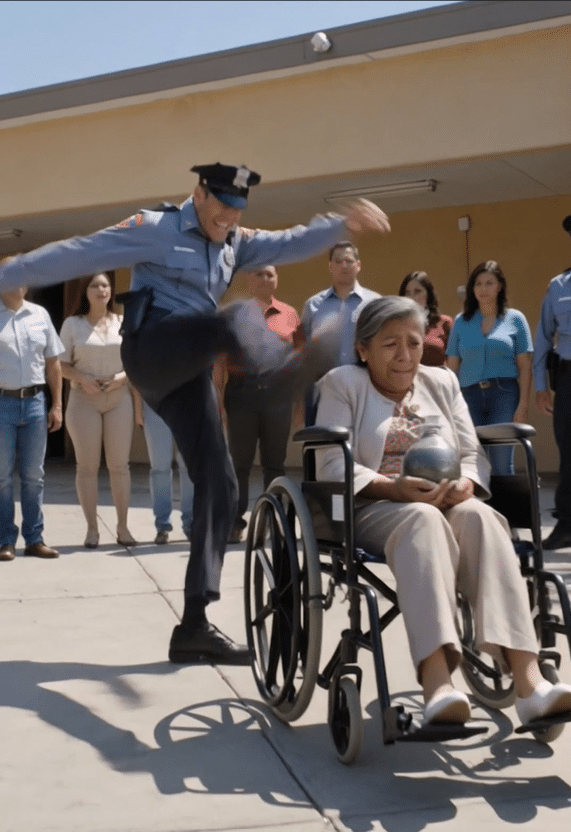
The midday sun beat down heavily on the burning concrete of the main entrance to the “Heroes of the Revolution” elementary school. It was dismissal time, and dozens of parents waited impatiently, seeking refuge under the sparse shade of the ash trees. Amidst the bustle and the suffocating heat was Doña Elena. At seventy-five years old, her fragile body rested in an old wheelchair. She wore simple clothes, a dark shawl that covered her shoulders, and held against her chest, with an almost sacred devotion, a small, polished wooden urn. Inside rested the ashes of her beloved daughter, María.
Suddenly, the imposing figure of a police officer shattered the old woman’s peace. He was a burly man, about thirty-five years old, with a fair complexion and an accent that betrayed his foreign roots—an American working in the municipal police force through one of those strange cross-border agreements. His blue uniform was impeccable, but his attitude exuded an unbearable arrogance. Without a single kind word, the officer advanced toward Doña Elena.
“Get out of here! You’re blocking the view of the important parents,” the police officer shouted with a thunderous voice, drawing the stares of everyone present at the school entrance.
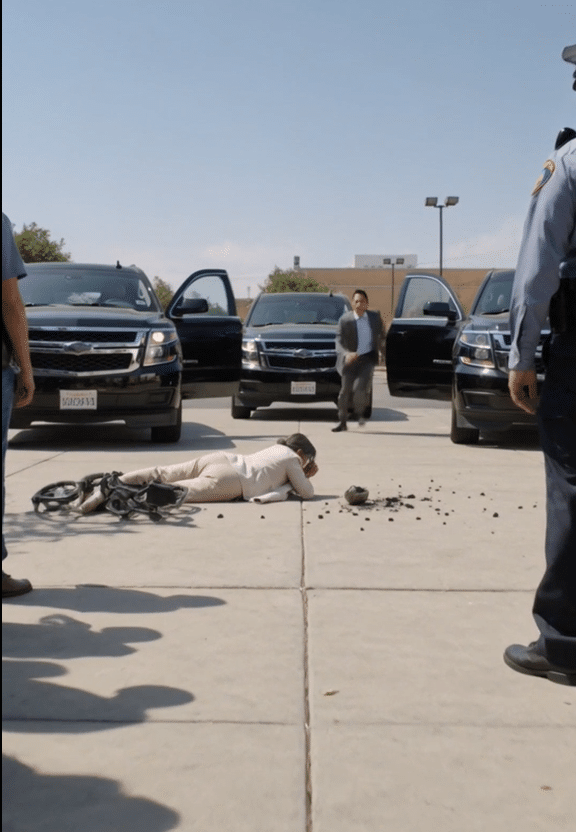
Before the old woman could stammer a response or explain her presence, the officer raised his leg and, with inexplicable cruelty, violently kicked the right wheel of her chair. The impact was brutal. The wheelchair shot backward. Doña Elena could not hold on and fell heavily onto the hot pavement. The wooden urn flew through the air, escaping her trembling hands, until it hit the ground with a dry crash. The wood splintered into a thousand pieces, and the gray ashes scattered across the concrete.
The wheelchair continued to slide a few more meters until it crashed into a pole. The crowd erupted in screams of horror, but no one moved. The fear of authority paralyzed them. Elena, lying on the ground, wept inconsolably. She reached out her wrinkled, scraped hand; her fingers trembled as she tried, in vain, to gather her daughter’s ashes. But the relentless north wind began to blow them away. She was completely alone.
Suddenly, the roar of powerful engines pierced through the crying. Three black, gleaming, armored SUVs braked sharply in front of the school entrance. The doors swung open. From the center vehicle stepped a fifty-five-year-old man, impeccably dressed in a tailored gray suit. He was the Mayor of the city. His face, normally serene and calculating, distorted upon seeing the terrible scene.
He ran toward Elena, not caring about staining his designer trousers. He fell to his knees on the dusty concrete, took the old woman’s wounded hand, now covered in gray dust, and stared in horror at the shattered urn. With eyes full of tears, he hugged her tightly against his chest in front of the entirely motionless crowd.
“Mother, forgive me for being late. No one will ever disrespect you again in this city,” the Mayor said with a broken voice, yet loud and authoritative enough for the entire street to hear.
The police officer, who until that moment had maintained a defiant posture, was petrified. His face instantly paled, draining of all color. A cold sweat began to slide down his forehead. His eyes widened enormously, unable to process his monumental mistake. Trembling like a leaf, he took a clumsy step back.
“M-Mother…?” the officer stammered.
CHAPTER 2: THE WEIGHT OF AUTHORITY
The silence that followed the officer’s words was sepulchral. Not even the wind seemed to dare to blow. Alejandro, the Mayor of the city, kept his mother clutched to his chest. He felt the spasms of her weeping, the deep pain that tore at his soul upon seeing the ashes of his sister María scattered across the dirty street ground. Slowly, Alejandro stood up. His expression of pain transformed into a mask of restrained fury, a cold and calculating anger that froze the blood of those present.
“What have you done?” asked the Mayor. His voice wasn’t a shout; it was a whisper laden with venom that cut through the tense midday air. “I asked you a question, officer. What the hell did you do to my mother?”
The American police officer, who just minutes before had felt like the absolute master of the street, now seemed to shrink inside his blue uniform. He looked at the bodyguards who had already descended from the SUVs and surrounded the scene, their hands discreetly resting on their tactical belts.
“Mr. Mayor… I… I didn’t know…” the officer babbled, taking another step back with terror reflected in his pupils. “She was blocking the entrance. It was a security protocol, sir. I thought she was a vagrant coming to beg from the parents. I was just trying to clear the area for…”
“For the important parents?” Alejandro interrupted him, taking a threatening step toward him. “For the people you consider worthy of your damn respect? That woman on the ground is the widow of a man who built half the schools in this city. She is the mother of the Mayor who pays your salary. And most importantly, she is a defenseless old woman who was doing absolutely no harm to anyone.”
Doña Elena, supported by one of the escorts who helped her sit back in her dented chair, wiped the dirt-streaked tears away with her shawl.
“Alejandro, son, your sister’s ashes…” the woman sobbed, pointing to the gray dust on the boiling concrete. “My little girl, my María…”
Hearing his sister’s name, the Mayor clenched his fists until his knuckles turned white. María had died tragically in a traffic accident just two weeks ago. She had been a first-grade teacher at that very school, loved by all her students and deeply respected by the community. Elena’s request was simple and pure: she wanted to scatter a handful of María’s ashes under the great ash tree in the central courtyard, the young teacher’s favorite spot.
CHAPTER 3: THE CROWD AWAKENS
The parents, who until now had been mere mute spectators out of fear and confusion, began to murmur among themselves. The name of teacher María spread like wildfire among the crowd gathered on the sidewalk. Several of them then recognized Doña Elena’s tired face. The shame of not having intervened began to weigh heavily on their consciences.
“That’s teacher María’s mom!” a woman shouted from the back, pushing her way through the crowd and pointing accusingly at the police officer. “And that wretch threw her to the ground without any mercy!”
“Abusive! Coward!” joined other infuriated voices. The collective indignation grew like a wildfire, fueled by the presence and backing of the Mayor. The citizens lost their fear of the badge and the uniform.
The officer, feeling cornered by the swirling crowd and Alejandro’s glaring gaze, tried to justify himself again, his gringo accent stumbling ridiculously over the Spanish words due to panic.
“Mayor, please listen to me! It was a protocol accident. The chair slipped on its own…”
“Shut your mouth,” the Mayor ordered with absolute authority, his voice echoing like thunder over the concrete. “Don’t you dare insult my intelligence or my sister’s memory. I saw exactly what happened. I saw you raise your boot against a woman in a wheelchair, leaving her lying there as if she were trash.”
Alejandro turned sharply to his head of security, a robust, scarred man with a severe gaze, a veteran of the local forces named Commander Garza.
“Garza, disarm this individual immediately. Strip him of his badge, radio, duty belt, and weapon. As of this damn second, he is no longer a police officer for our municipality or the state.”
“You can’t do this, sir!” the officer protested, his eyes bulging as Garza approached with a firm, military stride. “I have rights! I have immunity through the border union!”
“Your privileges ended the exact moment you assaulted an elderly citizen and desecrated my sister’s sacred remains,” the Mayor declared without a millimeter of hesitation. “And believe me, I will personally make sure you never wear a uniform again, neither in this country nor in yours. Take him away. Process him for aggravated assault, abuse of authority, and destruction of property.”
CHAPTER 4: PICKING UP THE PIECES
While two escorts immobilized and handcuffed the former officer, who was now whimpering and quietly pleading for mercy, Alejandro knelt beside his mother again. María’s gray dust was still scattered on the ground, cruelly mixed with the dirt, the heat, and the trash of the pedestrian street. It was a bleak image that irreparably broke the heart of the most powerful man in the city.
“Forgive me, Mom,” Alejandro whispered, and a single, heavy tear rolled down his sunburnt cheek. “I promised you the city would be safe for you, and I have failed miserably.”
Elena, with the infinite compassion that only a Mexican mother can harbor in her chest, caressed her son’s tense face, leaving a light ash smudge on his cheek.
“Don’t cry, my son. It’s not your fault that there are people with such dark and lost souls. But look around you. Not all is lost. Turn around and look, son.”
Alejandro slowly looked up, and his eyes widened in profound astonishment. To his surprise, dozens of mothers, housewives wearing aprons, and even some fathers in office suits, had approached in absolute reverential silence. They knelt on the boiling asphalt, disregarding the burn to their knees. Without saying a single word, they began to use their own cupped hands, clean handkerchiefs, and sheets of paper torn from their children’s notebooks to gather, with extreme and sacred care, the scattered ashes of the beloved teacher María.
A little girl, a first-grade student with perfectly braided hair, walked up to Elena and handed her a small, washed glass jar where she usually kept her candies.
“So that teacher María doesn’t stay lying on the hot floor, grandma,” the little girl said with a sweet and incredibly sincere voice that broke the soul.
The lump in Alejandro’s throat tightened, almost stopping him from breathing. That act of spontaneous solidarity was the true, pure, and noble essence of his people. It wasn’t the brutality of the foreign officer, but the indestructible, human warmth of his community. Slowly, together, they deposited the gathered dust into the child’s glass jar and a fine silk handkerchief that the Mayor himself pulled from inside his gray suit jacket.
CHAPTER 5: THE SHADOW OF JUSTICE
The news of the outrageous and cruel incident spread to every corner of the city before nightfall. Local newscasts, community radio stations, and social media exploded with the high-definition video recorded by the school’s security camera, footage that quickly went viral nationwide. The images of the ruthless kick and the spectacular fall of the Mayor’s mother generated an unprecedented wave of indignation in the region. The people demanded absolute justice, not only for the influential family of the Mayor but for any ordinary citizen who had suffered cowardly abuses by the authorities.
Alejandro, sitting in the twilight of his spacious municipal presidency office, watched through the large panoramic window the twinkling lights of the city he had sworn to protect with his life. His mother rested in the comfortable adjoining room, heavily medicated and attended to by the family’s best personal doctor. She had suffered severe bruises on her thin arms and a hairline fracture in her hip, but her spirit remained unbroken, serene, and full of peace.
Commander Garza entered the office without knocking, abruptly interrupting the Mayor’s dark thoughts.
“Sir, the ex-officer is locked up in the maximum-security holding cells. The American consul has already been notified and has made his first diplomatic moves. They tried to advocate for a quiet, quick deportation tonight to avoid an international public scandal. They claim the man has an extensive medical history of severe anger management issues and post-traumatic stress from his previous military service. They want to sweep this under the rug.”
Alejandro slammed his closed palm against the heavy mahogany desk, causing the silver pens to rattle loudly.
“Anger management? He kicked an old woman in a wheelchair out of pure malice and racism! I don’t care at all what the consul says or the cheap excuses his lawyers invent. This case will be processed fully and completely under the strict laws of Mexico, in the sovereign state where he committed this abhorrent crime. He is going to face a criminal judge face-to-face for grievous bodily harm to a vulnerable person, excessive abuse of authority, and unforgivable moral damage. I want the full, dark, and relentless weight of the law to fall upon him, without a single mitigating factor.”
“It will be done, Mr. Mayor. The prosecutor’s office is already drafting formal charges with no right to bail. No one in this entire city is going to accept a bribe in this case, I assure you on my badge. The whole town is backing your firm decision out on the streets, holding vigils.”
“This isn’t about my power or my bruised ego, Garza,” Alejandro whispered, picking up and staring intently at the framed photograph of his sister María resting on the desk. “It’s about setting a historic and definitive precedent. If I allow a wretch to treat my own mother like this, in broad daylight and in front of dozens of mute witnesses, what damn hope is left for the humble people who walk alone through those streets at dawn? This has to change today, whatever the cost.”
CHAPTER 6: THE TRIBUTE AT THE ASH TREE
Two days after the disastrous altercation, the “Heroes of the Revolution” elementary school woke up with an aura completely different from any given Tuesday. There was no usual disorganized bustle, no children shouting while playing hide-and-seek in the hallways. There was an immensely solemn respect in the air, an almost ecclesiastical silence honoring the stolen memory. The school’s general principal had suspended all regular classes to organize an official and dignified tribute to teacher María, taking advantage of the presence of her entire family and the highest local authorities.
In the central cement courtyard, under the immense protective shade of the old, centennial ash tree, a beautiful traditional altar was carefully placed. It was overflowing with fresh white flowers, dozens of lit candles flickering in the wind, and huge framed photographs of the young teacher smiling affectionately alongside her graduating students. In the exact center of the multi-tiered altar rested an imposing new urn. It was a dazzling piece of pure black onyx, hand-carved over entire nights by the town’s best local artisans, safeguarding the precious ashes that the brave community had helped recover grain by grain from the burning pavement.
Doña Elena sat with dignity in the front row, wrapped in her black mourning shawl. Alejandro had ordered the best, most comfortable, padded, and secure electric wheelchair on the market for her, but she, with the unyielding stubbornness that characterizes Mexican grandmothers forged in iron, preferred to use the exact same old metal chair, only with the wheel recently repaired and straightened. She wisely said that one shouldn’t waste things that still worked and that this chair, with all its dents, now told a story of resilience.
The large school courtyard was packed from end to end. All the students were there in impeccable dress uniforms, the parents who were no longer afraid, the entire teaching staff shedding tears, and a large contingent of local press and national correspondents. Alejandro stepped up to a small, varnished wooden podium adorned with black crepe. He wore a strict mourning suit, but his weathered face reflected a deep inner peace he did not possess on the fateful day of the incident.
“Neighbors, great friends, extended family of this noble city,” the Mayor began, leaning into the microphone, his voice resonating strong, crystal clear, and without the slightest tremor over the school’s loudspeakers. “Today we all gather here to give a dignified farewell to a great woman, a tireless educator by calling, my beloved sister María. But we are also here to remember, once and for all so that no one forgets, who we truly are as a community and what we Mexicans are made of. Just a couple of days ago, systematic brutality, racism, and ignorance tried to stain this sacred place of learning with blood and dust. They tried to trample in the most despicable way the absolute and sacred respect we owe to our elders, to our roots.”
He took a meticulously calculated pause and stared directly at his mother, who nodded back with a slight, serene, and proud smile.
“However, what brilliantly triumphed at the end of that dark day wasn’t the cowardly abuse of power. It was the genuine and overwhelming solidarity of an entire people. You, the ones who knelt to pick up my sister’s ashes from the hot ground, burning your hands, proved that the heart of our people is giant, brave, and supremely noble. The unscrupulous man who committed that unforgivable outrage is already locked behind the bars of a grim state prison, without bail, and he will face justice without diplomatic privileges. But the true and unforgettable lesson in humanity is the one each and every one of you taught us that afternoon on the street.”
CHAPTER 7: THE EARTH AND THE MEMORY
Alejandro’s emotional and raw speech moved the vast majority of those present to uncontrollable tears, managing to break even the toughness of the rugged armed security guards patrolling the school’s perimeter. The school principal, visibly affected and wiping her face, took the microphone to officially announce that, starting from this historic day and backed by the student council, the huge school library would permanently and honorably bear the name “Teacher María Elena,” and that the facility would receive a large financial and new book donation from the local city council. There was a very long, deafening, and deeply respectful round of applause that rose powerfully with the morning breeze to vigorously rustle the highest branches of the old ash tree.
Finally, the culminating moment arrived that Doña Elena had been anxiously and painfully awaiting for two long and torturous weeks of mourning. With Alejandro’s careful and loving help, the old woman approached the base of the immense tree in her old metal chair. A small, perfect, deep pit, adorned at the edges with freshly cut white rose petals, had already been dug with utmost reverence among the thick, labyrinthine exposed roots jutting from the earth. Elena, waving off the guards’ help, took the heavy, shiny onyx urn herself. Her worn hands, still marked with the painful purple bruises and scars from the cruel street accident, did not tremble at all this time as they held the weight.
“My beautiful girl, my invaluable treasure,” Elena murmured in an intimate whisper, caressing the cold, black, shiny stone, kissing it with a mother’s devotion. “Now you will be here forever, deeply rooted, listening closely to the laughter and songs of the children you loved and defended so much, exactly as you always asked me. No one, absolutely no one, will ever bother you or disrespect you in this town again. I promise you on my life.”
With extreme care and solemnity, Alejandro, the stoic Commander Garza, and the humble, old school gardener helped to firmly place the heavy onyx urn into the fertile, moist earth. Then, the principal invited all the little first-grade children to step forward, lined up straight, one by one. Each child, with their innocent little hands, took a handful of loose soil and gently deposited it over the surface of the urn, bidding farewell to their dear, absent teacher with tender and childish words of affection. The innocent laughter and children’s voices, which inevitably and naturally mixed with the silent tears of mourning from the adults, created a magical atmosphere of profound spiritual and collective healing.
Alejandro, after giving way to the children, knelt in the dirt next to his mother’s wheelchair. She watched with serene and dry eyes as the little students finished covering the hole and the gardener carefully planted a small white rosebush on top of the newly turned earth.
“Are you truly at peace, Mom?” the Mayor asked her in a private whisper, wrapping his strong arm around her shoulders in a protective, filial manner.
Elena sighed deeply from the bottom of her tired lungs, closing her wrinkled eyes to fully feel how the soft, cool morning breeze melodiously moved the green leaves of the ash tree above them, blowing away the last, heavy trace of pain and resentment.
“Yes, my son, I am in total peace. Earthly justice and the weight of the law will take care of punishing wicked and arrogant men in this life, but we, the good ones, must always take care of sowing good and beautiful things for the future of these children. Your sister is finally home now, resting, and this city… this city proved that, despite all the bad, it still has a soul, courage, and memory.”
The Mayor tenderly kissed his elderly mother’s forehead, knowing perfectly well that, even though the bustling border city had thousands of complex problems to solve every new day, that very afternoon they had successfully planted an unbreakable seed of community respect, unyielding justice, and human dignity. A pure seed that would take roots as deep, stubborn, and strong as those of the old ash tree that now jealously and eternally guarded the rest of the beloved teacher María. The relentless Mexican midday sun, which just two days earlier had been a mute witness to unbridled cruelty, now filtered warmly, golden, and supremely kind through the green leaves of the high branches, illuminating with an almost celestial halo a mother who, despite brutal adversity and abuse, had found the perfect way to give her beloved daughter a dignified and well-deserved final goodbye.