CHAPTER 1: THE SHATTERED MASTERPIECE
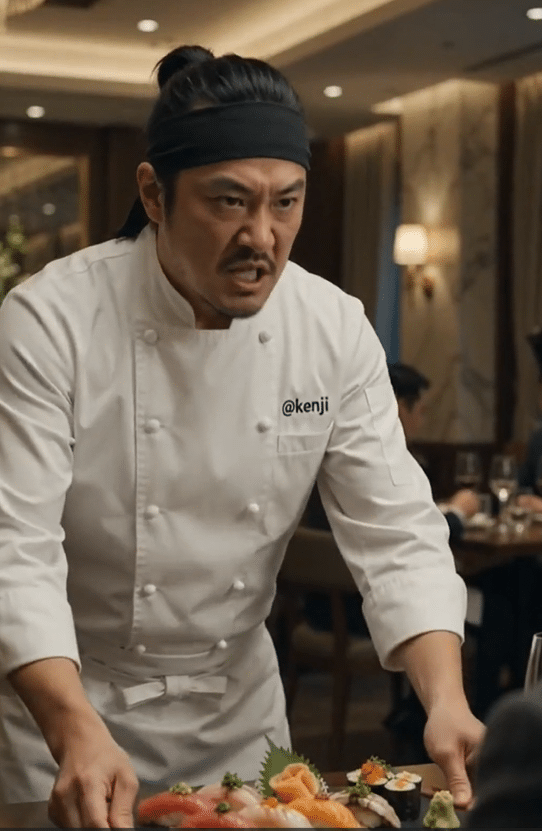
The ambient noise inside Lumière, a three-Michelin-starred sanctuary of modern gastronomy nestled in the heart of Manhattan, was a carefully orchestrated symphony. The delicate clinking of imported crystal wine glasses, the hushed, reverent whispers of the city’s most elite diners, and the faint, rhythmic sizzling emanating from the open kitchen created an atmosphere of pure, unadulterated luxury. At the center of this culinary theater stood Kenji. At thirty-five, he was the undisputed king of the New York dining scene. With his jet-black hair slicked back tightly beneath a signature black headband, and his pristine, tailored white chef’s coat, he moved with the aggressive, predatory grace of a man who knew he was untouchable.
Tonight, however, the symphony was about to hit a violently discordant note.
Sitting alone at the chef’s exclusive tasting counter was a man who starkly contrasted the glittering clientele. Sato, a sixty-year-old man with meticulously cropped silver hair, wore a minimalist, charcoal-gray business suit that looked off-the-rack. Strangely, he kept a pair of dark sunglasses resting on his face despite the dim, moody lighting of the restaurant. He had been quiet all evening, chewing slowly, his expression an unreadable mask of stone.
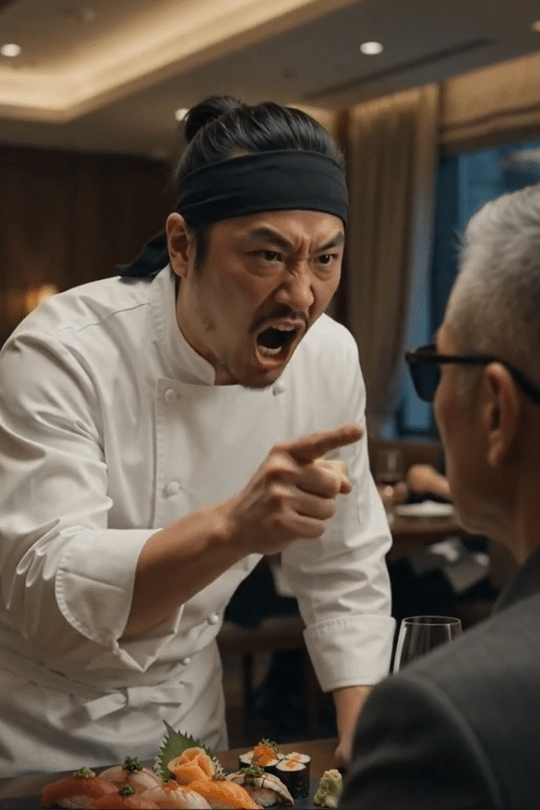
Kenji had spent the last twenty minutes meticulously assembling a plate of aged O-toro, crowned with a ludicrously expensive dusting of white truffle and 24-karat edible gold leaf. It was a dish designed to command worship. But when Sato took a bite, he didn’t close his eyes in ecstasy. He didn’t gasp. He simply set his chopsticks down with a soft, dismissive clack.
The slight gesture felt like a gunshot in Kenji’s kitchen. The chef’s blood boiled instantly.
Storming out from behind the counter, Kenji snatched the porcelain plate and violently hurled it onto the mahogany table directly in front of Sato. The expensive sushi exploded into a mess of rice and fish, splattering against the immaculate linen. The surrounding diners gasped, falling dead silent.
Kenji leaned in, his eyes blazing with absolute contempt. The veins in his neck bulged as he practically spat his words at the older man.
“Spit it out! You don’t deserve my masterpiece.”
The tension in the room skyrocketed. The background hum of the restaurant vanished, replaced by a suffocating silence. But Sato did not flinch. He did not reel back. He remained perfectly still, his hands resting gently on his lap. Slowly, deliberately, Sato tilted his head up, adjusting his sunglasses to peer directly into Kenji’s furious eyes.
When Sato finally spoke, his voice was chillingly calm, carrying a quiet authority that seemed to freeze the very air in the room.
“Your rice is cold. The soul is missing.”
Kenji’s face twisted into a mask of pure, unadulterated rage. The sheer audacity of this nobody, this aging salaryman, daring to critique his technique in his own domain was unfathomable. He thrust his body forward, pointing a trembling, furious finger inches from Sato’s face, letting out a harsh, mocking scoff.
“How dare you! I am a culinary god!”
Sato sat completely unbothered, an immovable mountain in the face of a violent storm. He didn’t blink. He didn’t speak. He just watched the self-proclaimed god unravel.
CHAPTER 2: THE CRUSHING WEIGHT OF THE TRUTH
Before Kenji could unleash another tirade, the heavy, soundproofed oak doors of the dining room burst open with a violent crash. The sudden noise made several patrons jump in their seats. Striding furiously through the dining room was the restaurant’s owner, Mr. Sterling. At fifty-five, Sterling was a man who usually projected polished charm, always impeccably groomed with a neat beard and a sharp, tailored black suit. But right now, his face was pale, glistening with a cold sweat, and his eyes were wide with sheer, unadulterated panic.
He moved with an aggressive, desperate energy, shoving past a cart of expensive champagne without a second glance. He practically threw himself toward the tasting counter, his chest heaving as he closed the distance. The aura of command he brought with him was absolute and terrifying.
Sterling didn’t look at Sato. His terrified gaze was locked entirely on his star chef.
“Kenji, drop your knife and bow right now!” Sterling roared, his voice cracking with an urgency that sent a shockwave through the kitchen staff.
Kenji flinched, genuinely taken aback. He instinctively lowered his hand, his aggressive posture faltering for the first time all evening. He looked at his boss, genuinely bewildered. A nervous, confused laugh escaped his lips as he pointed a thumb back at the old man sitting calmly at the counter.
“Boss? Why are we bowing to a salaryman?”
Sterling closed the final few feet between them, grabbing Kenji by the collar of his pristine white jacket. The owner’s face was inches from Kenji’s, and the raw fear radiating from him was palpable. Sterling’s voice dropped to a harsh, trembling whisper that still somehow echoed in the dead silence of the room. He grounded out every single syllable like it was a death sentence.
“He is the Head Inspector of Michelin Guide!”
The words hit Kenji with the force of a freight train. The camera of reality seemed to zoom in violently on his face. His pupils dilated rapidly, contracting in pure, unadulterated horror. A sickening wave of cold sweat instantly broke out across his forehead. His arrogant sneer vanished, replaced by a slack-jawed expression of utter devastation. His lips began to tremble uncontrollably. The culinary god had just realized he was standing before the executioner.
CHAPTER 3: THE EMPIRE BURNS
The silence that followed the revelation was deafening. It was the kind of heavy, suffocating quiet that only exists in the immediate aftermath of a catastrophic disaster. Kenji’s legs felt like lead. The custom Damascus steel knife resting on the cutting board behind him suddenly seemed like a child’s toy.
“Mr. Sato…” Sterling stammered, immediately dropping into a deep, desperate ninety-degree bow. The owner’s voice shook violently. “I… I cannot express the depth of my apologies. This is a profound misunderstanding. Chef Kenji has been under immense stress. Please, allow us to comp your entire evening. Let me personally escort you to the VIP suite.”
Sato didn’t look at Sterling. His cold, steady gaze remained fixed on Kenji, who was now visibly shaking, his previously slicked-back hair falling out of place, framing a face drained of all color.
“Stress,” Sato repeated, the word rolling off his tongue with quiet precision. “Stress does not make the rice cold, Mr. Sterling. Arrogance does.”
Kenji tried to speak. He opened his mouth, but his throat was bone dry. “I… I didn’t know,” he managed to choke out, his voice a pathetic squeak compared to his earlier booming declarations. “If I had known you were the inspector, I would have—”
“You would have what?” Sato interrupted, his tone razor-sharp, cutting through Kenji’s excuses effortlessly. “You would have cooked with respect? You would have treated the ingredients with the dignity they deserve? A true chef does not cook for the inspector, Kenji. A true chef cooks for the guest. If you only bring your soul to the table when you are being judged for a prize, then you have no soul at all.”
Sterling, realizing that his multi-million dollar investment and his coveted three stars were evaporating into thin air, made a brutal, instant business decision. He stood up straight, his face hardening as he turned back to Kenji.
“Take off the jacket,” Sterling ordered, his voice devoid of any warmth.
Kenji blinked, his eyes welling with panicked tears. “Boss… please. The tasting menu. The critics. You need me.”
“I needed a chef, Kenji. Not a liability,” Sterling hissed venomously. “You just threw a plate of food at the Head Inspector of the Michelin Guide. You are done in this city. You are done in this industry. Take off the goddamn jacket and get out of my restaurant.”
Kenji slowly reached for the heavy brass buttons of his custom jacket. His fingers, usually so nimble and precise with a blade, fumbled clumsily. Every eye in the dining room was on him. The patrons who had paid thousands of dollars to worship at his altar were now watching his public execution. He slipped the jacket off, dropping it onto the floor next to the ruined sushi.
CHAPTER 4: THE ANATOMY OF A FAILURE
Before Kenji could turn and make his humiliating retreat to the locker room, Sato finally stood up. He smoothed out the front of his inexpensive gray suit. He didn’t look angry; he looked profoundly disappointed, which somehow hurt Kenji even more.
“Before you leave, Kenji,” Sato said, commanding the room effortlessly. “You will understand why you failed tonight. You called this plate a masterpiece. You hid behind truffles from Alba and gold leaf from Dubai. You masked your insecurities with wealth.”
Sato pointed a steady finger at the mess of rice and fish on the table.
“Sushi is about the shari. The rice. It is the foundation of everything. Your rice was heavily packed, dense, and cold. It felt like chewing on refrigerated paste. Why? Because you prepared it hours ago, letting it sit while you focused on the expensive toppings. You didn’t adjust the temperature of your hands. You didn’t breathe with the fish. You treated the ingredients like props in your own stage play, rather than gifts from the ocean.”
Kenji stood frozen, absorbing the brutal, undeniable truth of the critique. Every word struck him like a physical blow. He had spent the last three years obsessing over Instagram aesthetics, hiring PR firms, and screaming at his sous-chefs to plate faster. He had forgotten the very first lesson he ever learned as a nineteen-year-old apprentice in Osaka: respect the grain.
“A chef who calls himself a god has stopped learning,” Sato continued softly. “And a chef who stops learning is already dead in the kitchen. I am not taking your stars away tonight, Kenji. You threw them away the moment you decided your ego was more important than your craft.”
Sato placed a crisp fifty-dollar bill on the counter to cover his water, adjusted his sunglasses, and walked slowly toward the exit. The crowd parted for him like the Red Sea. He didn’t look back.
CHAPTER 5: EXILED TO THE SHADOWS
The fallout was instantaneous and utterly devastating. By midnight, the story of the “Michelin Meltdown” had leaked to every major food blog in the country. By the next morning, Kenji was front-page news on the culinary circuits. Lumière released a polished PR statement distancing themselves from his “unacceptable behavior,” officially announcing his termination.
Within forty-eight hours, the Michelin Guide released its updated list. Lumière had been stripped down to a single star, and the accompanying review cited a “catastrophic failure of leadership and fundamental technique.” Kenji’s phone, which usually rang non-stop with offers for television appearances, brand endorsements, and cookbook deals, went completely dead.
He was radioactive. No high-end restaurant would touch him. His wealthy investors pulled out of his planned solo projects. The culinary god had been cast out of Olympus, plummeting rapidly back to earth.
A month passed. Kenji found himself sitting in a cheap, dimly lit apartment in Queens, surrounded by unpacked cardboard boxes. His custom Damascus knives remained locked in their leather roll, gathering dust in the corner. He spent his days drinking cheap beer and staring at the wall, replaying that disastrous night over and over in his head. The words echoed relentlessly in his mind: Your rice is cold. The soul is missing.
He realized that Sato had been completely right. Kenji couldn’t even remember the last time he tasted his own rice before serving it. He had been so obsessed with the illusion of perfection that he had lost touch with the actual food. The realization broke him. The arrogant, untouchable chef wept alone in the dark, mourning not the loss of his fame, but the loss of his passion.
He knew he couldn’t stay in New York. The city was a graveyard of his own making. He packed a single duffel bag, grabbed his knife roll, and bought a one-way bus ticket out of the state, heading toward the quiet, foggy coastline of the Pacific Northwest. He needed to disappear. He needed to find the soul he had lost.
CHAPTER 6: THE HUMBLE GRAIN OF RICE
Six months later, the relentless, freezing rain battered the neon sign of a tiny, rundown sushi joint in a forgotten strip mall on the outskirts of Seattle. The sign simply read: Minoru’s. It was a far cry from the velvet ropes and crystal chandeliers of Manhattan. Inside, the air smelled heavily of sweet vinegar, boiling soy sauce, and damp wood.
Behind the scratched wooden counter stood Kenji. He wasn’t wearing a custom, tailored chef’s coat. He wore a plain, slightly faded blue cotton uniform. His hair wasn’t slicked back; it was cut short, practical, and unpretentious. The dark circles under his eyes spoke of grueling, unglamorous labor.
He was not the executive chef here. He was the apprentice.
The owner, Minoru, was an eighty-year-old man who barely spoke English and had never heard of the Michelin Guide in his life. When Kenji first arrived, desperate and broken, begging for a job, Minoru had simply handed him a bucket of raw rice and pointed to the sink.
For the first three months, Kenji wasn’t allowed to touch a knife. He wasn’t allowed to handle the fish. His entire existence revolved around the shari. He washed the rice until the freezing water cracked the skin on his hands. He learned to listen to the sound of the water boiling, adjusting the flame by microscopic fractions. He learned how to fan the rice to the exact body temperature of a human being, gently folding in the red vinegar without bruising a single grain.
It was agonizing, monotonous, backbreaking work. His ego fought it at first, whispering that he was better than this, that he was a three-star chef doing the work of a dishwasher. But every time that arrogant voice crept up, the memory of Sato’s cold critique silenced it.
Slowly, the anger faded, replaced by a deep, meditative rhythm. Kenji began to understand the quiet dignity in doing one simple thing perfectly. He learned that true mastery wasn’t about shouting commands or demanding respect; it was about the silent, invisible devotion transferred from the chef’s hands into the food. The culinary god was dead, but a true chef was finally beginning to breathe.
CHAPTER 7: A SILENT REDEMPTION
It was a quiet Tuesday evening. The rain was drumming a steady beat against the small, foggy windows of Minoru’s. The restaurant was empty save for the rhythmic humming of the old refrigerator. Minoru was in the back, resting his aching joints, leaving Kenji to manage the front counter alone.
The bell above the door chimed softly.
Kenji didn’t look up immediately, his hands deeply focused on wiping down his cutting board with a damp cloth. “Welcome,” he called out in Japanese, his voice low and respectful.
Footsteps approached the counter. A man took a seat on the worn vinyl stool directly in front of Kenji. When Kenji finally lifted his eyes, his breath hitched in his throat, and his heart pounded wildly against his ribs.
Sitting there, wearing a heavy, rain-soaked trench coat over his familiar charcoal-gray suit, was Sato. He still wore his dark sunglasses, though he slowly took them off, folding them neatly and placing them on the counter. His face was just as unreadable as it had been on that fateful night in New York.
Panic instantly flared in Kenji’s chest, but he forced it down. He took a deep, grounding breath. He wasn’t the arrogant prodigy anymore. He was just a man serving food.
“Mr. Sato,” Kenji said softly, bowing his head in genuine respect. “It is an honor to see you again.”
Sato looked around the humble, dingy restaurant, noting the peeling wallpaper and the chipped plates. He then looked at Kenji’s scarred, working hands.
“I am hungry,” Sato said simply. “Make me whatever you wish.”
Kenji didn’t say another word. He didn’t reach for truffles, caviar, or gold. He turned to the wooden hangiri barrel beside him. He gently scooped a small portion of the warm, vinegared rice. He felt the temperature—it was perfect, exactly mimicking the warmth of his own palm. He molded it with swift, delicate precision, treating the grains as if they were fragile glass. He took a single, simple slice of local, cured mackerel—a cheap fish, but one he had spent four days meticulously preparing with salt and vinegar to draw out its deepest flavors.
He placed the fish over the rice, pressed gently, brushed it with a single stroke of house-made soy glaze, and set it on the wooden block in front of Sato. No tweezers. No edible flowers. Just fish and rice.
Sato picked up the sushi with his fingers. He closed his eyes and placed it in his mouth.
The silence in the small shop was agonizing. Kenji stood still, his hands clasped behind his back, waiting for the executioner’s blade to fall a second time.
Sato chewed slowly. He swallowed. He opened his eyes and looked at Kenji for a long, quiet moment. The heavy tension in the air slowly began to dissipate, melting away into the humid warmth of the kitchen.
A tiny, almost imperceptible smile tugged at the corner of Sato’s mouth.
“The rice is warm,” Sato whispered softly. “The soul has returned.”
Sato stood up, placed a twenty-dollar bill on the counter, and gave Kenji a small, respectful bow. As the old inspector walked out into the Seattle rain, leaving the bell ringing softly behind him, Kenji finally exhaled. A single tear escaped his eye, tracing a path down his cheek. He wiped it away, turned back to his cutting board, and began to prepare for the next guest.