CHAPTER 1: THE IGNORANCE OF NEW MONEY
The atmosphere inside the grand ballroom of the Monterey Peninsula Auction House was thick with the scent of aged leather, expensive European colognes, and the unspoken tension of extreme wealth. Beneath the blinding brilliance of crystal chandeliers sat millions of dollars in automotive history. The crown jewel of the evening was a pristine, silver 1964 Aston Martin DB5, resting on a rotating mahogany pedestal.
The crowd was a sea of refined elegance, murmuring quietly while sipping vintage champagne from crystal flutes. But the sophisticated ambiance was abruptly shattered by the arrival of Roman.
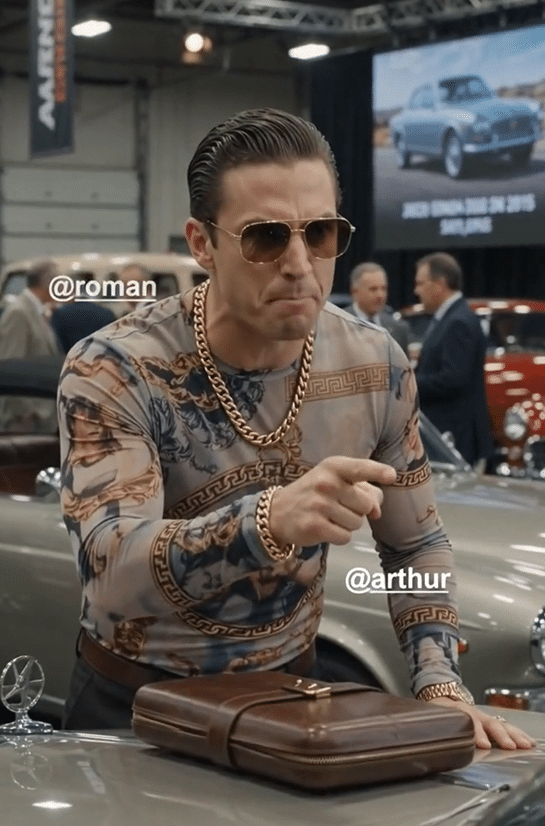
At thirty years old, Roman was the walking embodiment of a newfound, unearned fortune. He wore a skin-tight silk shirt unbuttoned halfway down his chest, revealing a heavy, ostentatious Cuban link gold chain. His hair was slicked back with far too much pomade, and despite being indoors, he wore dark, oversized designer sunglasses. He swaggered through the crowd like a conquering king, a freshly lit Cuban cigar dangling from his lips.
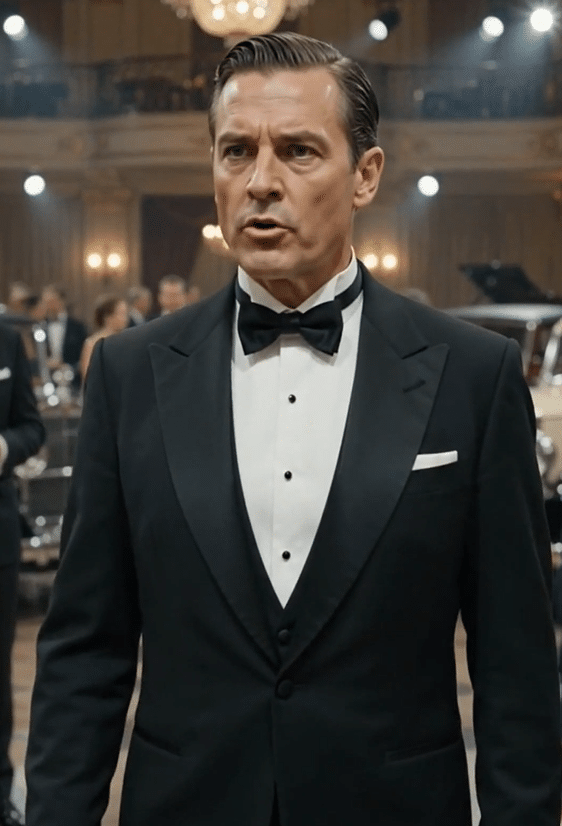
Standing quietly next to the Aston Martin was Arthur. At sixty-five, Arthur possessed the quiet, commanding presence of a man who had seen the world and conquered it several times over. He wore a well-fitted but noticeably worn tweed suit, his stark white hair neatly combed. He wasn’t looking at the crowd; his eyes were gently tracing the flawless curves of the classic car, a look of profound nostalgia on his face.
Roman shoved his way to the front of the pedestal, irritated by the old man standing in his way. Without a second thought, Roman slammed his heavy wooden cigar box right onto the immaculate hood of the priceless vehicle.
Arthur’s eyes darted to the box, his expression tightening for a fraction of a second, but he remained silent.
Roman leaned forward, jutting his chin out, and pointed a manicured finger directly into Arthur’s face, his eyes glaring with pure contempt behind his dark lenses.
“Don’t scratch the paint, grandpa. I’m buying this!” Roman barked, his words firing off in a rapid, aggressive cadence.
Arthur didn’t flinch. He didn’t raise his voice. He simply lifted his gaze, his pale blue eyes meeting Roman’s through the dark tint of the sunglasses. His posture remained perfectly relaxed.
“Money cannot buy class or respect, young man,” Arthur said, his voice a calm, even baritone that carried a weight far heavier than Roman’s shouting.
Roman scoffed loudly, crossing his arms over his chest. A smug, arrogant smirk spread across his face as he looked the older man up and down, taking in the frayed edges of the tweed jacket.
“I have ten million dollars,” Roman sneered, his voice dripping with absolute arrogance. “You have nothing.”
Arthur simply stood his ground, an immovable mountain of dignity. He didn’t offer a rebuttal. He didn’t need to.
CHAPTER 2: THE CRUSHING WEIGHT OF HUMILIATION
The sharp, echoing crack of a wooden gavel sliced through the rising tension in the room.
The auctioneer, a distinguished fifty-year-old man named Reginald, marched down from his podium. Dressed in a flawless bespoke tuxedo and wearing pristine white cotton gloves, Reginald possessed the sharp, meticulous demeanor of a man who brokered deals for the global elite. He bypassed the front row of bidders and walked straight toward the pedestal.
His eyes were locked onto Roman, his expression a mask of professional fury. Reginald didn’t just walk; he advanced with a dominating authority that made the surrounding billionaires step out of his way.
“Mr. Roman,” Reginald commanded, his voice projecting across the now-silent ballroom. “Your bids are no longer accepted.”
Roman jumped, visibly startled by the sudden intrusion. He threw his arms out wide, a mixture of outrage and genuine confusion twisting his features.
“What?” Roman yelled, his voice cracking slightly. “I am the richest guy in here!”
Reginald didn’t blink. He stepped directly into Roman’s personal space, forcing the younger man to tilt his head back slightly. The auctioneer’s face was inches from Roman’s, his eyes ice-cold.
“Arthur is the owner selling this entire collection,” Reginald stated, enunciating every single syllable with absolute, terrifying authority.
The silence that followed was deafening. The clinking of champagne glasses stopped. The murmuring ceased.
Roman froze. His breath hitched in his throat. The camera of his mind suddenly panned back, taking in the reality of his situation. He stared into Reginald’s eyes, desperately looking for a punchline to a joke that didn’t exist. Slowly, agonizingly, Roman turned his head to look back at Arthur.
Arthur hadn’t moved. He simply offered Roman a polite, razor-thin smile.
The blood drained completely from Roman’s face, leaving him a ghastly shade of pale. The pupils behind his designer sunglasses contracted to pinpricks. A cold, clammy sweat broke out across his forehead, ruining his perfectly styled hairline. The ten million dollars sitting in his bank account suddenly felt like a handful of loose change.
CHAPTER 3: A DESPERATE ATTEMPT AT REDEMPTION
The heavy silence in the ballroom was finally broken by a low, collective chuckle from the crowd. It wasn’t uproarious laughter, but something much worse: the quiet, polite mockery of high society. The billionaires and industry titans Roman had been desperately trying to impress were now looking at him like he was a stray dog that had wandered into a Michelin-star restaurant.
“Sir,” a voice rumbled from behind.
Roman spun around to find two massive security guards, dressed in sharp black suits, flanking him.
“It is time for you to leave,” the taller of the two guards said, gesturing toward the heavy oak doors at the back of the hall.
Panic seized Roman’s chest. “Wait, wait! Let me just talk to him,” he stammered, pulling out his platinum credit card. “I can pay double the reserve price! I can write a check right now! Just let me apologize to Arthur!”
Arthur, meanwhile, had already turned his back on Roman. He was quietly discussing the provenance of a 1955 Mercedes-Benz 300 SLR with an Italian prince.
“Now, sir. Before we have to make a scene,” the guard insisted, his hand hovering near Roman’s elbow.
Humiliation burned like acid in Roman’s veins. He grabbed his cigar box off the Aston Martin—leaving a faint smudge of ash on the pristine hood—and practically sprinted toward the exit, his expensive Italian leather shoes slipping slightly on the polished marble floor.
Outside in the cool Monterey evening, Roman practically threw himself into the back of his neon-green Lamborghini. He slammed his fists against the steering wheel, screaming in pure frustration. He had spent his entire life hustling, clawing his way up from the bottom, making his ten million in volatile cryptocurrency trades. He thought he had finally made it to the top of the mountain. Tonight proved he hadn’t even found the base camp.
He waited in the parking lot for three hours, hoping to catch Arthur on his way out. He wanted to apologize. He wanted to explain. But when Arthur finally emerged, he bypassed the line of waiting limousines and climbed into the passenger seat of an old, meticulously maintained Volvo station wagon driven by a casually dressed chauffeur. The Volvo drove right past Roman’s glaringly bright supercar without so much as a second glance.
CHAPTER 4: THE FALLOUT
Monday morning arrived with the subtlety of a sledgehammer.
Roman sat in his penthouse office overlooking the Miami skyline, nursing a massive hangover and staring at his frantic trading monitors. The story of the Monterey auction had not stayed in Monterey. High society is a small, tightly-knit village, and gossip travels faster than a private jet.
His phone began ringing at 7:00 AM, and it hadn’t stopped since.
“Roman, it’s Marcus,” his primary investor’s voice crackled through the speakerphone, sounding incredibly tense. “We’re pulling out of the real estate development deal.”
“What? Marcus, you can’t do that! The permits are approved! We’re breaking ground next week!” Roman pleaded, pacing across his expensive Persian rug.
“I can, and I am,” Marcus replied coldly. “Do you have any idea who Arthur Harrington is? He’s not just a guy who collects cars, Roman. He’s the majority shareholder in Vanguard Equity. He sits on the board of three international banks. Half the people you offended at that auction owe their fortunes to him. You didn’t just insult an old man; you spat in the face of the hand that feeds this entire industry. You’re radioactive.”
Click.
Roman dropped his phone onto the glass desk. Over the next forty-eight hours, the dominoes continued to fall. His lines of credit were frozen. His invitations to elite galas were mysteriously revoked. The country club where he had just paid a two-hundred-thousand-dollar initiation fee refunded his money with a polite letter stating his membership application was “under further review.”
His ten million dollars, mostly tied up in leveraged assets, was evaporating. In the world of the ultra-wealthy, cash was a tool, but reputation was the currency. And Roman was completely bankrupt.
He spent two weeks in a state of manic desperation. He sent a bottle of fifty-year-old Macallan scotch to Arthur’s corporate headquarters. It was returned unopened. He bought a full-page apology ad in the Financial Times. It became a laughingstock on Twitter.
Roman was losing his mind, his empire crumbling not because of a bad investment, but because of a few arrogant words spoken in the span of thirty seconds.
CHAPTER 5: THE INVITATION
A month had passed. Roman had fired half his staff to keep his overhead down. He had stopped wearing the silk shirts and the heavy gold chains. They felt suffocating now, like a clown costume he couldn’t take off.
He was sitting in his darkened office, drinking cheap coffee, when his assistant cautiously pushed the door open.
“Roman? This just arrived by private courier,” she said, handing him a thick, cream-colored envelope.
Roman took it with a sigh. The paper was heavy, made of high-quality cotton stock. There was no return address, only a wax seal stamped with a simple, elegant ‘H’.
With trembling fingers, he broke the seal and pulled out a single card. The handwriting was flowing and distinctly old-fashioned.
Mr. Roman, If you are finished throwing tantrums in the financial papers, I find myself in need of some youthful perspective on a new project. Join me for tea this Sunday at three o’clock. – Arthur Harrington.
Below the signature was an address in the remote, rolling hills of upstate New York.
Roman stared at the card until the letters blurred. It wasn’t a lawsuit. It wasn’t a cease-and-desist. It was an invitation. A lifeline.
He didn’t sleep for the next three days. He obsessed over what to wear. He finally settled on a simple, well-tailored navy suit, a white shirt, and a modest tie. No sunglasses. No jewelry. He left the Lamborghini in the garage and rented a black, understated sedan for the drive north.
He drove for hours, leaving the concrete jungle behind as the scenery shifted to dense forests and winding country roads. He was terrified. He was driving straight into the lion’s den, and he had no idea if he was going there to be saved, or to be finally, completely devoured.
CHAPTER 6: THE TRUE MEASURE OF WEALTH
The Harrington Estate was not what Roman expected.
There were no massive iron gates covered in gold leaf. There were no armed guards or imposing statues. It was a sprawling, historic stone manor that looked like it had grown naturally out of the landscape over centuries. The driveway was crushed gravel, winding through ancient oak trees and immaculately manicured gardens.
A quiet butler met Roman at the door and guided him through the house. The interior was breathtaking, not because it was flashy, but because every single item held history. Original Renaissance paintings hung on the walls; antique first-edition books lined the library. It made Roman’s Miami penthouse look like a cheap plastic toy.
He was led out to a massive glass conservatory filled with exotic orchids. There, standing by a wooden potting table and wearing a worn canvas apron over a simple button-down shirt, was Arthur. He was carefully pruning a delicate purple flower.
“Ah, Roman. Punctual. I appreciate that,” Arthur said without looking up.
“Mr. Harrington,” Roman said, his voice tight. “I… I don’t know how to begin to apologize for my behavior at the auction. It was inexcusable.”
Arthur set down his pruning shears and finally turned to look at the younger man. He wiped his dirt-stained hands on a towel.
“Yes, it was,” Arthur agreed pleasantly. He motioned to a small cast-iron table set with a silver tea service. “Sit down.”
Roman sat, feeling entirely out of his depth.
“You’re a very aggressive young man, Roman,” Arthur said as he poured the tea. “You made ten million dollars in three years. That requires intelligence, drive, and a fair amount of ruthlessness. But you are suffering from the disease of new money.”
“Disease?” Roman asked softly.
“Insecurity,” Arthur replied, taking a sip of his tea. “You yell because you are afraid no one will hear you. You wear heavy gold because you are terrified people won’t believe you are wealthy. You insulted me because I didn’t look like your definition of success, and it offended your fragile ego.”
Roman swallowed hard. Every word felt like a physical blow, mostly because it was the absolute truth.
“I brought you here to show you something,” Arthur continued, gesturing around the vast estate. “This house has been in my family for four generations. The wealth I control employs over fifty thousand people worldwide. We fund hospitals, universities, and clean water projects in developing nations. That is what money is for, Roman. It is a tool to build a legacy, not a weapon to bludgeon people with.”
Arthur leaned forward, his piercing blue eyes locking onto Roman.
“You thought you were the richest man in that auction room because you had cash in the bank. But true wealth is quiet. It doesn’t need to scream. It simply is.”
CHAPTER 7: A LESSON LEARNED
The drive back to the city felt remarkably different. The crushing anxiety that had plagued Roman for a month was gone, replaced by a profound, sobering clarity.
Arthur hadn’t offered him a business deal. He hadn’t bailed out Roman’s failing projects. He had simply given him an hour of his time and a brutal, honest mirror to look into. He had shown Roman the vast chasm between being rich and being wealthy.
When Roman returned to Miami, he didn’t go to his office. He went to his penthouse and began packing boxes.
Over the next six months, the transformation was absolute. Roman sold the neon Lamborghini. He liquidated the massive penthouse and bought a modest, tasteful townhouse. He pawned the heavy gold chains and the absurdly expensive designer watches.
He used the remaining capital to start a new firm. But this time, it wasn’t about volatile, high-risk trades designed to make a quick buck. He started a micro-lending firm focused on providing capital to small, family-owned businesses that traditional banks ignored. He operated quietly. He didn’t boast on social media. He didn’t wear silk shirts.
Two years later, Roman was standing in the back of a small community center in Detroit, watching a local baker cut the ribbon on her newly expanded storefront—a project his firm had funded. The community was cheering. The baker was crying tears of joy.
Roman stood in the back, wearing a simple, tailored grey suit, his arms crossed, a quiet smile on his face.
His phone buzzed in his pocket. He pulled it out and saw an email from an unknown address.
I see you have stopped shouting. The silence suits you. Keep up the good work. – A.H.
Roman smiled, slipping the phone back into his pocket. He didn’t have ten million dollars in his bank account anymore. But as he looked around at the real, tangible impact he had made in the community, he finally understood what Arthur had meant. For the first time in his life, Roman actually felt rich.