Major Derek Mason noticed the older woman the moment she entered the base cafeteria.
She did not look important.
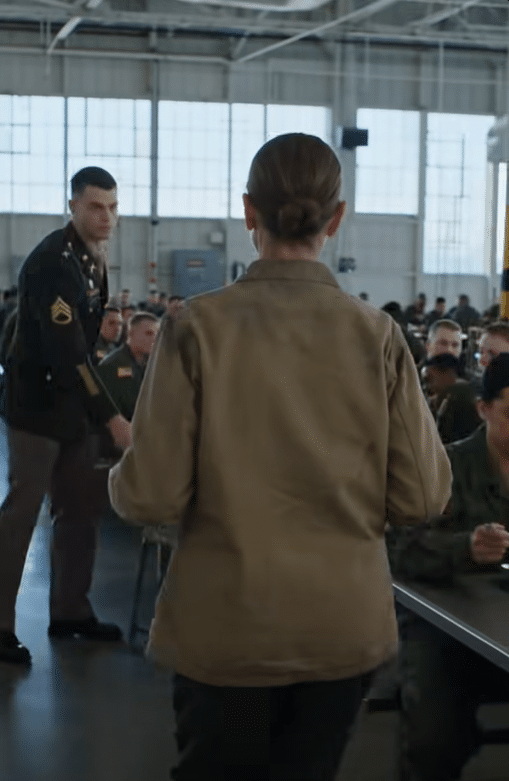
Her faded olive jacket had seen better years. Her dark trousers were plain, her shoes were practical, and her brown hair was pulled into a simple low bun. She carried a metal lunch tray with both hands and moved carefully between tables crowded with soldiers.
Mason watched her search for an empty seat.
Then he saw the vacant chair beside him.
Before the woman could reach it, Mason hooked one hand around the chair and dragged it away with a loud scrape.
Several soldiers looked up.
Mason leaned back with a faint smile.
“This table is for people with rank.”
The woman stopped.
She looked at the empty space where the chair had been, then at Mason.
There was no anger in her face.
“I only need somewhere to sit.”
Mason pointed toward the far end of the cafeteria.
“Sit by the trash cans they suit you.”
A few soldiers laughed nervously.
Sergeant Emily Hayes, sitting across from Mason, glanced at the woman and joined in.
“Better sit down and stop turning this cafeteria into a nursing home.”
This time the laughter was louder.
Not everyone participated.
A young lieutenant at the next table lowered his fork and stared at Mason. Two enlisted soldiers exchanged uncomfortable looks.
The older woman said nothing.
She simply turned around.
There was a small table near the wall with one empty chair. She walked toward it, placed her tray down, and sat.
Mason watched her go.
“Some people retire and still pretend they matter.”
The woman paused for half a second.
Then she picked up her fork and began eating.
Emily’s smile slowly disappeared.
“Something about her doesn’t feel ordinary.”
Mason laughed.
“You’re getting nervous over somebody’s grandmother?”
Emily did not answer.
She had spent enough years around senior officers to recognize a certain kind of stillness.
The woman was not embarrassed.
She was observing.
And that was different.
A few minutes later, the main doors of the cafeteria opened.
The conversations nearest the entrance stopped first.
Then the silence spread across the room.
Lieutenant Colonel Robert Hale, the base commander, stepped inside.
Two senior officers followed him.
Mason immediately straightened.
Hale rarely ate in the enlisted cafeteria. When he entered unexpectedly, there was usually a reason.
A soldier whispered, “Why is the base commander here?”
Mason glanced down at his uniform, instinctively checking his ribbons.
For one foolish second, he wondered whether Hale had come to congratulate him.
Mason had been expecting good news.
His promotion packet was under review. He had cultivated the right relationships, volunteered for visible assignments, and made sure senior leadership noticed every success connected to his name.
He rose from his chair.
But Hale walked past him.
Mason’s smile faded.
The commander continued down the center aisle.
One of the soldiers behind Mason whispered, “They’re walking straightly toward her.”
Mason turned.
Hale stopped in front of the older woman’s table.
The woman calmly placed her fork beside her tray.
The base commander stood at attention.
“Ma’am we’ve been expecting you.”
The cafeteria went completely silent.
The woman rose.
Her shoulders straightened.
The harmless-looking retiree who had entered the room minutes earlier seemed to disappear.
In her place stood someone who understood command so naturally that even Hale suddenly looked like a subordinate.
She saluted.
Hale returned it.
Mason felt the blood drain from his face.
The woman slowly turned toward him.
“Major Mason.”
His throat tightened.
“Yes, ma’am?”
“Stay exactly where you are.”
Nobody laughed now.
The woman stepped away from her table.
“My name is Margaret Cole.”
Mason recognized the name.
His stomach dropped.
Lieutenant General Margaret Cole had retired from active duty eight months earlier after more than thirty years of service.
She had commanded thousands of troops.
She had overseen operations on three continents.
More importantly for Mason, she had recently accepted a civilian appointment to chair an independent review board examining command culture, leadership standards, and promotion practices across several installations.
Including this one.
Mason stared at her.
“General Cole, I didn’t recognize you.”
Margaret’s expression did not change.
“That seems to be the point, Major.”
He swallowed.
“I apologize if there was a misunderstanding.”
“There wasn’t.”
The simplicity of the answer landed harder than shouting would have.
Margaret looked around the cafeteria.
“When you believed I had no authority, you decided I deserved no respect.”
Mason opened his mouth.
She raised one hand.
He stopped.
“You did not ask who I was. You did not ask why I was here. You saw an older woman carrying a tray, decided she could do nothing for your career, and treated her accordingly.”
Mason glanced toward Hale.
The commander gave him no help.
Margaret continued.
“I can survive being told to sit near a trash can. What concerns me is how you treat the people who cannot answer back.”
Nobody moved.
Emily stared down at the table.
Margaret noticed.
“You joined him.”
Emily stood quickly.
“Ma’am, I apologize.”
Margaret studied her.
“Why?”
Emily looked confused.
“Because what I said was disrespectful.”
“No. Why did you say it?”
Emily hesitated.
Finally she answered quietly.
“Because everyone else was laughing.”
Margaret nodded.
“That answer worries me more.”
Emily’s face turned red.
Margaret looked across the cafeteria.
“How many people here have seen Major Mason speak this way to someone before?”
For several seconds, nobody moved.
Then one hand rose.
A young sergeant near the window.
Another followed.
Then another.
Within moments, almost a dozen soldiers had raised their hands.
Mason stared at them.
“This is ridiculous.”
That was his second mistake.
Margaret turned back to him.
“Is it?”
“They’re misunderstanding leadership. Sometimes discipline requires—”
“Humiliation?”
Mason stopped.
Margaret’s voice remained calm.
“Does leadership require mocking family leave?”
Mason’s eyes changed.
“Does it require threatening evaluations when someone questions a scheduling decision?”
Emily slowly looked up.
Margaret continued.
“Does it require pressuring personnel to ignore safety concerns because an exercise needs to remain on schedule?”
Now Mason understood.
This was not a surprise visit.
She already knew.
Margaret had spent the previous two days moving quietly around the installation without ceremonial escorts.
She had spoken with mechanics, cooks, junior officers, military spouses, civilian employees, and enlisted personnel.
Most had been respectful.
Some had been cautious.
Several had mentioned one name repeatedly.
Derek Mason.
A captain had described how Mason mocked him for requesting leave when his daughter needed surgery.
A warrant officer had reported being threatened with a poor evaluation after refusing an unsafe training shortcut.
A young sergeant had quietly admitted that she avoided challenging Mason because he had influence over her next assignment.
Margaret had heard enough rumors.
But she wanted to see him when he believed nobody important was watching.
Now she had.
Mason’s confidence began collapsing.
“Ma’am, people complain about demanding leaders all the time.”
Margaret nodded.
“They do.”
For a moment, Mason looked relieved.
Then she added, “That’s why I separate complaints about high standards from complaints about abuse of authority.”
She looked at Hale.
“Commander.”
“Yes, ma’am.”
“Major Mason will have no supervisory authority while this review continues.”
Mason stepped forward.
“General, please. My promotion board—”
Margaret looked at him.
He stopped speaking.
“That is what you’re worried about?”
Mason said nothing.
Margaret walked closer.
“Not the people you embarrassed. Not the officers you pressured. Not the soldiers who were afraid that disagreeing with you could damage their careers.”
She paused.
“Your promotion.”
Mason’s jaw tightened.
Margaret turned toward the room.
“This is why rank can never be confused with character.”
The young lieutenant who had refused to laugh earlier watched her carefully.
Margaret noticed him.
“What is your name?”
“Lieutenant Daniel Brooks, ma’am.”
“You didn’t laugh.”
“No, ma’am.”
“Why?”
Brooks hesitated.
“Because it wasn’t funny.”
Margaret gave the smallest nod.
That answer seemed to satisfy her.
She faced the room again.
“There will always be moments when doing the right thing is socially inconvenient. Sometimes everyone around you will be laughing. Sometimes the person behaving badly will outrank you. Sometimes speaking up will cost you something.”
She glanced toward Emily.
“Character is what you do during those moments.”
Emily’s eyes filled with shame.
Margaret returned to her table and picked up the tray.
Mason seemed almost desperate now.
“General Cole, I made a mistake.”
Margaret stopped.
“Yes.”
“I can fix it.”
“That depends on what you think needs fixing.”
Mason looked around the cafeteria.
For the first time, he saw the faces of the soldiers who had raised their hands.
People he had commanded.
People who had smiled when he entered rooms.
People he had assumed respected him.
Now he realized that some of those smiles had been fear.
He lowered his eyes.
“I think I have some listening to do.”
Margaret studied him for several seconds.
“That’s a beginning.”
The investigation lasted six weeks.
Mason’s promotion recommendation was withdrawn.
He was removed from his leadership position and transferred to an administrative assignment while formal findings were reviewed.
Some expected Margaret to destroy his career immediately.
She did not.
She believed accountability was not revenge.
Mason was required to complete leadership remediation, respond formally to the complaints against him, and face the people whose careers he had tried to influence.
Emily received a written reprimand but remained in her position.
Margaret personally told her why.
“You followed the strongest personality in the room instead of the strongest principle. Make sure you never do that again.”
Emily never forgot it.
Months later, Margaret returned to the same cafeteria.
This time there were no senior officers beside her.
She wore the same faded olive jacket.
As she entered, Lieutenant Brooks noticed her first.
He stood and smiled.
“Ma’am.”
Margaret glanced at his table.
There were several young soldiers sitting with him.
One empty chair remained.
Brooks pulled it out.
“You’re welcome here.”
Margaret smiled.
“Is this table for people with rank?”
Brooks laughed.
“No, ma’am.”
He gestured toward the chair.
“This table is for anyone who needs somewhere to sit.”
Margaret placed her tray down and joined them.
Across the cafeteria, soldiers talked, ate, argued about football, and complained about tomorrow’s training schedule.
Nobody knew that one small moment months earlier had changed the culture of the installation.
It had begun with an empty chair.
With an older woman someone believed did not matter.
And with a major who learned too late that the true test of leadership is not how you treat people above you.
It is how you treat the people you believe can do nothing for you.