CHAPTER ONE: THE SPILL
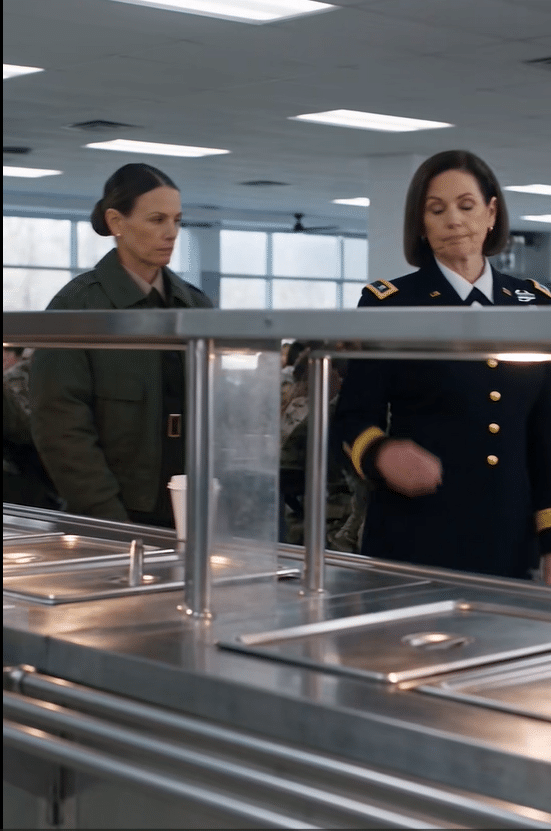
The sound of metal cracking against the tiled floor echoed across the mess hall like a rifle shot. It was noon at Fort Liberty, and the massive dining facility was a sea of restrained military activity. Nearly a hundred service members and decorated officers crowded the bright room, moving with the practiced efficiency of army personnel. Fluorescent lights reflected sharply off the stainless steel serving counters, illuminating the pristine white tiled floor. The air was thick with the low hum of overlapping conversations, the clatter of silverware, and the rich, roasted aroma of institutional coffee pouring into ceramic mugs.
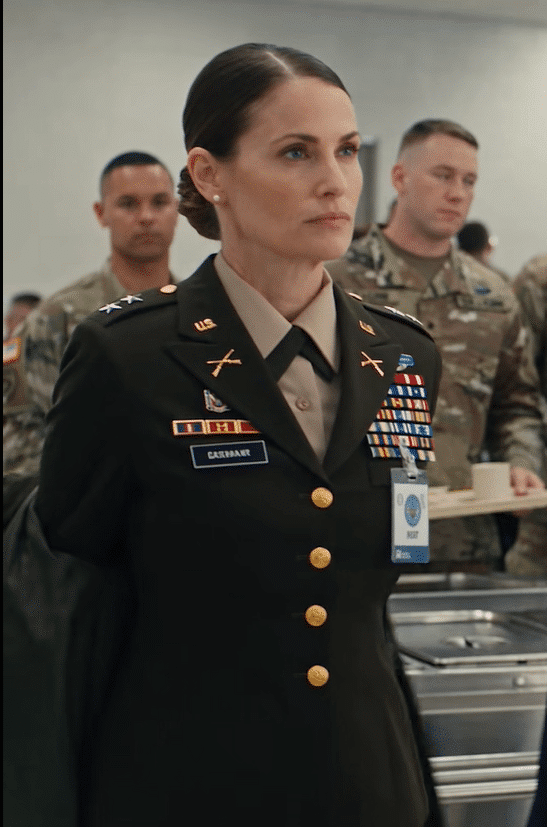
Sophia Carter stood near the edge of the busy counter, holding a freshly poured cup of black coffee. At fifty-eight, she possessed a slim, rigid build and an aura of quiet intelligence. Her dark-brown hair was pulled back into a meticulously tight, low bun. She wore a dark-green, civilian-style military jacket that completely obscured the formal service clothing beneath it, save for the edges of a crisp collar. A visitor identification badge dangled from a lanyard around her neck, resting against the jacket’s lapel. Simple pearl earrings caught the harsh overhead light. Her expression was perfectly calm, masking a deep, immovable authority that she rarely felt the need to display.
Major Evelyn Davis, a highly decorated officer with a straight dark-brown bob, marched through the serving lines as if she owned the very concrete beneath the facility. She wore a pristine black U.S. Army dress uniform, adorned with multiple ribbons, gold trim, and the unmistakable posture of profound arrogance. She was forty-five, fiercely ambitious, and entirely uncompromising. She walked with a proud, condescending demeanor, expecting the sea of junior officers and enlisted personnel to part for her.
As Davis approached the condiment station, she found Sophia standing in her immediate path. Instead of offering a polite request to pass, the Major’s eyes narrowed with instant irritation. Taking in Sophia’s civilian-style outer jacket and the visitor badge, Davis assumed she was dealing with a civilian contractor or a low-level base employee.
Davis stepped forward, gesturing dismissively with a gloved hand, and barked, “Move over to the other tables. You’re blocking the line.”
Sophia did not flinch, but as she shifted her weight to accommodate the sudden intrusion, Davis brushed harshly past her shoulder. The physical contact jolted Sophia’s arm.
Clatter. Splash.
The ceramic cup tilted, spilling a dark, steaming puddle of coffee directly onto the pristine white tiles, splashing against the toes of Davis’s polished black dress shoes. The immediate conversations in their vicinity dipped into an uncomfortable, sudden silence.
Davis looked down at the dark liquid pooling near her boots. Her lips curled into a sneer of pure disgust. She snapped her gaze up to Sophia’s unblinking eyes and said sharply, “Clean it up.”
Sophia did not bend down. She did not reach for a napkin. Instead, she slowly raised her eyes and studied the woman before her. It was a look of clinical observation, devoid of fear or subservience.
A nearby senior officer, a Captain who had witnessed the entire exchange, took a step forward, his brow furrowed in disbelief. “Excuse me, Major,” the Captain intervened cautiously. “Do you treat every worker like this?”
Silverware sounds began disappearing from the room as heads turned. The ambient noise of the bustling cafeteria evaporated, replaced by a heavy, suffocating tension.
Davis crossed her arms, her uniform creaking slightly, and answered without a shred of embarrassment. “People below us should know their place.”
A low, palpable tension settled over the immediate area, heavy and suffocating. Sophia gave the smallest, most incredulous smile. It was a micro-expression of pure, crystallized pity. She stepped gracefully around the spilled coffee, never breaking eye contact with the arrogant Major, and said in a smooth, quiet voice, “That was an interesting choice.”
For the first time, Davis’s confident expression flickered. A shadow of doubt crossed her eyes, though her chin remained tilted upward in defiance.
CHAPTER TWO: THE REVELATION
Without rushing, Sophia reached for the top button of her dark-green outer jacket. The entire mess hall seemed to hold its collective breath. She unfastened it, then the next, her movements fluid and deliberate. She shrugged the heavy civilian-style fabric off her shoulders and draped it calmly over the back of a nearby steel chair.
The removal of the jacket revealed the immaculate, formal military insignia beneath. The silver eagles of a full Colonel gleamed mercilessly under the fluorescent lights. But it was not just the rank that caused the air to be sucked from the room; it was the chest of her uniform. Row upon row of ribbons—decorations for valor, service, and combat command—spoke of a career built in the trenches of true military hardship.
Nearby soldiers instinctively straightened their postures. At a table to the left, a young corporal froze, a plastic tray paused halfway to the tabletop. Whispers spread through the room like a sudden gust of wind through dry leaves, carrying the realization of what was unfolding.
From the distant doorway, Colonel Thomas Miller, a man of forty-eight with a short gray-blond military haircut and a decorated dark-green Army service uniform, had been observing the room. He saw Sophia, froze mid-step, and his eyes widened in absolute shock. He immediately squared his shoulders, abandoning his own lunch plans, and walked toward her with urgent, terrified respect.
His polished boots echoed across the tile.
Click. Click. Click.
Each step grew louder as the room fell almost completely silent. The ambient sounds of the dining hall—the pouring coffee, the hum of the refrigerators—were suddenly deafening in the absence of human conversation.
Major Davis slowly turned toward the approaching Colonel. The arrogance in her eyes was rapidly melting, replaced by a cold, dawning confusion.
Colonel Miller stopped exactly three feet away from Sophia. He snapped to rigid attention, saluted with razor-sharp precision, looked directly into her eyes, and said in stunned recognition, “Colonel…”
Sophia returned the salute with the effortless grace of someone who had done it ten thousand times before. She maintained her composed expression while Major Davis, standing completely frozen beside her, realized with horrific clarity that she had just ordered one of the most senior combat commanders on Fort Liberty to mop up a coffee spill.
CHAPTER THREE: THE CHAIN OF COMMAND
The silence in the mess hall was absolute. It was the kind of silence that precedes an artillery strike. Major Davis’s face had drained of all color, her complexion shifting from flushed indignation to a sickly, pale gray. Her mouth opened slightly, but no words came out. The gold trim on her black dress uniform suddenly looked utterly ridiculous, like a costume rather than a symbol of authority.
“Colonel Miller,” Sophia said, her voice carrying effortlessly across the quiet room. It was not a shout; it was a calm, resonant tone that commanded absolute obedience. “It is good to see you again. I apologize for the disruption. I was merely attempting to get a cup of coffee before our scheduled briefing.”
“Ma’am, the disruption is entirely mine,” Miller replied, his eyes darting briefly to the spilled coffee, then to Major Davis, whom he was glaring at with a mixture of disbelief and fury. “I was not informed you had arrived on base early, Colonel Carter.”
At the sound of the name Carter, a sharp gasp escaped Major Davis’s lips. Colonel Sophia Carter was a legend in the command structure, recently appointed as the new Inspector General for the entire garrison. She was brought in specifically to audit the command climate and root out toxic leadership.
“I prefer to arrive unannounced, Thomas,” Sophia said, her eyes never leaving Davis. “It provides a much clearer picture of the daily operations. It allows me to see how our personnel interact when they believe no one of consequence is watching.”
Davis swallowed hard, the muscles in her throat working visibly. “Colonel Carter… Ma’am, I… I was not aware. I did not recognize you in the civilian jacket. I thought—”
“You thought I was a civilian contractor. Or a cafeteria worker,” Sophia interrupted, her voice dropping a fraction of an octave, freezing the air around them. “And because you believed I was below you in the hierarchy of this installation, you calculated that you had the right to treat me with profound disrespect.”
“No, Ma’am, I—”
“Do not interrupt me, Major,” Sophia said. The words were softly spoken, but they struck like physical blows. “Your exact words were, ‘People below us should know their place.’ I find that philosophy deeply troubling for a commissioned officer in the United States Army.”
CHAPTER FOUR: THE AFTERMATH
The enlisted personnel watching the exchange remained entirely motionless, their eyes wide, soaking in every second of the confrontation. The cafeteria staff behind the stainless counters had stopped serving, their ladles hovering over steam trays.
Sophia stepped closer to the puddle of spilled coffee. She looked down at it, then back up to Davis. “Leadership, Major Davis, is not a license to demean those who support you. It is a burden of responsibility. The people who cook our food, clean our facilities, and maintain our supply lines are the lifeblood of this army. Without them, your ribbons and your dress uniform mean absolutely nothing.”
Davis stood rigidly at attention, her eyes locked dead ahead, though a slight tremor had taken hold of her jaw. “Yes, Ma’am.”
“Since you are so concerned with people knowing their place,” Sophia continued, gesturing toward the nearest cleaning station, “I suggest you acquaint yourself with the place of those who clean up our messes. You will secure a mop or a roll of paper towels, and you will clean this floor. Personally. Right now.”
Colonel Miller blinked but remained perfectly silent. It was a humiliating order for a field-grade officer, especially in full dress uniform and in front of a hundred subordinates, but it was a lawful one—and entirely justified.
Davis hesitated for a fraction of a second, her pride violently warring with her military discipline. But one look into Sophia Carter’s uncompromising eyes extinguished any thought of rebellion. “Yes, Ma’am,” Davis whispered.
She turned sharply and walked toward the staff counter. A cafeteria worker wordlessly handed her a roll of heavy-duty paper towels. Davis returned to the spill, knelt on the white tiled floor, and began wiping up the coffee. In her nervous haste, she bumped her plastic dining tray, sending it clattering to the floor with a loud, metallic crack that made her flinch.
Sophia watched her for a long moment, ensuring the task was completed properly. When the floor was dry, Davis stood up, her uniform slightly wrinkled, clutching the soaked, brown paper towels in her fists.
“Dispose of that,” Sophia ordered quietly. “Then report to my office in building four at fourteen-hundred hours. We are going to have a very long conversation about your future at Fort Liberty.”
CHAPTER FIVE: THE ASSESSMENT
By 1330 hours, Sophia was seated behind the heavy oak desk in her new office. The walls were still relatively bare, save for a few framed citations and a map of the installation. The quiet hum of the air conditioning was a stark contrast to the chaotic echoes of the dining facility.
Colonel Miller sat in a leather chair across from her, a thick manila folder resting on his lap. He looked highly uncomfortable, but his respect for Sophia was palpable. They had served together in Afghanistan nearly a decade ago, and he knew better than anyone that Sophia Carter did not play political games.
“I pulled Major Davis’s personnel file as you requested, Colonel,” Miller said, opening the folder. “On paper, she is an exceptional officer. Top of her class at West Point. Two tours in Iraq. Highly commended for logistical efficiency. She is currently in line for a promotion to Lieutenant Colonel next spring.”
“Efficiency does not equal effectiveness, Thomas,” Sophia replied, leaning back in her chair and steepling her fingers. “Read me her retention rates. Read me the transfer requests from her immediate subordinates over the past twenty-four months.”
Miller sighed, flipping to the second section of the file. He already knew the numbers were damning. “In the last two years, seventy-four percent of the enlisted personnel assigned to her direct command have requested transfers. Fourteen junior officers have filed formal complaints regarding a hostile work environment, though all were dismissed by the previous Garrison Commander for lack of actionable evidence.”
“Because the previous commander only cared about the spreadsheet, not the soldiers,” Sophia noted grimly. “She gets results by grinding her people into dust. She manages through fear, intimidation, and public humiliation. What happened in the mess hall today wasn’t a mistake, Thomas. It was a symptom of a much deeper disease.”
“She is highly connected, Sophia,” Miller warned gently. “Her father was a General. She has allies at the Pentagon. Reprimanding her based on a spilled cup of coffee might invite significant blowback.”
“It isn’t about the coffee,” Sophia said, her eyes narrowing. “It is about the fundamental lack of character. When someone tells you who they are, you believe them. She told an entire room of soldiers that the working class is beneath her. I am the Inspector General. My job is to protect this installation from toxic leadership, regardless of who her father is. Send her in.”
CHAPTER SIX: THE CONFRONTATION
At precisely 1400 hours, a sharp knock echoed on the wooden door of the office.
“Enter,” Sophia commanded.
Major Evelyn Davis marched into the room, coming to a rigid halt three paces from the desk and snapping a textbook salute. “Major Davis reporting as ordered, Ma’am.”
“At ease, Major. Take a seat,” Sophia said, motioning to the chair beside Colonel Miller.
Davis sat down, her posture ramrod straight. She had spent the last two hours trying to compose herself, trying to build a defensive wall of military protocol around her catastrophic error in judgment. She looked at Sophia, her expression a fragile mix of deference and lingering entitlement.
“Colonel Carter, I want to formally apologize for the misunderstanding in the dining facility,” Davis began, her voice rehearsed and tight. “If I had known you were a senior officer, I would have never spoken to you in that manner.”
Sophia stared at her, letting the silence stretch until it became suffocating. She did not blink. She just watched Davis squirm under the weight of her gaze.
“That is exactly the core of the issue, Major,” Sophia finally said, leaning forward and resting her forearms on the desk. “Your apology misses the point entirely. You are apologizing because you disrespected a Colonel. You are completely unbothered by the fact that you intended to humiliate a subordinate. You thought I was a civilian worker. That is your defense?”
Davis swallowed hard. “Ma’am, military discipline requires a strict adherence to the chain of command. We must maintain authority.”
“Authority is given by rank; respect is earned by character,” Sophia fired back, her voice sharp as broken glass. “I have read your file, Evelyn. You have excellent logistical numbers. But you leave a trail of broken, demoralized soldiers in your wake. You use your rank as a weapon to cover your own insecurities. You demand compliance, but you inspire absolute hatred.”
“Ma’am, my record speaks for itself,” Davis said, a hint of her former arrogance flaring up. “My unit is the most efficient on this base.”
“Your unit is terrified of you,” Sophia corrected coldly. “And an army governed by fear will break the moment it faces true adversity. When bullets start flying, soldiers don’t fight for a commander who treats them like dirt. They fight for leaders who they know would die for them.”
CHAPTER SEVEN: THE CONSEQUENCE
Sophia opened the manila folder on her desk and picked up a pen. The scratching of the ink against the paper sounded excessively loud in the quiet room.
“I am initiating a formal administrative review of your command climate, Major,” Sophia announced without looking up. “Effective immediately, you are relieved of your duties as the commanding officer of the 4th Logistics Battalion. You are being reassigned to a desk in the records annex pending the outcome of the investigation.”
Davis gripped the armrests of her chair, her knuckles turning white. Her career, her impending promotion, her carefully curated reputation—all of it was disintegrating before her eyes. “Colonel, with all due respect, you cannot relieve me of command over a single incident in a cafeteria!”
“I am not,” Sophia replied, finally looking up, her eyes utterly devoid of sympathy. “I am relieving you because fourteen of your junior officers have filed complaints of toxic leadership, and seventy-four percent of your enlisted troops want to flee your command. The incident in the cafeteria simply proved to me that they were telling the truth. You are dismissed, Major.”
Davis sat frozen for a moment, the reality of the situation crushing her under its immense weight. She had played the game of military politics perfectly, but she had forgotten the most basic rule of military service: honor. Slowly, she stood up, rendered a weak, trembling salute, and walked out of the office.
One week later, Colonel Sophia Carter walked back into the Fort Liberty dining facility. She wore her full service uniform, her silver eagles shining, her ribbons displayed proudly. She held a tray and moved through the serving line.
The atmosphere in the room was entirely different. The stifling, tense energy that used to accompany the presence of senior officers was gone. Soldiers were laughing, eating, and conversing freely. When Sophia reached the checkout counter, the cafeteria worker—the same one who had watched the incident with Major Davis—looked up and gave her a small, respectful nod.
Sophia nodded back, paid for her meal, and went to sit at a table crowded with junior enlisted personnel. She did not demand their seats. She did not ask them to move. She simply pulled up a chair, sat down, and ate her lunch. The message was clear, echoing through every corridor of Fort Liberty: a new era had begun, and the standard was respect.