CHAPTER ONE: THE SHATTERED SILENCE
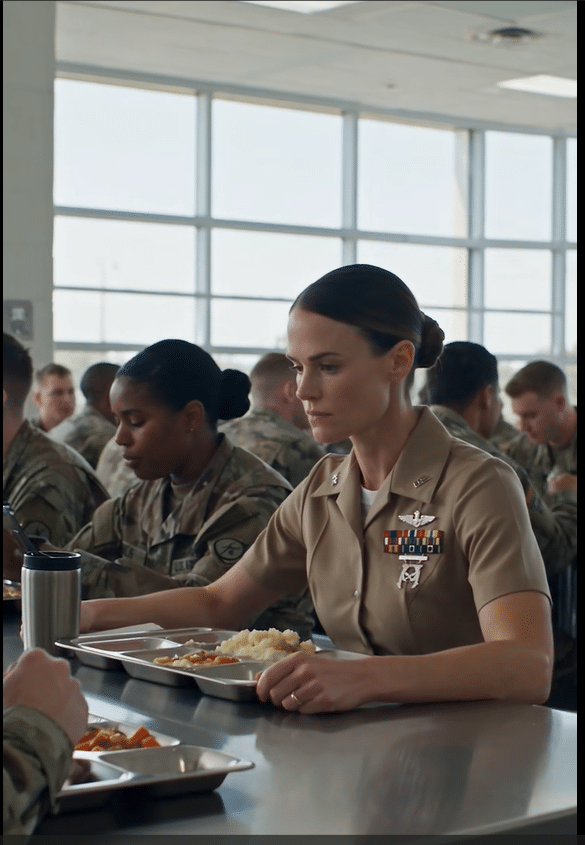
The bright fluorescent lights of the Fort Liberty dining facility reflected harshly off the polished stainless steel serving counters. The air was thick with the scent of roasted coffee, institutional bleach, and the collective hum of nearly a hundred service members. It was a space defined by restrained military activity—movements were precise, conversations were kept at a professional murmur, and the hierarchy of rank dictated the very flow of foot traffic across the white tiled floor.
Sophia Carter stood near the edge of the busy condiment station, a fresh cup of dark roast coffee in her hand. At fifty-eight, she possessed a slim, austere build and an expression of calm intelligence that concealed a lifetime of hard-won authority. Her dark-brown hair was pulled back into a severe, tight low bun, and she wore simple pearl earrings that caught the overhead light. Over her formal service clothing, she wore a dark-green, civilian-style military jacket, with a generic visitor identification badge clipped to the lapel. She looked entirely unassuming, blending seamlessly into the background of the bustling mess hall.
Major Eleanor Vance moved through the cafeteria like a battleship cutting through calm waters. She was forty-five, with a razor-straight dark-brown bob and a highly decorated black U.S. Army dress uniform. Ribbons stacked heavily on her chest, bordered by gleaming gold trim. Vance possessed a proud, condescending demeanor, her chin tilted upward as if the very air breathed by the enlisted personnel was offensive to her.
As Vance approached the coffee station, she noticed Sophia standing near the creamers. Assuming Sophia was a civilian contractor or a low-level base employee, Vance did not offer a polite request to pass. Instead, she stepped directly into Sophia’s personal space, gesturing dismissively with a gloved hand, ordering her toward a distant, empty table.
The physical brush of Vance’s arm against Sophia’s shoulder was sudden. The ceramic cup in Sophia’s hand tilted.
A sharp clatter rang out as the cup struck the edge of the counter, followed immediately by the splash of dark, scalding liquid across the pristine white tiles. The coffee splattered directly onto the toes of Vance’s polished dress shoes.
Nearby conversations briefly dipped. The ambient noise of the room hesitated.
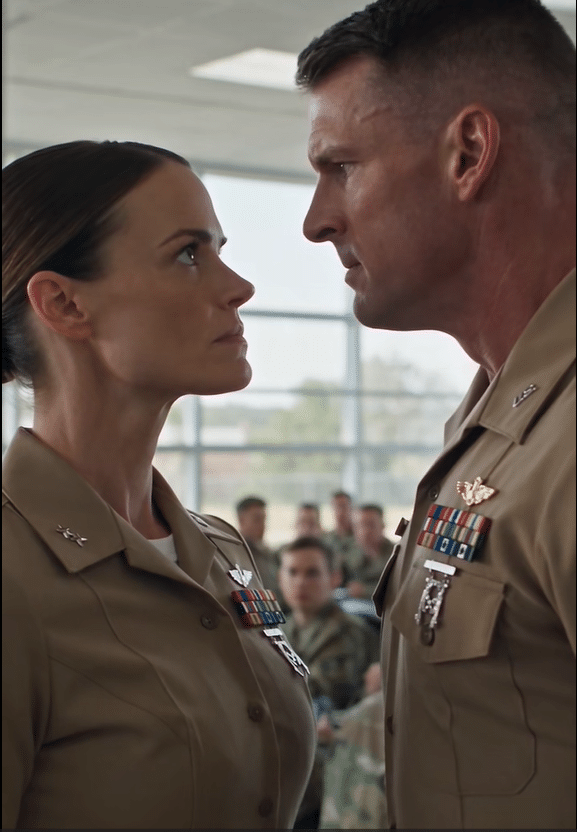
Vance looked down at the mess, her upper lip curling into a sneer of absolute disgust. She snapped her gaze up to Sophia’s unblinking eyes and said sharply, “Clean it up.”
Sophia did not bend down. She did not flinch, nor did she reach for a napkin. She slowly raised her eyes and studied the woman with the clinical detachment of a scientist observing a volatile chemical reaction.
A nearby senior officer, a Captain who had witnessed the unprovoked hostility, stepped forward. His brow furrowed in genuine disbelief. “Do you treat every worker like this?” he asked.
The clinking of silverware began disappearing from the room. Heads turned. The tension escalated rapidly, thick and suffocating.
Vance crossed her arms, the gold trim of her uniform flashing under the lights. She answered without a single shred of embarrassment. “People below us should know their place.”
A low, heavy silence settled over the immediate area. Sophia Carter gave the smallest, most incredulous smile. It was a micro-expression of pure, crystallized pity. She took a deliberate step around the spilled coffee, never breaking eye contact with the arrogant Major, and said in a quiet, resonant voice, “That was an interesting choice.”
For the first time, Vance’s confident expression flickered. A shadow of uncertainty crossed her eyes.
Sophia calmly reached for the zipper of her outer jacket. With fluid, measured movements, she removed the dark-green civilian coat, letting it drape over her arm. The removal revealed the immaculate, formal military insignia beneath. The silver eagles of a full Colonel, coupled with a chest full of combat decorations that dwarfed Vance’s own, gleamed mercilessly under the fluorescent lights.
Nearby soldiers instinctively straightened. One corporal’s tray paused halfway to a table, suspended in mid-air. Whispers spread through the room like a sudden gust of wind.
From the distant doorway, Colonel James Sterling—a man with a short gray-blond military haircut and a decorated dark-green Army service uniform—had been observing the room. He saw Sophia, froze mid-step, and his eyes widened in absolute shock. He immediately squared his shoulders and walked toward her with urgent, terrified respect.
His boots echoed across the tile. Click. Click. Click. Each step grew louder as the room fell almost completely silent.
Major Vance slowly turned toward the approaching Colonel, confusion rapidly replacing her arrogance. Sterling stopped several feet away, snapped to rigid attention, looked directly at Sophia, and said in stunned recognition, “Colonel…”
Sophia’s composed expression held steady, while the officer beside her finally realized she had just commanded one of the most senior combat commanders in the armed forces to mop the floor.
CHAPTER TWO: THE RECKONING
The silence in the Fort Liberty dining facility was no longer just quiet; it was paralyzing. Major Vance stood frozen, her complexion draining from a flushed pink to a sickly, ashen gray. The gold trim on her black dress uniform suddenly felt less like armor and more like a target.
“Colonel Sterling,” Sophia said, her voice carrying effortlessly across the breathless room. It was not a shout, but a tone that commanded absolute, unquestioning obedience. “It is a pleasure to see you again. I apologize for the disruption. I was merely attempting to procure a cup of coffee before our scheduled briefing.”
“Ma’am, the disruption is entirely mine,” Sterling replied, his eyes darting briefly to the puddle of coffee, then settling into a lethal glare directed at Vance. “I was not informed you had arrived on base early, Colonel Carter.”
At the sound of the name Carter, a sharp, involuntary gasp escaped Vance’s lips. Colonel Sophia Carter was a legend within the command structure. Recently appointed as the new Inspector General for the division, she was brought in specifically to audit command climates and root out systemic toxicity.
“I prefer to arrive unannounced, James,” Sophia said, her gaze slowly drifting back to Vance. “It provides a much clearer picture of daily operations. It allows me to see how our personnel interact when they believe no one of consequence is watching.”
Vance swallowed hard, the muscles in her throat working visibly. “Colonel Carter… Ma’am, I… I was not aware. I did not recognize you in the civilian jacket. I assumed—”
“You assumed I was a civilian contractor. Or perhaps a member of the cafeteria staff,” Sophia interrupted, her voice dropping a fraction of an octave, freezing the air around them. “And because you believed I was below you in the hierarchy of this installation, you calculated that you had the right to treat me with profound disrespect.”
“No, Ma’am, I only meant—”
“Do not interrupt me, Major,” Sophia said softly. The words struck like physical blows. “Your exact words were, ‘People below us should know their place.’ I find that philosophy deeply troubling for a commissioned officer in the United States Army.”
The enlisted personnel watching the exchange remained utterly motionless, their eyes wide, soaking in every second of the confrontation. The cafeteria staff behind the stainless counters had stopped serving entirely.
Sophia stepped closer to the puddle of spilled coffee. She looked down at it, then back up to Vance. “Leadership, Major Vance, is not a license to demean those who support you. It is a burden of responsibility. The people who cook our food, clean our facilities, and maintain our supply lines are the lifeblood of this military. Without them, your ribbons mean absolutely nothing.”
Vance stood rigidly at attention, her jaw trembling slightly. “Yes, Ma’am.”
“Since you are so deeply concerned with people knowing their place,” Sophia continued, gesturing toward the nearest janitorial station, “I suggest you acquaint yourself with the place of those who clean up our messes. You will secure a mop or a roll of towels, and you will clean this floor. Personally. Right now.”
Colonel Sterling blinked but remained perfectly silent. It was a humiliating order for a field-grade officer, especially in full dress uniform and in front of a hundred subordinates, but it was a lawful one—and entirely justified.
Vance hesitated for a fraction of a second, her pride violently warring with her military discipline. But one look into Sophia’s uncompromising eyes extinguished any thought of rebellion. “Yes, Ma’am,” Vance whispered.
She turned sharply, walked to the staff counter, and accepted a roll of heavy-duty paper towels from a wide-eyed cafeteria worker. Vance returned to the spill, knelt on the white tiled floor, and began wiping up the coffee. In her nervous haste, she bumped her own plastic dining tray, sending it clattering to the floor with a loud crack.
Sophia watched her for a long moment, ensuring the task was completed. When the floor was dry, Vance stood up, her uniform wrinkled, clutching the soaked brown paper towels.
“Dispose of that,” Sophia ordered quietly. “Then report to my temporary office in Command Headquarters at fourteen-hundred hours. We are going to have a very long conversation about your future in my Army.”
CHAPTER THREE: THE INSPECTOR GENERAL
By 1330 hours, Sophia was seated behind a heavy mahogany desk in the Command Headquarters building. The office was sparse, smelling of lemon polish and old paper. The quiet hum of the central air conditioning was a stark contrast to the chaotic echoes of the dining facility.
Colonel Sterling sat in a leather chair across from her, a thick manila folder resting on his lap. He looked highly uncomfortable, but his respect for Sophia was palpable. They had served together in combat zones a decade ago, and he knew better than anyone that Sophia Carter did not play political games.
“I pulled Major Vance’s personnel file as you requested, Colonel,” Sterling said, opening the folder. “On paper, she is an exceptional officer. Top of her class at the Academy. Highly commended for logistical efficiency. She is currently on the fast track for a promotion to Lieutenant Colonel next spring.”
“Efficiency on paper does not equal effectiveness in leadership, James,” Sophia replied, leaning back in her chair and steepling her fingers. “Read me her retention rates. Read me the transfer requests from her immediate subordinates over the past twenty-four months.”
Sterling sighed, flipping to the second section of the file. He already knew the numbers were damning. “In the last two years, seventy-four percent of the enlisted personnel assigned to her direct command have requested transfers. Fourteen junior officers have filed formal complaints regarding a hostile work environment.”
“And what happened to those complaints?” Sophia asked, her eyes narrowing.
“They were all dismissed by the previous Garrison Commander for lack of actionable evidence,” Sterling admitted, shifting uncomfortably in his seat.
“Because the previous commander only cared about the spreadsheet, not the soldiers,” Sophia noted grimly. “She gets results by grinding her people into dust. She manages through fear, intimidation, and public humiliation. What happened in the mess hall today wasn’t an isolated incident, James. It was a symptom of a much deeper institutional disease.”
“She is highly connected, Sophia,” Sterling warned gently. “Her father was a General. She has powerful allies at the Pentagon. Reprimanding her based on a spilled cup of coffee might invite significant political blowback.”
“It isn’t about the coffee,” Sophia said. “It is about a fundamental lack of character. When someone tells you who they are, you believe them. She told an entire room of soldiers that the working class is beneath her. I am the Inspector General. My job is to protect this installation from toxic leadership, regardless of who her father is. I want a full audit of her unit’s supply manifests on my desk by tonight.”
CHAPTER FOUR: THE PAPER TRAIL
Late into the evening, the Command Headquarters was silent, save for the rustling of paper and the soft ticking of a wall clock. Sophia and Sterling sat at a large conference table, surrounded by stacks of requisition forms, budget reports, and personnel evaluations.
Sophia adjusted her reading glasses, her eyes scanning a seemingly endless list of supply orders. “Look at this, James,” she said, tapping a polished fingernail against a ledger. “In the last fiscal quarter, Major Vance’s battalion requested an unprecedented amount of surplus operational gear. Yet, according to the deployment readiness reports, her troops are operating with equipment that is three years out of date.”
Sterling leaned over, tracing the lines of data with his pen. “The surplus gear was marked as ‘damaged in transit’ and written off as a loss. But there are no corresponding incident reports from the transport division.”
“Because it was never damaged,” Sophia concluded coldly. “She is misappropriating funds. She is starving her own soldiers of necessary equipment to artificially inflate her unit’s budget efficiency metrics, pocketing the surplus praise from command while her troops suffer.”
A soft knock interrupted their grim discovery.
“Enter,” Sophia called out.
The door opened to reveal a young enlisted soldier, Private First Class Miller. He looked terrified, his uniform slightly rumpled from a long shift. He clutched a manila envelope to his chest.
“Private Miller, what can I do for you?” Sophia asked, her tone instantly softening to a maternal, yet professional, warmth.
“Ma’am, Colonel,” Miller stammered, saluting hastily. “I was in the mess hall today. I saw what you did. What you said to Major Vance.”
“Stand at ease, Private,” Sophia instructed. “Take a breath. Why are you here?”
Miller swallowed hard, stepping into the room. “I work in Major Vance’s supply depot, Ma’am. For the last year, she has been ordering us to falsify the maintenance logs. If we refuse, she threatens us with Article 15s and dishonorable discharges. I… I couldn’t take it anymore. When I saw you stand up to her, I realized I had to do the right thing.” He placed the envelope on the table. “These are the real logs, Ma’am. The ones she ordered us to burn.”
Sophia looked at the envelope, then up at the young soldier. The courage it took for a Private to cross a Major was immense. “You did the right thing, Miller. You have my word as an officer, you will be protected from any retaliation.”
CHAPTER FIVE: THE CORNERED PREY
At precisely 0800 hours the following morning, Major Eleanor Vance marched back into Sophia’s office. She looked rested, having spent the night convincing herself that the cafeteria incident was a minor breach of etiquette that she could politically outmaneuver.
“Major Vance reporting as ordered, Ma’am,” she said, rendering a crisp salute.
“Take a seat, Major,” Sophia said, not looking up from her paperwork.
Vance sat, adjusting the creases of her uniform trousers. “Colonel Carter, I want to reiterate my apologies for yesterday’s misunderstanding. I have already drafted a formal letter of apology for your file. Furthermore, my father, General Vance, sends his regards. He mentioned you served together in the nineties.”
It was a blatant, clumsy attempt at intimidation. Sophia slowly set her pen down and folded her hands on the desk.
“Your father was a fine tactician, Major. It is a shame his daughter did not inherit his understanding of military honor,” Sophia said, her voice like ice.
Vance’s confident facade cracked. “Excuse me, Ma’am?”
“I am not interested in your apology, Eleanor. I am interested in your supply manifests,” Sophia said, sliding the thick stack of true maintenance logs across the desk. “Private Miller provided these to my office last night. They detail a systemic, deliberate falsification of government records, ordered directly by you.”
Vance stared at the documents, her face draining of color. “That… that is an enlisted soldier’s word against a field-grade officer. He is disgruntled. He is lying.”
“Do not insult my intelligence,” Sophia snapped, leaning forward. “We spent the entire night cross-referencing these logs with the base’s financial ledgers. You starved your troops of essential gear to pad your efficiency reports. You threatened junior enlisted personnel with court-martials to cover your tracks. You have built a career on the broken backs of the soldiers you were sworn to lead.”
“Ma’am, you have to understand the pressure of command—”
“I understand command better than you ever will,” Sophia interrupted. “Command is a privilege. It is the sacred trust placed in us by the parents who send their sons and daughters to serve. You viewed it as a playground for your own ego.”
CHAPTER SIX: THE FALLING DOMINOES
Vance’s hands were shaking as she reached for the edge of the desk. The political shield she had relied on her entire career was evaporating. “Colonel, if you pursue this, it will destroy my career. I am up for Lieutenant Colonel. I can fix this. I can transfer out.”
“You are not transferring anywhere, Major,” Sophia said, her voice devoid of any sympathy. “You are not going to spread your toxic leadership to another installation. You are a cancer to the United States Army, and my job as the Inspector General is to cut you out.”
“My father—”
“Your father is retired, and even if he were sitting in that chair next to you, he would be disgusted by what I read in this file,” Sophia fired back.
Sophia opened the top drawer of her desk and pulled out a single, typed sheet of paper. She slid it toward Vance.
“This is a formal notification of relief of command,” Sophia stated coldly. “Effective immediately, you are stripped of your authority over the logistics battalion. You will surrender your sidearm, your base security clearance, and your command access codes. You are confined to administrative quarters pending a full court-martial for falsifying official records, misappropriation of government funds, and conduct unbecoming an officer.”
Vance stared at the paper as if it were a venomous snake. She opened her mouth to speak, but the crushing weight of reality finally set in. There was no maneuvering out of this. There was no general to call, no political favor to cash in. She had finally encountered a wall she could not bully her way through.
Slowly, with trembling fingers, Vance signed the document acknowledging her relief of command.
“Colonel Sterling is waiting outside,” Sophia said, turning her attention back to her computer monitor, dismissing Vance entirely. “He will escort you to your quarters. You are dismissed.”
Vance stood up. She did not salute. She turned and walked out of the office, a broken, defeated woman, leaving her career and her arrogance in ashes on Sophia’s desk.
CHAPTER SEVEN: A NEW STANDARD
Two weeks later, the atmosphere at Fort Liberty had fundamentally shifted. The dark cloud of fear that had hovered over the logistics battalion had lifted. Transfers were canceled, morale began to climb, and the broken equipment was finally being replaced with the proper, legally acquired gear.
Colonel Sophia Carter walked back into the dining facility. She wore her full service uniform, her silver eagles shining, her ribbons displayed proudly. She held a plastic tray and moved quietly through the serving line.
The environment in the room was entirely different from the day she had arrived. The stifling, tense energy that used to accompany the presence of senior officers was gone. Soldiers were laughing, eating, and conversing freely.
When Sophia reached the checkout counter, the cafeteria worker—the same one who had handed the paper towels to Major Vance—looked up. He caught Sophia’s eye and gave her a small, deeply respectful nod.
Sophia nodded back, a genuine, warm smile touching the corners of her mouth. She paid for her black coffee, bypassed the secluded tables reserved for senior staff, and walked directly toward a table crowded with junior enlisted personnel, including Private Miller.
She did not demand their seats. She did not ask them to stop their conversation. She simply pulled up an empty steel chair, sat down among them, and took a sip of her coffee.
The message was clear, echoing through every corridor, barrack, and office of Fort Liberty: a new era had begun. The era of toxic royalty was dead, and the true standard of leadership had returned.