CHAPTER ONE: THE EMPTY SHELVES
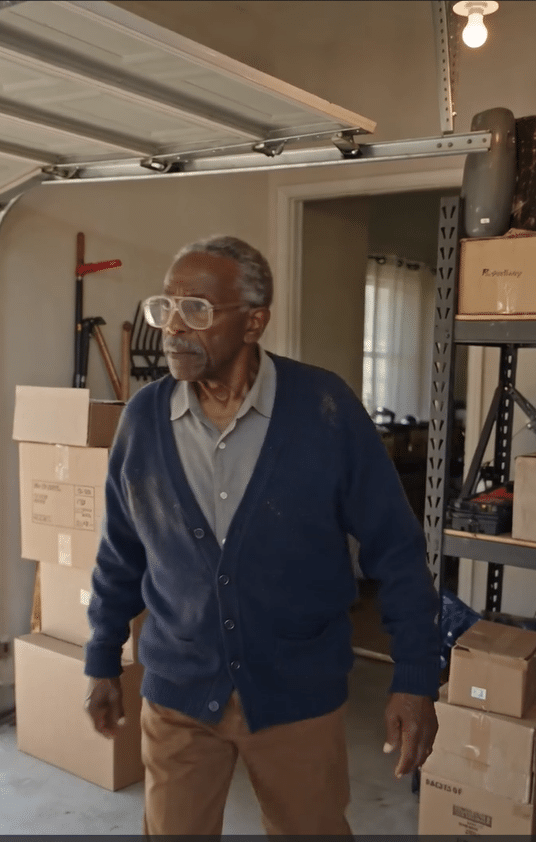
Marcus stepped into the cool, shadowed expanse of his suburban American garage. The familiar scent of motor oil, cut grass, and old paper usually brought him a deep sense of peace, but this afternoon, the space felt entirely hollow. The harsh fluorescent overhead light caught the lenses of his clear glasses as he scanned the heavy wooden shelves lining the far wall. They were completely bare. The dusty cardboard boxes—the ones meticulously labeled in his late wife’s looping cursive—were gone.
Marcus instinctively adjusted his navy cardigan, a sudden chill creeping into his bones despite the oppressive summer heat pressing against the garage door. He turned slowly, his tan pants brushing against a workbench, to see his son, Danson, standing near the edge of the driveway. Danson, broad-shouldered and athletic in his dark green polo and dark pants, was in the middle of tying off a heavy-duty black donation bag. The black watch on Danson’s wrist caught the light as he moved.
“Danson, where’s your mother’s stuff?” Marcus asked, his voice rough and laced with sudden confusion.
Danson sighed, dropping the bag and wiping a layer of dust from his hands. “Dad, I cleared some of it out.”
“Cleared it out where?” Marcus took a step forward, his brow furrowing deeply.
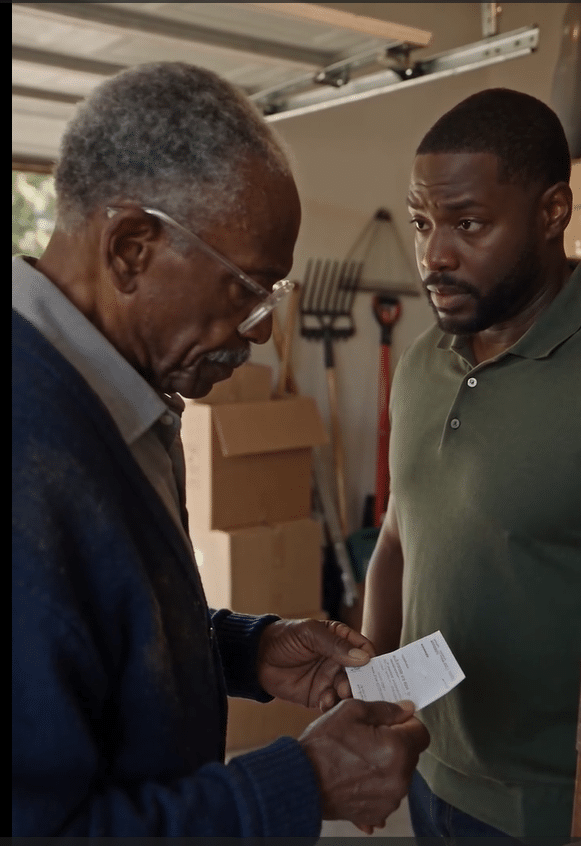
“I donated the clothes and some boxes. You haven’t touched any of it since Mom passed.”
Marcus felt a sharp, physical ache radiate through his chest, tightening his lungs. “You gave her things away without asking me?”
“This garage was packed,” Danson pleaded, taking a cautious step toward his father. “I thought holding on to everything was keeping you stuck in the past.”
“Those weren’t just boxes to me, Danson.”
“Dad, you were never gonna use those clothes again. They were just sitting here gathering dust.”
Marcus stood tall, his short gray hair catching the light, his gray mustache twitching as he fought desperately to keep his composure. He looked his thirty-five-year-old son directly in the eye, deeply emotional but fiercely controlled. “Who gave you permission to decide when I was done grieving?”
A heavy, suffocating silence fell between them. The gentle rustle of the suburban wind outside seemed to amplify the quiet tension inside. Marcus slowly walked toward the corner where a few stray items remained, untouched by the purge. He nudged a small plastic bin with his shoe, his heart sinking further.
“Her blue coat too?” Marcus asked quietly, his voice breaking on the final word.
Danson swallowed hard, shifting his weight uncomfortably. “Yeah.”
Marcus closed his eyes, the memory washing over him with vivid, agonizing clarity. “She wore that the night we brought you home from the hospital.”
Danson’s expression instantly shattered. The stubborn certainty of his actions evaporated into deep, painful regret. “Dad, I didn’t know.”
“That’s why you should have asked.”
Without another word, Danson quickly pulled his phone from his pocket, his thumb swiping frantically across the screen. “The donation center might still have some of it. I’ll call them right now.”
Marcus didn’t answer. He just stood there, quietly looking at the empty space where his wife’s history had safely rested, while the muffled sound of a ringing phone echoed against the concrete walls.
CHAPTER TWO: THE DIAL TONE AND THE DRIVE
“Yes, hello? I dropped off a large load of donations about an hour ago. At the Elm Street location,” Danson spoke rapidly into the receiver, his free hand nervously pacing through his short black hair. “Is there any way to hold them? Wait, what do you mean the truck already left?”
Marcus turned his head, his posture rigid, listening to the panic rising in his son’s voice.
“To the main distribution warehouse? On the county line?” Danson’s voice cracked slightly. “Okay. Okay, thank you. I’m on my way right now.”
He ended the call and looked at his father. The tension in the garage had morphed into a heavy fog of desperate hope and lingering resentment.
“They loaded a freight truck twenty minutes ago,” Danson explained, his tone apologetic but urgent. “They take everything from the neighborhood drop-offs to a central sorting facility out in Westbridge. If we leave right now, we can beat them to the sorting floor before it gets processed.”
“Get the keys,” Marcus said, not wasting a single second.
The drive through the winding suburban streets was excruciatingly silent. Danson gripped the steering wheel of his SUV until his knuckles turned white, navigating the afternoon traffic with aggressive precision. Marcus sat in the passenger seat, his hands folded neatly in his lap, his eyes fixed on the blurring trees passing outside the window.
“Dad, I really thought I was helping,” Danson finally said, unable to bear the crushing quiet of the car any longer. “Every time I come over, you’re sitting in the garage just staring at those cardboard boxes. You don’t golf anymore. You hardly call your friends. It scared me to see you fading away in there.”
“Grief is not a mess on the floor that you can just sweep up and throw away, Danson,” Marcus replied, his voice barely above a whisper, never taking his eyes off the road. “You don’t clean it away. You just learn to walk around it. But you need the landmarks to know where you are. That coat… it was a landmark. It was the start of our family.”
Danson checked his mirrors, aggressively merging onto the interstate highway. “I’ll get it back. I promise you, Dad, I’ll get it back.”
Marcus didn’t reply. He simply pressed his hand against his chest, feeling the steady, rhythmic ache of a broken heart, praying that time was on their side.
CHAPTER THREE: THE MOUNTAIN OF MEMORIES
The Westbridge Sorting Facility was a colossal, windowless concrete structure that smelled heavily of industrial detergent, stale dust, and forgotten lives. Inside, the sheer volume of noise was deafening. Massive rubber conveyor belts hummed aggressively, forklifts beeped as they reversed down narrow aisles, and dozens of workers tossed plastic bags into massive, wheeled canvas carts.
Danson pushed his way through the heavy double doors, Marcus trailing closely behind, navigating the chaotic environment. They approached a makeshift front desk, where a tired-looking manager in a bright yellow high-visibility vest was clipping shipping manifests to a metal clipboard.
“Excuse me,” Danson said, leaning over the counter and raising his voice over the machinery. “I made a terrible mistake. I donated some items at the Elm Street branch this morning, and a truck just brought them here. We need to recover a specific coat.”
The woman looked up, her expression a practiced mix of customer-service sympathy and deep exhaustion. “Sir, we process over ten thousand pounds of textiles here every single day. Once it comes off the local truck, it goes straight into the bulk bins. It’s physically impossible to track an individual item.”
“You don’t understand,” Marcus stepped forward, leaning against the counter. His voice was steady, carrying a quiet authority that demanded immediate attention. “My wife passed away recently. Her coat is in one of those bags. It’s a heavy navy blue wool coat with silver buttons. It’s all I have left of the very day my son was born.”
The manager paused, her pen hovering over the clipboard as she looked from the desperate young man to the heartbroken older gentleman. She sighed deeply, setting down her paperwork. “The Elm Street truck is being unloaded at Bay 4 right now. They haven’t dumped the bags onto the main sorting belt just yet. I can give you twenty minutes. If you don’t find it before the line starts, it’s gone forever. It gets baled by the hydraulic press and shipped overseas.”
“Thank you,” Danson breathed out, his shoulders dropping in temporary relief. “Thank you so much.”
“Bay 4. Follow the yellow painted line on the floor. Wear these,” she said, sliding two pairs of thin blue rubber gloves across the counter.
Marcus took the gloves, his aged hands trembling slightly as he pulled them on, and began walking purposefully toward the cavernous back room.
CHAPTER FOUR: NEEDLE IN A HAYSTACK
Bay 4 was an absolute nightmare of black plastic. The bags were piled nearly ten feet high inside enormous metal cages, waiting to be slashed open, sorted, and forgotten. The sheer volume of discarded human possessions in just this one corner of the warehouse was staggering to witness.
“Okay,” Danson said, rolling up the short sleeves of his dark green polo shirt. “The bags I used were heavy-duty contractor bags. They had bright yellow drawstrings. That’s what we need to look for.”
“Let’s get to work,” Marcus said, stepping up to the towering mountain of plastic.
They plunged into the pile with reckless abandon. Danson used his athletic build to heave incredibly heavy bags aside, creating a narrow, safe walkway for his older father. They tore open anything that had a yellow string. Out poured decades of other people’s memories: old moth-eaten sweaters, faded denim jeans, discarded children’s toys, and broken leather shoes. Every pile looked exactly the same.
Marcus fell to his knees on the hard concrete, ripping open a heavy bag. His breath suddenly hitched in his throat as he pulled out a familiar, brightly colored floral blouse.
“Danson! Look here.”
Danson rushed over, dropping a bag of shoes. “That’s Mom’s blouse. This is the right batch. We’re in the right place.”
They frantically tore through the remaining contents of that specific bag. They found a pair of Eleanor’s worn-out leather gardening gloves. They found her favorite knitted winter scarf. But there was no blue wool coat.
Time was aggressively slipping away. The deafening, shrill buzzer of the main conveyor belt system sounded overhead, signaling a five-minute warning that the main processing line was about to start moving.
“We need to hurry,” Danson yelled over the rising industrial hum, frantically slashing another yellow-stringed bag with his car keys. He pulled out more of his mother’s clothes—things he had recklessly stuffed away just hours earlier without a second thought. Seeing them now, spread across the dirty warehouse floor, completely stripped of their dignity, the reality of his actions hit him harder than before. He wasn’t just cleaning a garage; he was accidentally erasing her footprint on the world.
Marcus was panting heavily, a distinct sheen of cold sweat forming on his forehead. The seventy-year-old was pushing his body far past its limits.
“Dad, sit down on that crate. Let me do this,” Danson ordered, grabbing his father’s shoulder gently but firmly.
“No,” Marcus wheezed, ripping open another bag. “I’m not leaving this building without it.”
CHAPTER FIVE: THE WEIGHT OF LETTING GO
Only minutes remained. The pile of heavy-duty bags with yellow drawstrings was rapidly dwindling. They had managed to find three boxes of old family photo albums and several of Eleanor’s summer dresses, but the iconic blue wool coat remained devastatingly absent.
Danson sank back on his heels, his breathing ragged, wiping a mixture of sweat and warehouse grime from his forehead. He looked over at his father, who was meticulously folding the floral blouse they had found earlier. Marcus’s rough hands were treating the cheap cotton fabric like it was made of fragile, priceless glass.
“Dad,” Danson started, his voice cracking loudly in the vast space. “I’m so incredibly sorry. I was just so angry.”
Marcus looked up, pausing his delicate folding. “Angry at me?”
“Angry at the whole damn world,” Danson admitted, tears finally pooling in his eyes and spilling over his cheeks. “Mom is gone, and it feels like you’re disappearing right in front of me too. I come to the house, and it’s like walking into a museum dedicated to a ghost. I just felt like… if I got rid of the stuff, if I forced you to look at the empty space, I might finally get my father back.”
Marcus silently absorbed the painful words. The harsh, unforgiving fluorescent lights of the warehouse seemed to soften just a fraction around them as the raw truth settled between father and son.
“Danson, when you lose the person who was your entire world, your compass, for forty years, the silence left behind is deafening,” Marcus said gently, his voice thick with unshed tears. “Those things in the garage… they were the only things making noise. They told our stories. I wasn’t holding onto the clothes to stay stuck in the past. I was holding onto them to remember how to live in the present.”
Danson buried his face in his hands, overwhelmed with guilt. “I broke everything. I lost her coat. The one she brought me home in. I ruined it.”
Marcus moved closer, groaning as his old knees protested, and placed a remarkably steady hand on his son’s broad, shaking shoulder. “You didn’t break anything, son. You just wanted your dad. And I haven’t been fair to you either. I’m right here. I’m right here.”
For a brief, profound moment, amidst the deafening chaos of a thousand discarded lives, they were just a father and son, finally mourning their shared loss together.
CHAPTER SIX: THE FLASH OF BLUE
“Hey! You two! Wrap it up!”
The loud shout came from the far end of the aisle. The manager in the high-visibility vest was marching toward them rapidly, flanked by two burly men pushing a massive mechanical loader toward the remaining bags.
“Time is officially up,” she shouted over the roaring machinery that was springing to life around them. “The belt is turning on right now. You need to clear the processing floor immediately.”
Danson scrambled to his feet, his heart pounding against his ribs. “Please, just give us five more minutes. We found her other clothes in these bags, the coat has to be right here in this last pile!”
“I’m sorry, sir. Strict insurance policies. You absolutely cannot be back here while the heavy loaders operate. Grab whatever you found and head to the exit.”
Utterly defeated, Danson bent down to gather the photo albums and the few shirts they had managed to salvage. Marcus stood up slowly, his joints aching in protest. He looked longingly at the remaining mountain of unsearched black bags. It was a dark, endless sea of plastic. The coat was in there, somewhere, destined to be crushed into a square bale and shipped across the ocean.
“Let’s go, Dad,” Danson whispered, carrying the salvaged items against his chest like a shield.
Marcus nodded solemnly, adjusting his clear glasses to hide the moisture in his eyes. He turned to walk back down the faded yellow-lined path toward the front lobby.
As they neared the final exit doors, they passed a small, well-lit sorting station where workers meticulously pulled “premium” items to be sold in the boutique section of the local thrift store. Racks of pristine business suits, vintage leather jackets, and heavy winter wear stood in neat rows, waiting to be priced and tagged.
Marcus stopped dead in his tracks. His breathing hitched.
There, hanging flawlessly on the very end of a metal rolling rack, was a heavy navy blue wool coat. Its polished silver buttons caught the bright overhead light, gleaming like beacons in the dreary warehouse.
“Danson,” Marcus gasped, pointing a fiercely trembling finger toward the rack.
Danson dropped the plastic bags he was holding, the photo albums clattering loudly against the concrete floor, and sprinted to the rack. He grabbed the heavy sleeve, frantically turning it over to check the inner lining. The familiar silk interior, complete with a small, meticulously repaired tear near the collar that Eleanor had fixed years ago, stared back at him.
“It’s here,” Danson laughed, a sudden, wet sound of pure, unadulterated relief echoing through the corridor. “They pulled it for the premium rack because it was in such good condition. Dad, it’s here!”
Marcus practically ran over, pressing his weary face directly into the soft, heavy wool. Even over the harsh smells of the factory, it still faintly, beautifully smelled of her lavender perfume.
CHAPTER SEVEN: THE RIGHT PLACE
The long drive back to their suburban neighborhood felt entirely different than the frantic journey hours earlier. The oppressive, angry silence that had suffocated them in the car was completely gone, beautifully replaced by a quiet, comfortable, and healing peace. The blue wool coat rested safely on the backseat, carefully laid out, right alongside the few recovered cardboard boxes of photographs.
When Danson finally pulled his SUV into the driveway, the garage door was still wide open, revealing the glaringly empty wooden shelves that had sparked the entire day’s turmoil.
Danson shifted into park and killed the engine. He immediately grabbed the items from the backseat, carefully draping the heavy wool coat over his strong arm to ensure it didn’t drag on the ground.
They walked up the concrete driveway and into the house together. Marcus didn’t head toward the garage. Instead, he walked directly into the front hallway, stopping squarely in front of the main closet—a space usually reserved exclusively for everyday rain jackets and umbrellas.
He reached out, opened the white wooden door, and pulled out a sturdy, polished wooden hanger.
“Give it here,” Marcus said softly.
Danson handed the heavy coat to his father. Marcus carefully draped it over the wooden hanger, taking his time to smooth out every single wrinkle in the wool, and hung it right in the absolute center of the front closet.
“Dad?” Danson asked softly, leaning against the doorframe. “You don’t want to put it back in the garage?”
“No,” Marcus smiled, a genuine, warm smile that finally reached his tired eyes, lighting up his face for the first time in months. “You were right about one thing today, Danson. The garage is absolutely no place for a memory as important as this. She doesn’t belong in a dusty cardboard box in the dark. She belongs right here, where we can see it every single time we leave the house, and every single time we come back home.”
Danson felt a massive, invisible weight permanently lift from his chest. He reached out, pulling his father into a tight, grounding, and desperate hug. Marcus hugged him back fiercely, burying his face in his son’s shoulder.
“I’m sorry I didn’t ask you,” Danson whispered into the quiet hallway.
“I’m sorry I shut you out of my life,” Marcus replied.
They eventually broke apart, both turning to look at the beautiful blue coat hanging proudly in the hallway. It was no longer a heavy chain holding Marcus captive to the past. It was a beautiful reminder of their family’s beginning, hanging right by the front door, ready to watch them finally step forward into whatever life brought next.