Part One: The Empty Chair and the Cold House
The scent of roasted rosemary chicken and garlic butter hung heavily in the warm evening air, a cruel contrast to the freezing emotional temperature of the dining room. It was a beautiful home, an upscale suburban sanctuary with bright recessed lighting, gleaming hardwood floors, and an open-concept kitchen that flowed seamlessly into a meticulously decorated dining area. But for eleven-year-old Emma, this house was a labyrinth of silent rules and invisible landmines. She stood near the island counter, her slender, fragile frame practically swallowed by her oversized mustard-yellow hoodie. Her warm deep-brown skin looked pale under the kitchen lights, and her large, expressive dark-brown eyes darted nervously toward the large oak dining table.
Her aunt, a woman of striking but severe elegance with shoulder-length dark-auburn locs and an immaculate emerald-green blouse, was carefully arranging steaming portions of dinner onto fine ceramic plates. She set one down for her sixteen-year-old son, Ryan, who slouched in his burgundy varsity jacket, and another for her thirteen-year-old daughter, Sophie, who sat quietly in a lavender cardigan. There was one empty chair left at the table, right beside Sophie. It was a chair that belonged to Emma. Or at least, it should have.
Emma swallowed hard, her small hands trembling slightly as she picked up her own chipped plate, which held a noticeably smaller portion of food. She took a hesitant step forward, the rubber soles of her white sneakers silent against the hardwood. She approached the empty chair beside her female cousin, her heart hammering against her ribs. She just wanted to be part of the warmth, to pretend, even for twenty minutes, that she belonged.
Her aunt didn’t even look up at her. She calmly, fluidly raised a manicured hand, gesturing dismissively toward the cold granite of the kitchen counter. “Emma, eat in the kitchen.”
Emma stopped dead in her tracks. The aroma of the food suddenly made her feel nauseous with anxiety. She looked at the empty chair, then at her aunt’s hardened profile. “Can I sit with you?” she asked, her voice a fragile, hopeful whisper.
Her aunt finally turned her head. Her eyes were flat, devoid of any maternal warmth. “This table is for my kids.”
Before Emma could process the sharp sting of the words, her older male cousin, Ryan, leaned back in his chair, his thick twists casting shadows over his face. He looked at her with the casual cruelty only a teenage boy imitating his mother’s worst traits could muster. “You heard Mom. Go.”
A heavy, suffocating silence fell over the room. Sophie shifted uncomfortably in her seat, her natural curls bouncing slightly as she looked from her mother to her shivering younger cousin. Sophie had been watching this psychological torture for months, the quiet marginalization of the orphaned girl who had nowhere else to go. Sophie bit her lip, her conscience finally winning over her fear of her mother. “She’s family,” Sophie said, her voice trembling but defiant.
Her aunt slammed a serving spoon down onto the table. “Sophie. Enough.”
The absolute finality in the woman’s voice drained the last ounce of hope from Emma’s chest. She quietly lowered her eyes, a masterclass in making herself small, and walked back to the cold granite kitchen counter. She climbed onto the high stool and sat down with her plate, her back to the family, staring at the blank subway tile backsplash while the clinking of silverware and warm murmurs of a family dinner carried on behind her.
Then, the heavy oak front door clicked open.
The ambient tension in the room instantly shifted as Uncle David stepped into the foyer. He was a tall, broadly built man of forty-two, his bald head and short salt-and-pepper beard giving him an air of commanding authority. Dressed in a navy blazer and light-blue shirt, his sheer presence usually brought a sense of safety to the house. He dropped his briefcase, loosened his collar, and strode into the dining room, a weary smile forming on his lips—until he stopped abruptly.
His sharp eyes swept the room. He saw his wife, his son, and his daughter eating at the main table. Then, he saw the small, yellow-hooded figure hunched over the kitchen counter in the background. The smile vanished from his face, replaced by a cold, protective focus.
“Why is Emma eating alone?” he asked, his deep baritone cutting through the room like a blade.
His wife didn’t miss a beat. She offered a smooth, practiced smile, sipping her water. “She wanted to.”
David didn’t buy it for a second. He walked past the dining table, ignoring his wife entirely, and approached the kitchen counter. He stood behind Emma, his large frame casting a protective shadow over her. “Emma, is that true?”
Emma froze. She knew the consequences of telling the truth. She knew what her aunt would do when David left for work the next morning. But as she briefly glanced over her shoulder, catching the chilling, warning glare from her aunt, something inside her broke. She was so tired of shrinking.
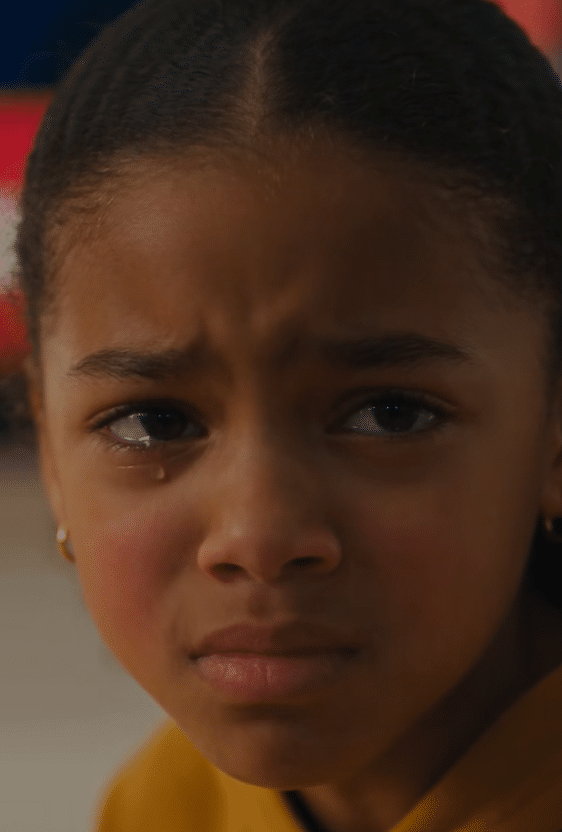
“No, Uncle David,” Emma whispered, the words barely making it past her throat. She looked down at her plate, a single tear escaping her large eyes and splashing silently onto the ceramic. She added softly, her voice breaking, “She says I’m not one of her kids.”
David’s jaw clenched. The muscles in his neck tightened as a quiet, terrifying fury built behind his eyes. He remained perfectly controlled, refusing to raise his voice, which only made his anger more intimidating. He turned his head slightly toward the dining table. “She belongs at this table.”
His wife opened her mouth to argue, but the look in David’s eyes instantly silenced her. She went completely still, her polished veneer cracking.
Before the aunt could recover, Sophie put down her fork. The metallic clink echoed loudly in the tense room. She looked at her father, her heart pounding with the terrifying thrill of total honesty. “Dad… she does this whenever you leave.”
Her aunt’s head snapped toward her daughter, her eyes blazing with raw panic and rage. “Sophie. Stop.”
But the dam had broken, and the floodwaters of truth could no longer be contained. Sophie looked directly toward her older brother, pointing a shaking finger at him. She revealed the darkest, most vicious secret of all: “Ryan takes Emma’s dinner too.”
David slowly, deliberately turned his imposing frame away from the counter, his gaze locking onto his sixteen-year-old son. The arrogant, dismissive smile completely disappeared from Ryan’s face, replaced by stark, paralyzing terror. His mother became visibly rigid, the air leaving her lungs. Emma quietly lowered her eyes, clutching her hoodie with shaking hands, bracing for the explosion.
Part Two: The Starving Child
The silence that followed Sophie’s revelation was deafening, broken only by the hum of the refrigerator. David’s eyes were locked onto his son, entirely dark and unreadable. He stepped away from Emma, closing the distance to the dining table with slow, deliberate steps that felt like the steady ticking of a bomb. He stopped right beside Ryan, looking down at the teenage boy who suddenly looked very small inside his varsity jacket.
“You took Emma’s dinner?” David’s voice was dangerously low, vibrating with a restrained wrath that made the silverware on the table seem to rattle.
Ryan instinctively leaned away from his father, his eyes darting to his mother for rescue, but she was frozen. He threw his hands up defensively. “Mom said she was done!”
From the kitchen counter, Emma turned around, her large, tear-filled eyes wide with hurt and desperation. “I hadn’t even started!”
David didn’t take his eyes off his son, but the heartbreak in his niece’s voice struck him physically. He leaned closer to Ryan, his broad shoulders blocking out the light. “How often?”
Emma shifted uncomfortably on her stool. She glanced nervously at her aunt, who was staring daggers at her, silently commanding her to shut her mouth. But David’s presence was a shield. Emma looked down at her battered white sneakers and confessed quietly, “Whenever you work late.”
Ryan, desperate to shift the blame and feeling the crushing weight of his father’s judgment, lashed out irritably. “She eats lunch at school!”
The words hung in the air. Emma’s shoulders slumped, a deep, exhausted sadness washing over her youthful face. “Not anymore,” she whispered, the sheer hopelessness in her tone causing David’s blood to run cold.
David immediately turned his massive frame toward his wife. The protective calmness was eroding, giving way to a frantic, demanding panic. “What happened to her lunch?”
His wife pushed her chair back slightly, her warm-brown skin flushing with defensive anger. She crossed her arms, trying to maintain her polished authority. “Her lunch account had issues!”
Sophie wasn’t having it. The thirteen-year-old stood up from the table, her lavender cardigan slipping off one shoulder, her voice ringing out with firm, unshakeable conviction. “Mom canceled it!”
David stared at his wife as if looking at a total stranger. The cruelty of it was incomprehensible. “I paid for that!” he barked, his voice finally cracking like thunder in the quiet house. He had deposited the funds himself. He had made sure his late sister’s daughter would want for nothing.
Sophie didn’t wait for her mother’s excuses. She marched over to the kitchen island, pulled open the heavy oak drawer, and frantically dug through a pile of neatly organized bills and takeout menus. She pulled out a crumpled, officially stamped piece of paper and slammed it down onto the center of the dining table right in front of her father. It was a hidden school nurse’s report.
Sophie pointed an accusing finger at her mother, her voice breaking with righteous anger. “Then why’d you hide this?”
David picked up the paper. His large hands trembled slightly as he unfolded the document. His eyes scanned the clinical, terrifying words printed in stark black ink. Patient presented with severe dizziness, pallor, and hypotension. Collapse in the hallway. Cause: Severe caloric deficit. Malnutrition.
David froze. The breath was knocked out of his lungs. He looked up, his face a mask of absolute, horrified shock. “She fainted at school?”
By the counter, Emma couldn’t hold it in anymore. The memory of the cold linoleum floor against her cheek, the spinning darkness, the agonizing cramps in her stomach—it all came rushing back. Tears spilled over her eyelashes, streaming down her cheeks. “I hadn’t eaten all day,” she cried, her fragile voice echoing tragically in the large room.
Sophie moved swiftly, pointing to a small, highlighted box at the bottom of the nurse’s call record. It showed the exact timestamp when the school had called the mother’s cell phone. It showed that her mother had received the terrifying notification, acknowledged it, and then deliberately chosen to bury the paperwork, never informing David that his niece had collapsed from starvation under their roof.
David slowly lowered the report. He didn’t yell. He didn’t scream. He simply turned toward his wife, his expression changing from shock to a cold, utterly terrifying fury. It was the look of a man who had just realized he was married to a monster. His wife stepped backward, her cream trousers brushing against the wall, her mouth opening and closing as she found herself completely unable to explain away the undeniable, documented proof of her abuse.
Emma clutched her nearly empty plate to her chest like a shield, tears tracking down her chin, while Sophie walked over and stood firmly, protectively beside her younger cousin, wrapping an arm around the mustard-yellow hoodie.
Part Three: The Forged Goodbye
The dining room felt like it had been plunged into an ice bath. David stood motionless, the crumpled nurse’s report clutched so tightly in his fist that his knuckles were stark white. He looked at his wife, stripping away the polished emerald blouse and immaculate locs, seeing only the rotten core beneath. Emma remained huddled by the counter, shivering despite the warmth of Sophie’s arm around her, terrified of the eruption she knew was coming.
David stepped toward his wife, his voice dropping to a terrifying, deadly calm. “You knew she fainted?”
His wife backed up until her shoulders hit the expensive wallpaper. She threw her hands up, her defensive tone sharp and desperate. “I handled it, David!”
Emma flinched at the volume of her aunt’s voice. She buried her face into Sophie’s shoulder, sobbing openly now. “She told me not to tell.”
David’s hard eyes softened for a fraction of a second as he looked at the frightened eleven-year-old. He took a slow, deep breath, fighting to keep his rage in check for the child’s sake. He asked gently, “Why, Emma?”
Emma looked up, her dark-brown eyes wide with a deep, ingrained terror that no child should ever possess. She looked at her aunt, then back to David, her voice shaking uncontrollably. “She said you’d blame me.”
The psychological manipulation was staggering. David felt a wave of nausea hit him. He turned his lethal gaze back to his wife. Rather than showing remorse, the woman doubled down, waving a dismissive, elegant hand in the air. “She needs a fresh start!”
The audacity of the statement hung in the air, toxic and thick. But Sophie wasn’t finished tearing down her mother’s empire of lies. Leaving Emma’s side for just a moment, Sophie marched over to the hallway storage closet. She yanked the heavy wooden door open and aggressively dragged out a large, battered black suitcase, its wheels scraping loudly against the hardwood floors. She hauled it into the middle of the dining room.
Sophie glared at her mother, her young face contorted with angry, protective tears. “Then why’d you pack her bag?”
David stared at the suitcase, his mind struggling to comprehend the sheer scale of the betrayal happening under his own roof. He stepped aggressively toward his wife, demanding with a booming, authoritative voice, “Where are you sending her?”
His wife lifted her chin, attempting a facade of total calm, though a drop of nervous sweat was forming at her temple. “To Grandma’s. Just a visit.”
From across the room, Emma let out a devastated, crying gasp. Her aunt had been slowly stripping away everything she loved, and this was the final blow. “She said I couldn’t come back!” Emma sobbed, her fragile frame shaking violently under the yellow hoodie.
David didn’t hesitate. He crossed the room in three massive strides and positioned his tall, broad frame directly between his wife and his weeping niece, moving protectively beside Emma to shield her from the woman’s venomous gaze.
Sophie knelt on the floor and aggressively unzipped the suitcase. She dug through the hastily packed clothes—Emma’s few meager belongings shoved thoughtlessly together—and her hand found a stiff, unsealed white envelope hidden near the lining. She ripped it open and pulled out a boarding pass. Her eyes widened in horror. She stood up, holding the paper in the air, pointing an accusing, trembling finger at her mother. “Then why’s her ticket one-way?”
His wife’s polished facade completely shattered. She became visibly nervous, her eyes darting toward the front door, her breathing becoming shallow and erratic as the walls of her deception rapidly closed in on her.
David snatched the envelope from his daughter’s hand. He ripped it open completely, searching through the remaining papers. Beneath the itinerary was a heavy, watermarked document bearing the crest of Emma’s middle school. He read the bold print at the top, his heart stopping in his chest. He looked up, absolutely stunned by the sheer, calculating malice of the woman standing before him. “You withdrew her from school?”
Sophie leaned over her father’s thick arm, staring at the bottom of the withdrawal form. Her eyes locked onto the ink on the dotted line. She gasped, grabbing her father’s forearm with urgent panic. “Dad, look at your signature!”
David examined the document closely. The signature was a clumsy, desperate attempt at mimicking his own sweeping handwriting. The loops were wrong; the pressure of the pen was hesitant. He stared at it for a long, agonizing moment, the realization settling over him like a suffocating shroud. He looked up, his eyes dead, his voice a whisper of cold, terrifying fury. “That’s not my signature.”
At the dining table, Ryan suddenly lowered his head. The sixteen-year-old boy, who had been sitting in paralyzed silence, nervously pushed his chair backward, the wooden legs screeching horribly against the floor. His mother immediately snapped her head toward him, shooting him a vicious, desperate warning look, a silent command to take this secret to the grave.
But David noticed the silent exchange. He connected the dots instantly. He walked slowly back to the dining table and slammed the forged document down directly in front of his son. Ryan froze, his hands trembling violently on his lap, visibly terrified of the giant of a man looming over him. Emma stood silently beside Sophie, her small hands clutching the fabric of her hoodie, watching as the family that was supposed to protect her entirely unraveled. The extreme close-up of Ryan’s frightened, guilty expression told the whole damning story before a single word was spoken.
Part Four: The Heartbreak and the Banishment
The silence in the dining room was suffocating, heavy with the stench of guilt. David stood over his son like an immovable mountain. He tapped a massive finger directly onto the clumsily forged ink on the withdrawal form.
“Ryan, is that your handwriting?” David demanded, his voice dangerously low, offering absolutely no avenue for escape.
The boy swallowed hard, a bead of sweat tracing down the side of his face. He nervously glanced up at his mother, searching for a lifeline in her panicked eyes. Finding none, he crumbled under his father’s immense, crushing pressure. “Mom told me to sign,” he confessed, his voice cracking into a pathetic, terrified squeak.
David didn’t yell. The betrayal was too deep, too systemic, for screaming. He turned his head slowly, his neck cracking slightly, and leveled a look of pure, unadulterated coldness toward his wife. “By sending Emma away?”
Ryan, desperate to unburden his soul and perhaps save himself from his father’s wrath, didn’t stop there. He immediately exposed the deeper, more sinister layer of the psychological torture his mother had orchestrated. He looked down at the table, unable to meet anyone’s eyes. “She made me tell Emma you wanted her gone.”
The words hit the room like a physical shockwave. Emma flinched violently as if she had been slapped. Her large, expressive eyes filled with fresh, devastated tears. All those nights crying into her pillow, believing the only family she had left in the world despised her existence—it had all been a lie designed to break her spirit so she wouldn’t fight back when they put her on a plane. She turned toward her uncle, her voice a fragile, shattered whisper. “You really didn’t want me?”
David felt his heart physically ache. The imposing, stoic man rushed over to the small, broken girl. He knelt down to her eye level, his large hands gently placing a reassuring, anchoring weight on her small shoulders. He looked directly into her tear-filled eyes, his own voice thick with emotion. “Never. I never said that.”
As David held his niece, trying to piece her shattered heart back together, Sophie was still kneeling by the open suitcase. She noticed Emma’s small, faded purple backpack shoved aggressively against the side of the luggage. She unzipped it, pulling out a few wrinkled notebooks. Tucked between the pages of a math workbook was a small, carefully folded piece of lined notebook paper. On the outside, written in Emma’s neat, careful cursive, were the words: To Uncle David.
Sophie’s breath hitched. She stood up and immediately handed the envelope to her father. “Dad, Emma wrote you this.”
David stood up slowly, taking the paper from his daughter. He unfolded it with immense care, as if the paper itself were fragile. The handwriting was a little shaky, stained with dried teardrops that had warped the blue lines. He read the short, agonizing paragraph silently. His broad chest heaved. He swallowed hard, fighting the lump in his throat, and read one heartbreaking sentence aloud, his deep voice quietly breaking in a way neither of his children had ever heard before: “I’m sorry I caused trouble.”
Emma lowered her eyes, unable to look at the man she loved so dearly, her face burning with profound shame. “I thought I was leaving forever,” she whispered into the collar of her yellow hoodie.
David looked heartbroken, a tragic vulnerability washing over his usually stoic features. He carefully walked over to the dining table and placed Emma’s goodbye letter gently beside the forged withdrawal forms and the one-way boarding pass—a grim, undeniable altar of his wife’s unforgivable cruelty.
The power dynamic in the room shifted irreversibly. His wife, realizing her empire of control was completely destroyed, decided to burn the bridge rather than apologize. She squared her shoulders, her face twisting into a mask of bitter, ugly resentment. She looked at Emma with pure disgust and coldly declared, “She isn’t my child.”
David slowly turned toward her. All the heartbreak, all the shock, vanished from his face, replaced by an expression of absolute, terrifying control. He stood at his full height, a towering figure of paternal authority, and responded with a firmness that left no room for debate. “She’s my family. You leave tonight.”
His wife froze, her jaw dropping slightly. She had expected an argument, a fight, a negotiation. She had not expected instant, permanent exile.
David didn’t give her a second glance. He turned toward his older son, who was practically trying to shrink into the floorboards. David’s tone was military, barking an absolute order. “Ryan, you’ll tell the school everything.”
The teenager nodded frantically, terrified and ashamed, remaining seated in total silence.
Realizing it was truly over, that she had lost her home, her husband, and her power in the span of ten minutes, the aunt reluctantly walked over to the entryway. She collected her expensive leather handbag and her heavy trench coat. Without looking back at the family she had shattered, she walked out the front door, the heavy lock clicking definitively behind her.
David systematically gathered the forged documents and the plane ticket, sliding them into his briefcase. He was keeping the evidence. He was ensuring that Emma would never, ever be threatened with leaving again.
Part Five: The Empty Chair Filled
The heavy thud of the front door closing echoed through the quiet house, leaving a vacuum of stillness in its wake. The oppressive, suffocating tension that had choked the dining room for months seemed to seep out under the doorframes, replaced by the steady, rhythmic hum of the refrigerator and the distant rustle of the wind outside.
Emma stood exactly where she had been in the beginning, backed against the cold granite of the kitchen island. She was still clutching her chipped plate, the small portion of food now cold. The emotional whiplash of the last ten minutes had left her entirely drained, her small body trembling with the adrenaline of survival. She looked at the front door, half expecting the terrifying woman to burst back in, but the lock remained still.
David took a long, steadying breath, running a hand over his bald head. He looked at the shattered remains of his family dynamic—his son weeping silently at the table, his daughter standing bravely by the luggage, and his niece, shivering in her yellow hoodie, still believing she was a burden. He knew the road ahead would be grueling. There would be divorce lawyers, custody battles, endless meetings with school administration to undo the forgery, and deep, intensive therapy for the children.
But tonight, there was only one thing that mattered.
David walked over to the grand oak dining table. He looked down at the empty chair—the chair that had been aggressively defended by a woman who was no longer welcome in this home. He reached out and pulled the heavy wooden chair out, the legs scraping gently against the hardwood. Beside it, Sophie quickly shifted her own chair, enthusiastically making extra room, her eyes bright with welcoming warmth.
Emma watched them hesitantly. She looked down at her cold plate, then up at the empty chair. The kitchen lights seemed a little less harsh now, the warm glow of the dining room chandelier beckoning her. She took a slow, timid step forward, her white sneakers squeaking softly on the floor. She approached the table, still holding her dinner plate like a shield against her chest, her dark-brown eyes looking up at her towering, protective uncle.
“Can I sit here?” she asked quietly, the trauma of the evening still lacing her fragile voice with doubt.
David didn’t just point to the chair. He looked directly into her large, expressive eyes, stripping away every ounce of fear and uncertainty that his wife had planted in her mind. He offered a warm, incredibly tender smile that reached all the way to the corners of his eyes, his deep voice resonating with absolute, permanent certainty.
“This was always your seat.”
A profound wave of relief washed over Emma’s face. The tension melted from her slender shoulders. She stepped up to the table and finally, truly, sat down. She placed her chipped plate onto the expensive placemat. Immediately, Sophie reached across the table, grabbing the large serving platter of roasted rosemary chicken and warm garlic potatoes. She began piling fresh, steaming, beautifully smelling food onto Emma’s plate, completely ignoring Ryan, who kept his head bowed in deep, solitary shame.
Emma looked down at the mountain of warm food. She picked up her fork. For the first time in what felt like an eternity, she wasn’t rushing to eat before someone snatched it away. She wasn’t terrified of the footsteps behind her. She took her first warm bite, the rich flavors exploding on her tongue.
She looked up at David, who had taken his seat at the head of the table, watching her with a quiet, fierce devotion. Emma’s delicate features softened, and slowly, a small, genuine smile broke across her face—a brilliant spark of light in the heavy aftermath of the storm. It was a smile that promised healing, belonging, and the undeniable truth that she was finally, permanently, home.