CHAPTER 1: THE UNWELCOME GUEST
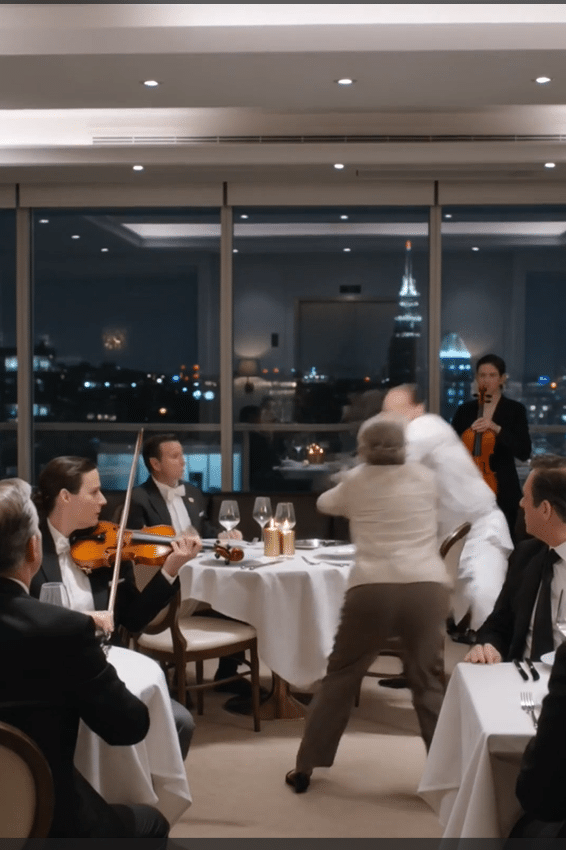
High above the sprawling, neon-lit metropolis, El Restaurante de Cristal sat like a glittering crown jewel in the city’s skyline. It was a prestigious, three-Michelin-star fortress of culinary perfection, encased entirely in floor-to-ceiling glass that offered a breathtaking, panoramic view of the bustling streets below. Inside, the atmosphere was one of hushed, intimidating opulence. The tables were draped in immaculately pressed, heavy white linens, illuminated by the soft, flickering glow of tall gold candles. A live violinist stood in the corner, playing a delicate, melancholic classical sonata that floated over the gentle clinking of heavy silver cutlery against fine crystal. The patrons were the city’s undisputed elite—hedge fund managers in bespoke tuxedos, socialites dripping in diamonds, and tech billionaires donning effortlessly expensive formal wear. Flanking the perimeter, a small army of servers stood in perfect, military-like formation, their hands clasped behind their backs, waiting for the slightest nod from a wealthy guest.
Presiding over this temple of gastronomy was the Chef Owner, Julian. At forty-eight, he was a man who wore his arrogance as comfortably as his premium, custom-tailored white chef’s coat. A heavy, solid gold Rolex peeked out from under his cuff—a constant, flashing reminder of his wealth and elite status. Julian was a notoriously brutal perfectionist, a textbook bully who ruled his kitchen and his dining room with an iron fist. He despised anything that didn’t perfectly align with his meticulous, snobbish vision of high-society dining.
That evening, a jarring anomaly disrupted his perfect domain. Standing near the host’s stand was an elderly woman, perhaps in her seventies. She wore a simple, faded grey cardigan, loose-fitting slacks, and sensible, worn-out shoes. Clutched in her frail, trembling hands was an old, tattered cloth tote bag. She looked entirely out of place, like a lost sparrow that had somehow fluttered into a hawk’s nest. She was simply looking around, her eyes wide with a mixture of awe and gentle confusion as she took in the dazzling, intimidating surroundings.
Julian’s face twisted into a snarl of sheer disgust. He didn’t see a human being; he saw a blemish on his masterpiece. Marching across the pristine marble floor, his heavy footsteps cut through the gentle hum of the dining room. He reached the elderly woman just as she was tentatively resting a hand on the back of an empty chair at a white table near the entrance.
Without a second thought, Julian grabbed the chair and violently yanked it away from her. He slammed a heavy leather-bound menu down onto the table with such vicious force that a crystal water goblet violently shook, sending droplets flying through the air. The elderly woman gasped, flinching violently and stumbling backward. In her panic, she dropped her old cloth bag. The contents spilled onto the floor, and a small, rustic loaf of bread rolled away, coming to a stop near a nearby patron’s polished leather shoe.
Julian stepped forward, using his large frame to block her path, pointing aggressively toward the glass doors.
“Get out of my restaurant, trash!” Julian barked, his voice loud enough to carry across the room. “People like you scare away my customers.”
The entire restaurant froze. The violinist abruptly stopped playing. The low hum of elite conversation died instantly, replaced by a suffocating, heavy tension. Patrons turned in their seats, their faces a mixture of shock and morbid curiosity. The elderly woman, her eyes welling with tears, slowly bent down. Her hands shook violently as she reached for her fallen cloth bag, her head bowed in profound humiliation.
Suddenly, a crisp, electronic ding sliced through the dead silence.
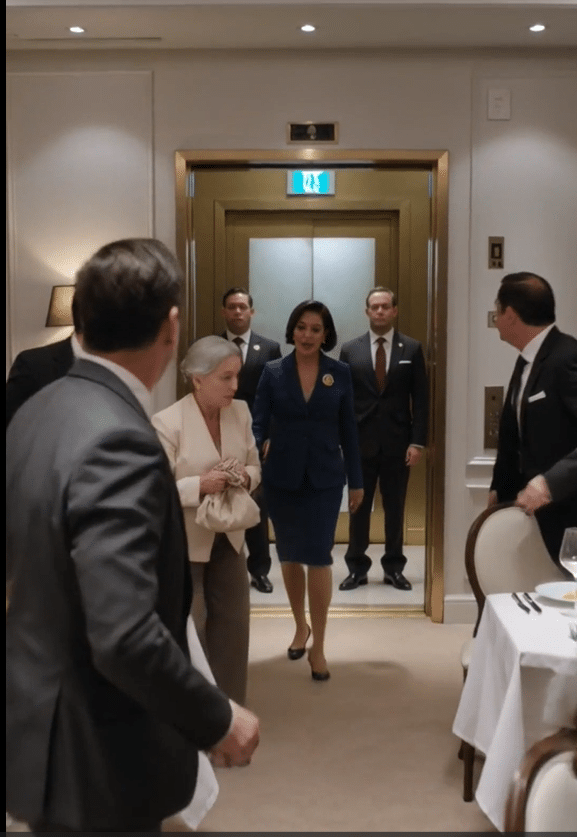
The private, VIP elevator doors at the back of the restaurant slid open. The crowd instinctively parted, creating a wide, unobstructed path. Two burly men in dark suits with earpieces stepped out first—diplomatic security. Behind them emerged a striking woman in her mid-fifties. She wore a sharp, perfectly tailored navy blue power vest over a crisp white blouse. Pinned to her lapel was a gleaming international diplomatic badge. She radiated an aura of absolute, unshakable authority.
She took in the scene with a cold, sweeping glance, her eyes locking onto the elderly woman kneeling on the floor. The Ambassador walked forward, her heels clicking rhythmically against the marble. She ignored the gawking billionaires. She ignored Julian. She walked straight to the elderly woman, knelt down gracefully, and gently helped her to her feet. With profound reverence, she took a luxurious silk scarf from her own arm and draped it over the elderly woman’s trembling shoulders.
Only then did she slowly turn her head to face Julian. Her voice was calm, carrying the devastating weight of a judge delivering a final sentence.
“Mother, forgive our late arrival.”
Julian froze. His breathing stopped. The silver plating knife he had been holding loosely in his left hand slipped from his numb fingers, clattering loudly onto a silver tray nearby. The sound echoed like a gunshot in the silent room. The color rapidly drained from his face, leaving him a ghastly shade of pale. He stumbled a half-step backward, his mind desperately trying to process the catastrophic reality of what he had just done. He stared at the frail woman in the faded cardigan, then back at the imposing Ambassador.
“M-mother…?” Julian stammered, his arrogant façade shattering into a million irreparable pieces.
CHAPTER 2: THE SHIFTING TIDES OF POWER
The silence in the dining room grew so dense it felt as though it could crush the breath out of everyone present. Julian’s mind raced, his eyes darting between the humble, trembling elderly woman and the fiercely composed Ambassador standing protectively by her side. The two diplomatic security agents had silently moved to flank the women, their postures rigid and their eyes locked onto Julian with menacing intent.
“Madam Ambassador,” Julian choked out, his voice entirely stripped of its former bravado. He wiped a sudden bead of cold sweat from his forehead with the back of his trembling hand. “I… I had absolutely no idea. If I had known she was your mother, I would have—”
“You would have what?” the Ambassador interrupted, her tone frigid and razor-sharp. “You would have treated her with the basic human decency she deserves? Is respect in your establishment reserved only for those who wear designer labels and carry heavy wallets?”
Julian opened his mouth to speak, but no words came out. He looked to his wealthy patrons for some sort of silent support, but they were all pointedly looking away, suddenly deeply fascinated by their half-eaten caviar and truffles. No one wanted to be associated with a man who had just publicly humiliated the mother of one of the most powerful diplomats in the country.
“Evelyn, please,” the elderly woman whispered, gently touching her daughter’s arm. Her voice was soft, devoid of any anger, only laced with a profound, weary sadness. “Let us just go. This place… it is too cold.”
Evelyn’s eyes softened momentarily as she looked at her mother, before hardening into obsidian daggers as she turned her gaze back to the Chef Owner. “My mother has spent her entire life building orphanages and feeding the homeless in conflict zones. She dresses simply because she knows the true value of a dollar, unlike the hollow men who hide behind gold watches and Michelin stars.”
Julian swallowed hard, his Adam’s apple bobbing nervously. The gold Rolex on his wrist suddenly felt like a heavy, damning shackle. “Please, allow me to make this right. A private table, our finest vintage champagne, a tasting menu on the house…”
“Your food,” Evelyn said, her voice dropping to a terrifyingly quiet register, “is poisoned by your arrogance. I wouldn’t let my mother eat a single crumb from your kitchen if it were the last establishment on earth.”
CHAPTER 3: THE FALLOUT
As the Ambassador gently guided her mother toward the VIP elevator, the spell over the dining room finally broke. The whispers began—hushed, frantic, and entirely merciless. A prominent tech CEO sitting at a corner table subtly raised his smartphone, capturing the final, devastating moments of the confrontation. A renowned food critic, known for her scathing reviews, was furiously typing notes into her phone, a grim smirk playing on her lips.
“Wait!” Julian pleaded, taking a desperate step forward, only to be immediately blocked by the broad chest of a security agent. The agent didn’t say a word; he simply gave a slow, warning shake of his head.
The elevator doors slid shut, sealing Julian’s fate behind polished steel.
He stood alone in the center of his magnificent glass restaurant, but the glittering skyline outside now felt like a cage. He turned back to his patrons, pasting a sickly, terrified smile onto his pale face. “My apologies, ladies and gentlemen. A slight misunderstanding. Please, enjoy the rest of your evening. Dessert will be complimentary for the entire floor.”
Nobody cheered. A wealthy venture capitalist at table four stood up, tossing his linen napkin onto his half-eaten wagyu steak. “Check, please,” he said loudly, not bothering to hide his disgust. Within seconds, a domino effect swept through the room. Chairs were pushed back. Coats were requested from the frantic coat check staff. Half the dining room emptied in less than ten minutes, leaving behind plates of untouched, exorbitant food and a palpable sense of revulsion.
Julian retreated to the kitchen, the heavy swinging doors slamming behind him. His sous-chefs and line cooks stood frozen, having watched the entire disaster unfold through the porthole windows.
“Get back to work!” Julian screamed, his voice cracking with panic and impotent rage. He grabbed a stainless steel mixing bowl and hurled it against the tiled wall, the deafening clatter echoing through the stainless steel kitchen. But even as he yelled, he knew it was over. The foundation of his glass empire had just suffered a massive, irreparable fracture.
CHAPTER 4: CONSEQUENCES IN MOTION
By the time the sun rose over the city the next morning, the fracture had turned into a total collapse.
Julian sat in his plush, leather-bound office, his bloodshot eyes glued to his computer screen. The video taken by the tech CEO had gone instantly viral overnight. It was everywhere—on local news outlets, trending globally on social media, and splashed across the front pages of high-society blogs. The caption burned into Julian’s retinas: Michelin Star Monster: Elite Chef Assaults Mother of UN Ambassador.
His phone had not stopped ringing since 4:00 AM. His PR manager had already quit via a terse, two-line email. The reservation system, usually booked solid six months in advance, was pinging non-stop, but not with new bookings. It was a torrential downpour of cancellations.
Then, his private cell phone vibrated. The caller ID flashed the name of his primary investor, a ruthless private equity billionaire who owned the building. Julian took a deep, shaky breath and answered.
“Richard, I can explain—”
“Save it, Julian,” Richard’s voice was like grinding ice. “I’ve been on the phone with the board for the last three hours. The diplomatic community is already boycotting the entire hotel group. The Michelin committee has issued a statement saying they are ‘reviewing their association’ with your establishment. You’re radioactive.”
“Richard, please. I built this place from the ground up! It’s one mistake. A PR spin, a public apology, a donation to a charity…”
“You called an international humanitarian ‘trash’ and physically intimidated her in front of fifty of the wealthiest people in the city,” Richard fired back, devoid of any sympathy. “There is no PR spin for a rotten soul. We are pulling all funding effective immediately. You have forty-eight hours to vacate the premises. The restaurant is being shuttered and rebranded.”
The line went dead. Julian stared at the phone in his hand, the dial tone ringing in his ears like a funeral dirge. He looked out the window of his office at the city he thought he conquered. He was losing everything. His reputation, his life’s work, his identity. He had built his entire existence around exclusivity and elitism, only to be utterly destroyed by a woman carrying a faded cloth tote bag.
CHAPTER 5: THE APOLOGY ATTEMPT
Desperation is a powerful motivator. Stripped of his ego and facing total ruin, Julian decided he had to grovel. He spent hours meticulously assembling the most extravagant apology gift his culinary mind could fathom. He packed a bespoke, velvet-lined hamper with imported white Alba truffles, a bottle of 1945 vintage Bordeaux, and a handwritten, tear-stained letter of apology begging for forgiveness.
He drove his sleek, black sports car to the gated diplomatic residence where Ambassador Evelyn lived. The heavy iron gates were flanked by heavily armed security personnel. Julian parked his car, grabbed the lavish hamper, and approached the guard booth, his usual swagger entirely replaced by a nervous, hunched posture.
“Good afternoon,” Julian said, offering a weak, trembling smile to the stoic guard. “My name is Chef Julian. I am here to drop off a profound apology and a gift for the Ambassador and her mother. It is of the utmost importance.”
The guard glanced at his clipboard, then up at Julian, his expression utterly blank. He pressed a button on his earpiece, murmured a few words, and listened to the response.
“The Ambassador has left explicit instructions,” the guard stated coldly, crossing his arms. “You are not permitted on the premises. Furthermore, she instructed me to tell you that neither she nor her mother has any use for your truffles or your wine.”
“Please,” Julian begged, his voice cracking, the heavy hamper shaking in his hands. “Just let me speak to them for two minutes. Let me show them I am not the monster I was last night.”
The guard stepped out of the booth, placing a hand on his holstered weapon—not as a threat, but as a firm reminder of the boundary. “Leave the premises immediately, sir, or I will have you arrested for trespassing.”
Julian stood there for a long moment, the cool autumn wind biting at his face. He looked down at the velvet hamper. Thousands of dollars of rare ingredients, completely worthless in the face of true moral authority. He had spent his life believing that money, status, and luxury could buy anything, excuse any behavior, and open any door. He was horribly, painfully wrong. Defeated, he turned around and walked back to his car, his empire officially reduced to ashes.
CHAPTER 6: A NEW PERSPECTIVE
Miles away from the sterile, gated diplomatic enclave and the shattered glass of Julian’s restaurant, Eleanor, the Ambassador’s mother, was doing what she did every Tuesday afternoon.
She was standing in the warm, bustling kitchen of a downtown community center, wearing the same faded grey cardigan. Around her, volunteers were chopping vegetables, stirring massive pots of hearty stew, and laughing with one another. There were no Michelin stars here, no crystal chandeliers, and certainly no gold watches. But the air was rich with the scent of real, honest food and genuine human connection.
Evelyn walked into the community kitchen, having traded her sharp navy power vest for a comfortable, oversized sweater. She approached her mother and began helping her slice a large loaf of rustic bread—a loaf very much like the one that had rolled across Julian’s pristine marble floor.
“The news is saying his restaurant is officially closing its doors today,” Evelyn mentioned casually, passing a slice of bread to her mother. “His investors pulled out completely. He is ruined.”
Eleanor paused, her knife resting on the cutting board. She looked out into the dining hall, where dozens of people from all walks of life were sitting together, sharing a meal and sharing their stories. She didn’t look triumphant; she merely looked thoughtful.
“It is a pity,” Eleanor said softly, resuming her slicing. “He clearly has a gift for making beautiful food. But he forgot who the food is actually for. Food is meant to nourish, to bring people together. He weaponized it. He used it to build a wall between himself and the world, to make himself feel superior.”
“He got what he deserved,” Evelyn replied, her tone firm. “He was a bully who thought he was untouchable.”
“Perhaps,” Eleanor nodded, placing the sliced bread into a large, simple wicker basket. “But let us hope that in losing his glass tower, he finally learns how to walk on the ground with the rest of us. Humility is a bitter dish, Evelyn, but it is the most nourishing one a person can ever consume.”
CHAPTER 7: THE FINAL DISH
Six months later, El Restaurante de Cristal was nothing but a memory. The space had been bought out by a vibrant, family-owned restaurant group that stripped away the suffocating white linens and the intimidating atmosphere, replacing them with warm woods, open kitchens, and loud, joyful music. The floor-to-ceiling windows remained, but they no longer looked down on the city; they simply let the light in.
In a small, cramped apartment on the outskirts of the city, Julian stood in his tiny kitchen. The custom-tailored white chef’s coat was gone, replaced by a plain, slightly stained grey t-shirt. The heavy gold Rolex had been pawned months ago to pay for legal fees and rent.
He opened a small, basic oven and carefully pulled out a baking sheet. On it sat a single, rustic loaf of bread that he had spent the morning kneading by hand. It wasn’t perfect. It wasn’t symmetrical. It wouldn’t earn him any stars or accolades from pretentious critics.
Julian carried the hot loaf to his small, scuffed wooden dining table and sat down. He broke the bread with his bare hands, watching the steam rise into the air. He took a bite. It was simple, warm, and grounding.
As he chewed in the quiet solitude of his apartment, he thought about the elderly woman with the faded cloth bag. He thought about the fear in her eyes when he had towered over her, and the quiet dignity she possessed that he had utterly lacked. He had spent forty-eight years building a glass castle of arrogance, and it took only one moment of cruel hubris to shatter it completely.
Julian swallowed the bread, staring at his empty hands. He was no longer a king looking down from a high-rise tower. He was just a man, starting over from the very bottom, finally learning the true recipe for humanity.