They Called Her Poor, Until the CEO Called Her Mother
Part 1 — The Woman at the Gala Door
The golden doors of Saint Aurelia Medical Center had never looked more beautiful.
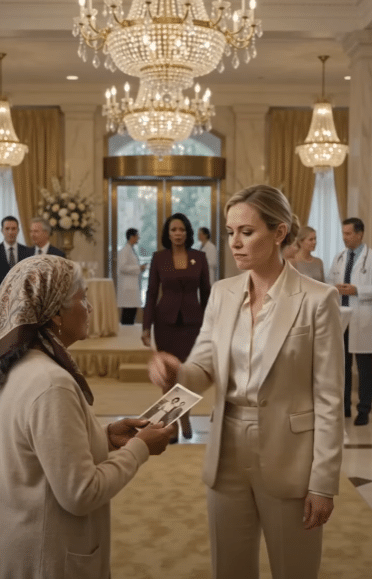
Crystal chandeliers spilled warm light across the marble lobby. White roses climbed the grand columns. A gold carpet ran from the entrance to the anniversary stage, where donors, surgeons, board members, and television cameras waited for the hospital’s most important night of the year.
Above the stage, a glowing screen read:
Saint Aurelia Medical Center — 25th Anniversary Gala
Honoring CEO Maya Whitmore
Outside those doors stood Mia.
She was seventy years old, small, and dressed in a beige cardigan, a faded floral dress, and worn black shoes. Her hands were empty. She carried no designer bag, no invitation envelope, no proof of status. Only hope.
She had worked most of her life in kitchens, laundry rooms, and private homes. Her hands had scrubbed floors, folded hospital sheets, cleaned offices, and packed lunches before sunrise. Years ago, when Maya was still a frightened little girl with no one else, Mia had taken her in and raised her as her own daughter.
Tonight, Maya was being honored as the woman who had rebuilt Saint Aurelia into one of the most powerful hospitals in the country.
Mia only wanted to stand somewhere in the back and watch her daughter smile.
She stepped carefully onto the edge of the gold carpet.
Before she could reach the entrance desk, Rosa appeared.
Rosa was thirty-five, polished, blonde, and dressed in a champagne-gold blazer that matched the event theme perfectly. She was the gala manager, and she treated the lobby like her personal kingdom. Her eyes moved over Mia’s cardigan, her shoes, her nervous hands.
Then her face hardened.
“Stop right there,” Rosa snapped. “Poor old women don’t belong at donor galas.”
Mia froze.
Several donors turned. A doctor lowered his champagne glass. A photographer paused with his camera halfway lifted.
Mia opened her mouth, but no sound came out.
Rosa stepped closer, fast and aggressive, forcing Mia backward with the force of her presence. Mia stumbled against a flower table. The crystal vase shook. A few white petals fell to the marble floor.
“Oh!” someone gasped.
“My God,” another guest whispered.
Mia steadied herself with one trembling hand.
“Please,” she said softly. “My daughter’s being honored here tonight.”
Rosa gave a small laugh, not loud, but cruel enough to cut through the room.
“Your daughter?” she said, looking toward the stage where Maya’s name glowed in gold. “That dress screams charity hallway, not the mother of anyone important.”
Mia looked down at herself. Her cardigan was old, yes. Her shoes were worn, yes. But they were clean. She had washed and pressed her dress herself that morning. She had brushed her gray hair carefully. She had wanted Maya to see her and feel proud, not ashamed.
“I only came to see Maya smile from that stage,” Mia whispered.
Rosa stepped between Mia and the VIP desk.
“No seat, no status, no reason to be seen here.”
Mia clasped her hands together.
“I’m her mother. I just want her to know I came.”
Rosa leaned close, lowering her voice into something colder than shouting.
“If Maya is smart, she’ll thank me for keeping you hidden.”
The words struck Mia harder than the fall against the flower table.
Rosa snapped her fingers. Two event guards came forward.
“Hide her before Maya sees what kind of mother poverty gave her.”
The guards hesitated, but Rosa’s glare pushed them into motion. They each took one of Mia’s arms and guided her away from the gold carpet. Not roughly enough to cause a scene, but firmly enough to make the humiliation public.
Mia looked back once.
The stage lights were bright. Maya’s name still shone above the crowd.
“Please,” Mia said. “I don’t want money. I only want to see my daughter proud.”
Rosa stood in the golden light with her arms crossed.
“Women like you raise children with guilt, then beg to stand beside their success.”
Mia stopped fighting.
She let the guards lead her into a side hallway where the music sounded distant and muffled. There, away from the donors and cameras, she sat on a bench and pressed both hands against her chest as if trying to hold herself together.
For a long moment, she did nothing.
Then she took out her phone.
Her fingers shook so badly she almost dropped it.
When Maya answered, the gala applause could be heard faintly in the background from both ends of the call.
“Maya,” Mia said, her voice breaking, “they said I would shame you if I entered.”
On the other end, there was silence.
Maya Whitmore sat in the back of a black executive car, dressed in a burgundy suit with a gold hospital pin on her lapel. She had been minutes away from the gala entrance. On her lap was the speech she had planned to give about leadership, gratitude, and the future of medicine.
The paper slipped from her fingers.
Her face changed.
The warmth left her eyes, replaced by something colder, sharper, and far more dangerous.
“Stay there, Mom,” Maya said. “They just threw out the woman who built this hospital.”
The driver looked into the rearview mirror.
Maya’s voice dropped.
“Turn around. Now.”
The black car surged through the city lights toward Saint Aurelia.
And inside the side hallway, Mia held the phone against her ear and cried silently, not knowing that the entire night was about to change.
Part 2 — The Woman Behind the Name
Maya did not enter the hospital through the front ceremony doors.
She entered through the executive entrance.
The security team recognized her immediately. Doors opened before she touched them. Staff straightened as she passed. A nurse holding a clipboard stepped aside so quickly that the papers fluttered in her hands.
Maya did not look at anyone.
“Where is my mother?” she asked.
The head of security went pale.
“Madam CEO, we were told a guest was moved to the side hallway because—”
“Where is she?”
No one answered fast enough.
Maya walked past them.
When she found Mia sitting alone on the bench, the sight almost broke her. Her mother looked smaller than usual under the cold hallway lights. One hand rested against her chest. Her eyes were red. Her cardigan sleeve had slipped down her arm.
Maya knelt in front of her.
“Mom.”
Mia tried to smile.
“I didn’t want to trouble you,” she said. “It is your night.”
Maya took her mother’s hands.
“It was never my night without you.”
Behind them, Richard Cole, the hospital board chairman, arrived from the elevator with an executive tablet in his hand. He was fifty-five, dressed in a black tuxedo with a gold pocket square, and his usual calm expression vanished when he saw Mia.
“Mia,” he said quietly.
Mia looked embarrassed and tried to stand.
Richard lowered his head with respect.
“Please don’t get up.”
Maya stood slowly.
“Richard,” she said, “pull the first donor records. The original founding file. The construction file. The first treatment wing. All of it.”
Richard understood at once.
His jaw tightened.
“Yes, Madam CEO.”
Maya turned back toward the gala.
From the stage, the host’s voice echoed through the hospital lobby.
“And now, please welcome the woman who transformed Saint Aurelia Medical Center—”
Maya stepped through the side hallway doors before the host could finish.
The crowd applauded, expecting her to enter from the gold carpet.
Instead, Maya appeared from the side, holding Mia’s hand.
The applause weakened.
People turned.
Rosa’s face drained of color for half a second before she recovered.
She rushed forward, smiling too brightly.
“Madam CEO,” Rosa said, “I am so sorry. We had a small disturbance near the entrance, but I handled it.”
Maya stopped walking.
The lobby went quiet.
“A disturbance?” Maya asked.
Rosa’s smile twitched.
“A confused woman tried to enter the donor area. She was dressed very inappropriately. I was protecting the image of the hospital.”
Maya looked at Mia.
Mia lowered her eyes.
Then Maya looked back at Rosa.
“This woman,” Maya said, “fed me when I was hungry. She worked double shifts when I needed school books. She sold the only home she ever owned so I could finish medical school.”
A murmur spread through the crowd.
Rosa’s mouth opened slightly.
Maya stepped closer.
“When the banks refused to fund my first clinic, she gave me everything she had. The first treatment wing of this hospital exists because of her.”
Richard reached the podium and connected his tablet to the main screen.
The anniversary logo disappeared.
In its place appeared an old scanned document.
Initial Private Donor: Mia Grace Whitmore
Founding Contribution: First Treatment Wing
Gasps moved through the room.
Mia stared at the screen as if she were seeing someone else’s life. She had never told anyone. She had never wanted credit. Maya had promised years ago that one day the hospital would know. Mia had always told her, “Help people first. Tell stories later.”
Tonight, the story had arrived.
Rosa stepped back.
“I didn’t know,” she said.
Maya’s expression did not change.
“That is why you never deserved power over anyone’s dignity.”
Part 3 — The Board Opens the Past
Rosa tried to recover.
Her voice shook, but she forced it into the polished tone she had used all night.
“Madam CEO, I was managing a high-profile donor event. We cannot allow just anyone to walk into a formal gala.”
Richard looked up from his tablet.
“Just anyone?”
He tapped the screen again.
Another file appeared.
A photograph of a small brick clinic from twenty years earlier. In front of it stood a younger Maya in a white coat, and beside her stood Mia, smiling proudly in the same humble way she smiled now.
Richard spoke to the room.
“Before Saint Aurelia had a surgical tower, before it had a private donor wing, before any of you called it prestigious, this hospital survived because a woman named Mia paid the first overdue equipment bill.”
The donors shifted uncomfortably.
Some looked away.
Maya took the microphone.
“My mother cleaned rooms in this hospital before some of you would even donate to it. She watched patients turned away because they had no insurance. She told me, ‘If you ever build something, build it for the people who are embarrassed to ask for help.’ That is why our free treatment program exists.”
A woman in a diamond necklace covered her mouth.
A senior surgeon bowed his head.
Rosa’s face hardened with panic.
“I apologized,” she said quickly. “I made a mistake.”
Maya turned to her.
“No. You made a choice.”
Rosa looked toward Richard.
“Please. I was protecting the hospital’s image.”
Maya’s voice dropped.
“You thought she was poor, so you thought she was powerless.”
The silence that followed was complete.
Then Mia gently touched Maya’s arm.
“Don’t let anger eat the whole night,” she said.
Maya looked at her mother, and for a moment, the CEO disappeared. The little girl Mia had raised was there again.
But Richard stepped forward.
“Mia can forgive whatever she chooses,” he said. “The board still has a duty.”
He turned to Rosa.
“Your employment ends tonight. Every donor, partner, and department head will receive a full report. You will leave this hospital immediately.”
Rosa’s eyes filled with tears.
“Please,” she whispered. “I didn’t know she mattered that much.”
Maya looked at her with quiet disbelief.
“That sentence is exactly why you cannot stay.”
Security approached.
This time, the room watched Rosa being escorted away from the very carpet she had guarded so cruelly.
No one stepped forward to help her.
No one defended her.
Mia watched with sadness, not satisfaction.
“She looks frightened,” Mia said softly.
Maya squeezed her hand.
“So did you.”
Part 4 — The Speech That Was Never Planned
The host did not know what to do.
The orchestra sat frozen. The photographers waited. The donors whispered in clusters, trying to understand whether the gala should continue or end.
Maya walked back to the stage with Mia beside her.
Richard offered Maya the prepared speech she had dropped earlier.
Maya looked at it, then folded it in half.
“I don’t need that anymore,” she said.
She faced the room.
“Tonight, I was supposed to speak about success. I was supposed to thank the board, the donors, the surgeons, and the partners who helped Saint Aurelia grow.”
She paused.
“All of that matters. But none of it matters more than the person we are when we think no one important is watching.”
The room went still.
Mia stood beside her, overwhelmed.
Maya continued.
“My mother came here tonight without diamonds, without a designer dress, without a private escort, and without announcing who she was. That made some people believe she had no value.”
She looked across the audience.
“But dignity does not come from clothing. Respect is not a reward for wealth. Kindness should not require proof of status.”
A few staff members in the back began to cry quietly.
Maya turned toward Mia.
“This hospital taught the world that care could be excellent and compassionate at the same time. But before this building had a name, my mother taught me that.”
Mia shook her head slightly, embarrassed by the attention.
Maya smiled through tears.
“You used to pack my lunch in a paper bag and write my name on it because you said every child deserves to feel expected somewhere. Tonight, you were treated like you were not expected in the place you made possible.”
Mia’s face crumpled.
Maya took her hand.
“I am sorry, Mom.”
Mia whispered, “You have nothing to be sorry for.”
“Yes,” Maya said. “I do. I built a hospital powerful enough to impress the world, but I did not make sure it was gentle enough to recognize you.”
The room absorbed the words like a verdict.
Richard stepped to the microphone.
“By authority of the board, effective tonight, the central atrium will be renamed Mia Hope Hall. Every donor, patient, doctor, and guest will enter beneath the name of the woman whose sacrifice opened our first treatment wing.”
The main screen changed.
A digital rendering appeared:
MIA HOPE HALL
The first applause came from a nurse.
Then a surgeon.
Then the entire staff.
Soon the donors stood too.
Mia covered her mouth with both hands.
For the first time that night, she was not being stared at with judgment.
She was being seen.
Part 5 — The Door That Opens First
Three months later, Saint Aurelia looked different.
The chandeliers were still there. The marble still shone. Wealthy donors still walked through the lobby in tailored suits and expensive shoes.
But above the entrance, engraved in warm gold letters, was a new name.
MIA HOPE HALL
Every morning, patients passed beneath it.
A single mother carrying a sick child. An elderly man leaning on a cane. A delivery driver with no insurance. A young nurse arriving for her first shift. A billionaire donor stepping out of a black car.
All of them entered through the same doors.
Mia visited on a quiet Tuesday afternoon, not for a gala, not for an award, not for cameras.
She came to bring Maya soup.
The receptionist saw her and stood immediately.
“Mrs. Whitmore,” the young woman said warmly, “welcome home.”
Mia smiled, still not used to the words.
“I’m only here to see my daughter.”
“She’s expecting you.”
Mia walked slowly through the atrium. Her shoes clicked softly on the marble. Staff members greeted her with respect, but not the stiff kind that made her uncomfortable. They greeted her like someone known.
Near the free treatment desk, a woman sat crying quietly with a hospital bill in her hands.
Mia stopped.
The woman looked up, embarrassed.
“I’m sorry,” the woman said. “I’m just trying to understand if I qualify for help.”
Mia sat beside her.
“What’s your name, dear?”
The woman blinked.
“Caroline.”
Mia took her hand.
“Caroline, this hall was named for people who are afraid to ask. You are already in the right place.”
Across the atrium, Maya watched from the balcony.
Richard stood beside her.
“She still does more for this hospital in five minutes than most of us do in a board meeting,” he said.
Maya smiled.
“That’s how she built it.”
Down below, Mia guided Caroline toward the assistance desk. A staff member came forward gently. No one looked annoyed. No one judged her clothes. No one asked whether she belonged.
Later, Maya found Mia in the atrium, standing beneath the gold letters of her name.
“You know,” Maya said, “you still don’t have to bring me soup. We have an entire cafeteria.”
Mia handed her the container anyway.
“Hospital soup tastes like sadness.”
Maya laughed for the first time that day.
Then her eyes moved to the engraved sign.
“Does it still feel strange?” she asked.
Mia looked up.
“A little.”
“Do you dislike it?”
Mia thought for a moment.
“No,” she said. “But I hope people don’t remember me because my name is on the wall.”
Maya softened.
“How do you want them to remember you?”
Mia looked toward the entrance, where another patient was being welcomed in.
“I want them to remember that a door can be beautiful, but it only matters if it opens for the right reasons.”
Maya put an arm around her mother.
Outside, the afternoon sun warmed the glass.
Inside, the hospital moved around them: footsteps, quiet voices, rolling carts, distant monitors, life continuing in all its fragile, ordinary urgency.
Mia leaned her head lightly against Maya’s shoulder.
“I only wanted to see my daughter proud,” she said.
Maya kissed her gray hair.
“You did more than that,” she whispered. “You taught her what pride should mean.”
At the far end of the atrium, a new family entered hesitantly, unsure if they belonged in such a beautiful place.
The receptionist smiled and stepped forward.
“Welcome to Mia Hope Hall,” she said. “How can we help you?”
Mia heard the words.
This time, she did not cry from pain.
She cried because the door had opened.