The Award That Carried Her Name
Part 1 — The Woman in the Back Hallway
The Aurelius Global Awards had been designed to make ordinary people feel small.
Everything inside the grand ballroom shone too brightly. Gold chandeliers poured light over polished marble. Champagne glasses caught the glow like tiny stars. Executives in black tuxedos and diamond jewelry moved slowly through the room, speaking in quiet voices that sounded expensive even when they said nothing important.
At the center of the hall stood a massive stage framed by velvet curtains and a gold corporate emblem.
Tonight, the world had gathered to honor Hector Vale.
At forty-five, Hector was one of the most powerful men in American business. He had built ValeBridge Holdings from a failing supply company into a billion-dollar empire. His face had been printed on business magazines. His speeches were studied in leadership programs. People called him visionary, ruthless, brilliant, unstoppable.
But before all of that, he had been a grieving boy with no mother.
And Mia had been the woman who took him in.
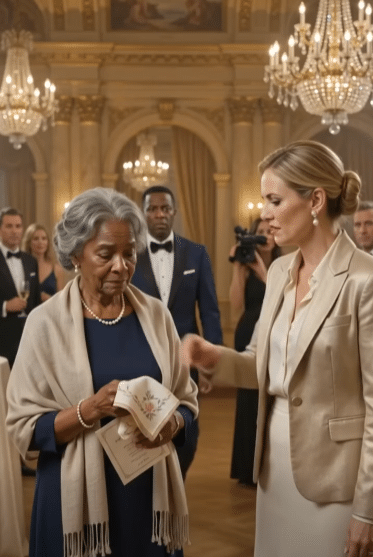
She arrived at the gala quietly, wearing a modest navy dress, a beige shawl, and worn black flats polished as carefully as she could manage. She had spent nearly an hour brushing her soft gray hair and smoothing her dress in front of the mirror. She knew she did not look like the women in the front row. She had no diamonds. No designer handbag. No assistant guiding her through the doors.
But Hector had asked her to come.
He had said, “Mom, I want you in the front row when they give me that award.”
So Mia came.
She stepped carefully onto the gold carpet, eyes shining as she looked toward the stage where Hector’s name glowed above the podium. For one brief moment, pride warmed her chest so deeply that she forgot to feel nervous.
Then Rosa stepped in front of her.
Rosa Hart was the elite event director for the gala, a white woman in a champagne-gold blazer, ivory blouse, and cream skirt. Her blonde hair was twisted into a perfect bun, and every movement she made seemed rehearsed to communicate control.
Her eyes swept over Mia’s dress, shawl, shoes, and trembling hands.
Disgust flickered across her face.
“Stop right there,” Rosa snapped, loud enough for nearby guests to turn. “Front-row seats are for people who built success, not old servants wearing borrowed importance.”
Before Mia could answer, Rosa grabbed the velvet rope and pulled it hard across Mia’s path. The rope snapped tight with a sharp sound. At the same moment, Rosa stepped forward and bumped Mia’s shoulder with enough force to knock her sideways.
Mia stumbled into a chair.
A few guests gasped.
“Oh my God,” someone whispered.
Mia gripped the back of the chair to keep herself from falling. Her face burned with humiliation.
“Hector asked me to sit here tonight,” she said, her voice shaking. “And I only came to watch him receive his award.”
Rosa stepped closer, blocking the aisle completely.
“Then Hector should have hidden you better,” she said. “Because that dress makes his success look painfully cheap.”
Mia looked down at herself. The dress was simple, yes, but it was clean. She had pressed it twice. The shawl was old, but she had chosen it because Hector once said blue made her look peaceful.
Rosa did not care.
She circled Mia like an inspector examining something that should have been removed before guests arrived.
“Look at you,” Rosa said. “You brought kitchen memories to a billion-dollar room and expected respect.”
“I held Hector through every night after his mother died,” Mia replied softly. “Before anyone in this room knew his name.”
The words did not soften Rosa. They seemed to irritate her more.
At the VIP check-in desk, Rosa slapped her palm on the surface and leaned forward.
“Standing near a famous man does not turn a tired old caregiver into someone important.”
Mia swallowed hard.
“I raised him when he had no one left,” she said. “And he told me this seat was meant for me.”
Rosa gave a small, polished laugh.
“That is exactly the kind of story people tell when they want credit for someone else’s success.”
Then she signaled to two event ushers.
“Move her before Hector sees poverty standing beside his name like it helped create him.”
The ushers hesitated, but Rosa’s glare made them obey. They guided Mia away from the front row and toward a side hallway. Mia looked back once, toward the glowing stage, toward the place where she had promised herself she would sit still and clap proudly when Hector walked up.
“I only wanted to watch him receive his award,” she whispered. “Not take anything from his night.”
Rosa followed her into the corridor, heels clicking sharply on the floor.
“Sweet stories about raising someone do not make you a legend,” Rosa said. “They make you an old woman begging for credit.”
Mia stopped near the wall.
The music from the gala became muffled behind the side door. The applause sounded far away, like it belonged to a different life.
Mia’s voice broke.
“I sold my diner so Hector could start his first company,” she said. “And I never asked him to repay me.”
For the first time, Rosa paused.
Not because she believed Mia.
Because she hated the idea that someone so plain could still speak with dignity.
“Sit here,” Rosa said coldly. “And stay out of the way.”
Then she returned to the golden hall.
Mia sat alone in the side corridor while the gala continued without her.
For several minutes, she tried not to cry. She folded her hands in her lap. She told herself Hector had enough to carry tonight. She told herself she should not trouble him. She told herself maybe Rosa was right in one small way: perhaps she did not belong in the front row of such a wealthy room.
But then she heard the announcer through the wall.
“And now, the man whose leadership transformed an industry — Mr. Hector Vale.”
The crowd erupted.
Mia reached for her phone with trembling fingers.
Hector answered on the second ring.
“Mom?” he said. “Are you already seated? I’m about to walk out.”
Mia closed her eyes.
“Hector,” she whispered, “they said I make your front row look cheap, and maybe I should not have come.”
There was silence.
In the backstage executive suite, Hector stood beside a polished table with his speech in his hand. The first line read:
To the woman who raised me.
His face changed.
All the warmth left his expression. Not because he stopped loving Mia, but because something inside him had gone cold with purpose.
“Stay there, Mom,” he said. “Tonight’s award was always for you, and everyone will know that before I speak.”
He ended the call.
The stage manager smiled nervously.
“Mr. Vale, they’re waiting for you.”
Hector placed his speech on the table.
“Good,” he said. “Let them wait.”
Part 2 — The Man Behind the Empire
When Hector stepped into the ballroom, he did not walk toward the stage.
He walked toward the side corridor.
The applause became confused, then faded. Guests turned their heads. Cameras followed him. Executives whispered. Rosa, standing near the gold aisle, stiffened when she saw him moving in the wrong direction.
She hurried toward him.
“Mr. Vale,” she said with a practiced smile. “The stage entrance is this way.”
Hector did not look at her.
“Where is my mother?”
Rosa’s smile cracked.
“I’m sorry?”
“My mother,” Hector repeated. “Mia Vale. Where is she?”
A few people nearby fell silent.
Rosa tried to recover. “There was a small seating misunderstanding. An elderly woman became confused about the front row, so I had staff guide her somewhere more appropriate.”
Hector finally looked at her.
The expression on his face made Rosa take half a step back.
“More appropriate?”
Before she could answer, Mia appeared at the edge of the hallway. She had heard his voice and risen from the bench.
“Hector,” she said quickly, embarrassed. “Please, don’t make trouble. It’s your night.”
Hector crossed the space between them and took her hands in his.
“My night?” he asked. “Mom, there is no night, no stage, no company, no award without you.”
Mia shook her head, eyes wet.
“I didn’t want them to laugh at you.”
Hector turned slowly toward the ballroom.
“They are going to learn why they should have stood for you.”
Rosa rushed forward, voice low and panicked.
“Mr. Vale, I truly think we should handle this privately.”
Hector’s eyes never left her.
“You already handled it publicly.”
The room went still.
Hector guided Mia back toward the front row. Each step felt heavier than the last. Guests moved aside, not because anyone told them to, but because the power in the room had shifted.
Rosa tried to stop them again.
She forced a laugh, desperate to sound in control.
“Look at her,” she said, gesturing toward Mia. “She thinks raising a child makes her worthy of standing near billionaires.”
The words barely left her mouth before she realized Hector had gone completely still.
He stepped in front of Mia like a wall.
“Careful,” he said. “That woman kept me alive when money, status, and people like you were nowhere near me.”
Rosa’s pride fought against her fear.
“A tuxedo cannot rewrite a kitchen woman into a legend,” she said, “no matter how sentimental you sound.”
A murmur rippled through the audience.
Hector walked to the podium and placed one hand on it.
“Say one more word,” he said. “My board is hearing everything, and every camera in this hall is still recording.”
Rosa’s eyes flickered toward the cameras.
But humiliation had made her reckless.
She grabbed the microphone.
“Good,” she said, loud enough for the room. “Let them hear me protect this award from a kitchen beggar pretending sacrifice is the same as success.”
The crowd inhaled.
Mia looked down, as if the words had struck her physically.
Hector took out his phone, tapped one contact, and placed it beside the microphone on speaker.
“Then repeat every word when Richard opens my first funding file and reads who made this empire possible.”
The call connected.
Richard Cole, the board chairman, answered from the private lounge above the ballroom.
“Hector?”
“Richard,” Hector said. “Stop the award now. Open the first company funding file and put it on the main screen.”
Richard did not ask why.
Something in Hector’s voice told him this was not a request.
“Mr. Chairman,” Richard said, now fully alert, “no one leaves that hall. I am coming to the stage with the board records.”
Rosa’s face changed.
“Chairman?” she whispered.
Hector looked directly at her.
“Good,” he said. “Say that again when the board meets my mother and learns what your arrogance just insulted.”
For the first time that night, Rosa had nothing to say.
Part 3 — The File That Broke the Room
The executive elevator opened with a sharp chime.
Richard Cole entered the ballroom with three board members behind him. He carried a tablet in one hand, his face pale with anger and shame.
The guests parted.
Rosa tried to step forward.
“Mr. Cole, I can explain—”
Richard passed her without stopping.
He reached the podium and slammed the tablet down hard enough to make the microphone rattle.
The main screen behind the stage changed.
The gala logo disappeared.
In its place appeared an old scanned document: a sale record for a small neighborhood diner.
Beneath it was another file.
Initial Funding Deposit — ValeBridge Supply Company
Source: Mia Vale
Amount: Proceeds from sale of diner property
The room fell into stunned silence.
Richard turned toward Rosa.
“Who called the woman behind this empire a kitchen beggar in front of every partner we respect?”
Rosa’s lips parted, but no answer came.
She gripped her event badge as if it might protect her.
“I protected the ceremony from someone who looked completely inappropriate for a room this important.”
The sentence sounded weaker once it entered the air.
Hector turned to the screen.
“That diner was her whole life,” he said. “She opened it before sunrise and closed it after midnight. When my mother died, I slept in the storage room because I had nowhere else to go. Mia fed me, raised me, and gave me a reason to survive.”
Mia covered her mouth, overwhelmed by the attention.
Hector continued.
“When I wanted to start my first company, every investor laughed at me. Every bank rejected me. I came home ashamed and told her I was done.”
He looked at Mia.
“She sold her diner the next week.”
Gasps spread across the room.
Mia shook her head, as if trying to stop him from giving her too much credit.
But Hector would not stop.
“She sold that diner when no investor believed in me, and she never once asked for credit.”
Richard swiped the tablet.
The next document appeared.
A bank transfer. A business registration. A photo of Hector at twenty-three standing beside Mia in front of a tiny rented office.
Richard addressed the room.
“Her sacrifice funded the first company account this empire ever had, before any partner trusted his name.”
Several executives lowered their eyes.
Some of them had been in business long enough to know what that meant. Before the headquarters, before the investors, before the global contracts, there had been one woman giving up everything she owned.
Rosa tried to save herself.
“I did not know she mattered that much,” she said. “I thought she was just another old woman chasing importance.”
The room went colder.
Hector turned to her slowly.
“That,” he said, “is why you never deserved power over dignity, image, access, or anyone standing at your door.”
Richard tapped the tablet.
“Your contract ends tonight,” he said. “Every partner will receive this footage and the reason you were removed.”
Two security officers approached.
Rosa’s composure collapsed.
“Please,” she said, dropping to one knee. “I was only protecting the award’s image. I did not mean to destroy my career.”
Hector looked at her, not with rage now, but with final disappointment.
“You destroyed it when you decided a woman’s worth depended on how expensive she looked.”
Security escorted Rosa away from the stage.
No one applauded.
No one laughed.
The silence was worse.
Part 4 — The Award Changes Hands
For a moment, the gala had no direction.
The orchestra did not know whether to play. The host stood frozen behind the curtain. The photographers waited, unsure if they were witnessing a scandal or a historic moment.
Then Hector reached for Mia’s hand.
“Come with me.”
Mia resisted softly.
“Hector, no. Please. I don’t need all this.”
“I do,” he said.
He led her up the gold carpet toward the stage.
This time, everyone moved aside with respect.
Richard stepped away from the podium and bowed his head. The board members stood behind him. Guests rose slowly from their chairs.
Hector brought Mia to the center of the stage.
The old diner photo still glowed on the screen behind them.
He turned to the audience.
“I prepared a speech tonight about ambition,” he said. “About leadership. About risk. About building something from nothing.”
He looked at Mia.
“But I did not build something from nothing. I built it from her sacrifice.”
Mia’s shoulders trembled.
Hector continued.
“I used to think success meant proving the world wrong. Now I know success means remembering who loved you before the world knew your name.”
A few people in the audience wiped their eyes.
Mia whispered, “You don’t have to say more.”
Hector smiled gently.
“I have to say what I should have said years ago.”
He turned to the screen.
The gala team, following Richard’s quiet instruction, changed the display.
A new image appeared: a gold plaque design.
THE MIA LEGACY AWARD
Mia stared at it, unable to move.
Hector’s voice softened.
“From today, this award carries my mother’s name, because every empire should remember who kept it alive.”
The audience rose.
The applause began quietly, then grew until it filled the ballroom.
Mia touched the edge of the podium to steady herself.
“I only wanted to see my son stand tall,” she said through tears. “But you made my old love stand beside him.”
Hector pulled her into his arms.
For a moment, the billionaire disappeared.
He was only a son holding the woman who had saved him.
Part 5 — What the Name Meant
The story did not end at the gala.
By morning, clips from the event had spread across every major business platform. Headlines named Hector generous, loyal, noble. Commentators praised the board for acting quickly. People shared photos of Mia touching the new plaque with tears in her eyes.
But Hector refused every interview request that tried to make him the hero.
“My mother is the story,” he told his communications team. “Not me.”
A week later, he announced the Mia Vale Foundation, built to fund small businesses started by caregivers, widows, foster parents, and working-class families who had been overlooked by traditional investors.
At the first foundation meeting, Richard presented a list of applicants. Hector read through the names quietly, but Mia sat beside him and asked the questions no algorithm could answer.
“Who is taking care of children while building this?” she asked.
“Who has already sacrificed something?”
“Who has been told they do not belong in the room?”
Hector smiled as he listened.
This was why the foundation needed her.
Months passed.
The first Mia Legacy Award was given not to a billionaire, not to a celebrity founder, and not to a polished executive, but to a woman who had run a laundromat for twenty-eight years and used her savings to help three foster children start college.
Mia presented the award herself.
She wore the same navy dress.
This time, no one looked at it with contempt.
When she stepped onto the stage, the audience stood before she spoke.
Mia looked out at the room, nervous but steady.
“I used to think love disappeared when no one saw it,” she said. “But love waits. It waits in kitchens, in diners, in laundry rooms, in long shifts, in tired hands, in people who give without asking to be remembered.”
She looked at Hector in the front row.
“And sometimes, if we are lucky, love is remembered after all.”
Hector stood with tears in his eyes.
The applause that followed was not the empty applause of rich people honoring themselves.
It was deeper than that.
It was the sound of a room understanding, at last, that dignity had never belonged to the front row.
It belonged to the people who made it possible for others to sit there.
After the ceremony, Mia walked slowly through the ballroom. Younger founders came to her, not to flatter her, but to thank her. One woman said she had almost given up before hearing Mia’s story. A young man said his grandmother had raised him too. Another founder simply hugged her and cried.
Near the exit, Hector found Mia standing beside the old diner photo, which had been framed and placed permanently in the hall.
“Are you tired?” he asked.
“A little,” she admitted.
“Do you want to go home?”
Mia looked around the golden room, then back at the photograph.
“For years, I thought selling that diner meant I lost my place in the world,” she said. “But maybe I did not lose it. Maybe I planted it somewhere else.”
Hector took her hand.
“You planted it in me.”
Mia smiled.
“And look how tall you grew.”
Outside, the city lights shimmered against the glass. Inside, the last guests slowly left the ballroom. The stage crew dimmed the chandeliers one by one, but the plaque remained lit.
THE MIA LEGACY AWARD
Hector walked his mother toward the door, not behind him, not beside the staff entrance, not hidden in a side hallway.
Beside him.
Where everyone could see.
Mia paused at the threshold and looked back once more.
“You gave my love a name,” she said quietly.
Hector kissed her hand.
“No, Mom,” he replied. “I only put your name where it always belonged.”
Then they stepped out together, leaving the golden room behind them.
And from that night forward, no one entered a ValeBridge event without seeing the words engraved above the main hall:
Success is not built by the powerful alone. It is built by the people who loved them before they were powerful.