CHAPTER 1: THE FALL AND THE MONARCH
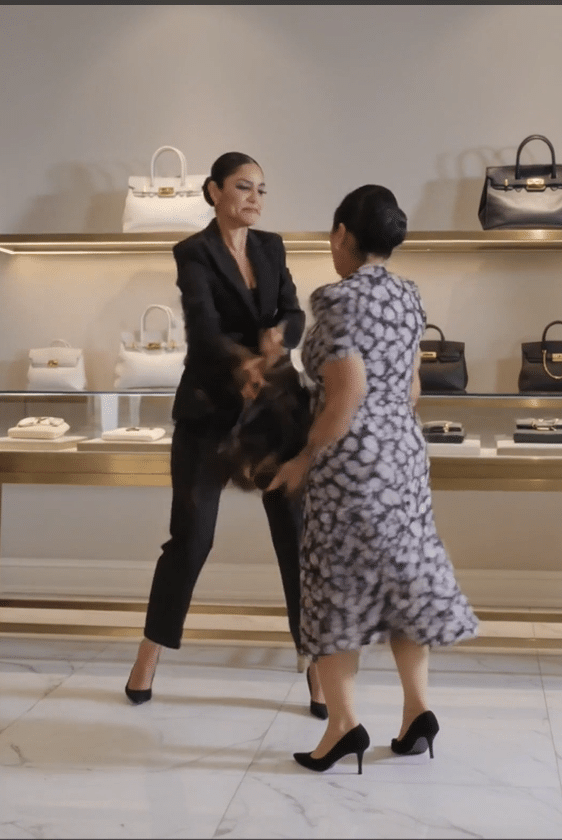
The distinguished crowd in the store stood absolutely paralyzed. A unison, scandalous “Oh!” burst from the throats of those present, followed by muffled gasps of “My God!” and “Who is she?”. The air grew thick with an unbearable tension. Yet no one—absolutely no one—made the slightest move to help the fallen woman. Whispers multiplied like a swarm of bees as the wealthy VIP clients took several steps back, horrified by the scandal or simply morbidly curious, shielding their expensive clothes from the scene.
Elena planted herself right over the fallen elderly woman, casting a menacing shadow upon her. She looked down on her from above with absolute, visceral contempt, her red-painted lips pursed in an expression of indescribable disgust.
“Get your filthy hands off here! You can’t afford this!” Elena screamed at the top of her lungs, her voice cutting through the tense air of the boutique like a sharp knife, making sure everyone present witnessed her demonstration of power.
Doña Maria, visibly dazed by the blow and the fall, placed a trembling hand on the freezing floor to try and push herself up slowly, while her other hand touched her reddened cheek, which was already beginning to swell. Despite the humiliating public assault, her dark eyes maintained an unshakeable dignity—an ancient, silent strength that no classist slap could ever break or subdue.
“Go back to the market, you reek of the streets,” Elena added, delivering the final blow of her cruel verbal assault, sardonically enjoying the fleeting power she believed she held in her small, frivolous glass kingdom.
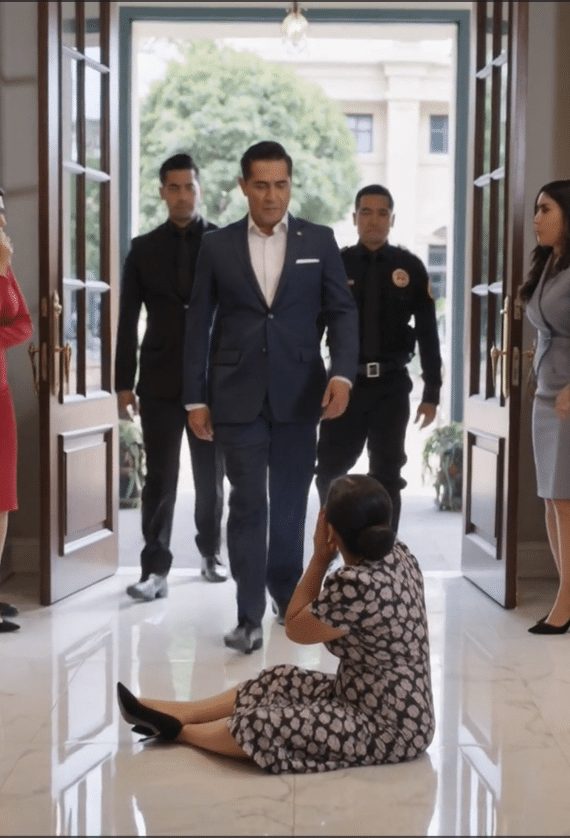
But before the elderly woman could even process the words or respond to the offense, a massive metallic crash echoed at the entrance of the premises. The heavy glass and bronze doors of the boutique swung wide open with such force that the glass threatened to shatter into a thousand pieces. The elegant crowd parted immediately, involuntarily forming a wide aisle out of pure survival instinct before the overwhelming, intimidating presence that had just burst into the place.
He was an imposing man of about fifty-five, a billionaire with an unmistakable aura and eyes of steel. He wore a custom-made, dark gray suit that radiated absolute power, money, and authority from every fiber of its fabric. Closely flanked by a pair of formidable bodyguards who looked like mountains in suits, he walked directly and without hesitation toward the spot where Doña Maria still lay. The tension in the store reached its peak; the silence was deafening. The influential man completely ignored Elena, who still maintained her haughty, threatening pose over the victim.
Upon arriving exactly in front of the elderly woman, the tycoon stopped abruptly. Before the astonished, perplexed, and terrified eyes of everyone present—including the wealthiest snobs of Polanco—he bowed deeply. He bent his torso at a perfect ninety-degree angle, showing a level of respect and submission that bordered on religious devotion.
“Doña Maria, the board of directors of this brand awaits your orders,” the billionaire said in a grave, firm, deep, and deeply respectful voice, breaking the tense silence of the room and altering the order of the universe for everyone present.
Elena froze on the spot. The color drained from her face in a fraction of a second, leaving her as pale and cold as the marble beneath her designer feet. Her eyes widened excessively, on the verge of absolute panic and a mental breakdown. She staggered half a step back, her hands falling to her sides like dead weights, stripped of all the strength, haughtiness, and arrogance she had so proudly exhibited just a few miserable seconds ago. A paralyzing fear seized her vocal cords while her limited, superficial mind tried to process the monumental catastrophe she herself had just unleashed.
“W-what…?” was all Elena managed to articulate in a trembling, barely audible sigh, suddenly becoming the vivid image of the total collapse of her false reality.
CHAPTER 2: THE TRUE OWNER
The silence that followed the sudden and shocking intervention of the powerful tycoon was so dense, heavy, and suffocating that it could almost be physically cut with a scalpel. Don Alejandro, widely known and feared in the highest financial, corporate, and political circles of all Latin America as the ruthless “Shark of Monterrey,” maintained his strict posture of absolute respect before the humble woman in the floral dress. Slowly, after a few seconds that felt like hours, he extended his strong hands—neatly clad in fine leather gloves of the highest quality—to help Doña Maria up from the boutique’s cold floor.
The elderly woman accepted the billionaire’s help with a natural elegance, serenity, and grace that contrasted violently and poetically with the undeserved roughness of her previous fall. With slow, meticulous, and deliberate movements, Doña Maria brushed imaginary dust from her simple floral skirt and proceeded to carefully adjust her colorful Oaxacan shawl over her fragile yet strong shoulders. Her left cheek bore a clear, painful, reddened mark—the infamous imprint of the manager’s fingers—but her dark eyes, deep, wise, and ancient like the cenotes of the peninsula, showed no physical pain or fear, but rather a profound, heavy disappointment in humanity.
The VIP clients, who just moments before were whispering with disdain and looking away with moral superiority, now looked like statues of salt frozen in terror. Wealthy women, clutching convulsively to their exclusive European designer handbags, avoided any kind of eye contact with the elderly woman at all costs. The vast majority of them knew perfectly well and without a doubt who Don Alejandro was; his stern, calculating face regularly graced the cover of Forbes magazine and major international financial newspapers every single year. And if that untouchable man, absolute owner of transnational banks and immense conglomerates, bowed that way before that village-looking elderly woman, it irremediably meant they had all just witnessed—and been silent accomplices to—an error of truly catastrophic proportions.
Elena, visibly shaking from head to toe like a leaf whipped by a relentless hurricane, desperately tried to regain a fraction of her professional composure, though her knees threatened to buckle and collapse under her own weight at any moment. A cold, paralyzing, definitive dread coursed down her spine, freezing her blood.
“Mr. Alejandro… sir, I… I swear to you this is a terrible, a dreadful misunderstanding,” Elena stammered frantically, her voice, which was once sharp, authoritative, and painfully arrogant, now reduced to a pleading, pathetic, high-pitched squeak. “This woman… this person was harassing our most valuable clients. We have extremely strict operational policies regarding the dress code and behavior inside this luxury boutique. You better than anyone know that we must maintain the high standards of this prestigious international brand.”
Don Alejandro didn’t even deign to turn his head to look at her. He ignored her with the same coldness one would show an annoying insect on the wall. He kept his eyes firmly fixed on Doña Maria’s serene face, patiently awaiting her indication or command. It was the aggrieved elderly woman who, letting out a long sigh heavy with the accumulated weariness of the years, slowly turned around to face the terrified store manager eye-to-eye.
CHAPTER 3: THE TRIAL IN THE BOUTIQUE
“Money, my young and confused girl, can buy many things in this complex world,” Doña Maria began to speak. Her voice was soft, with that characteristic sing-song, maternal, and warm accent typical of kind Mexican grandmothers from the south of the country, but at the same time, it was charged with an absolute, undeniable, and overwhelming authority that filled the entire space of the store. “It can easily buy these ridiculous imported marble floors that you care for and polish so much. It can effortlessly buy those European leather bags you idolize as if they were gods. But listen to me well, there are two fundamental things in this life that all your money will never be able to buy: true education and authentic class.”
Elena swallowed with extreme difficulty, feeling a knot of panic the size of a rock blocking her throat. She vividly felt that the central air conditioning of the luxury boutique had suddenly dropped to sub-zero temperatures, freezing the cold sweat that now beaded her perfectly made-up forehead.
“Ma’am, please, I beg you, let me explain my reasons…” Elena tried to intervene in an act of pure desperation, her French-manicured hands trembling so violently and uncontrollably that she had to interlock them tightly in front of her stomach to try to hide her terror.
“Explain exactly what to me?” Doña Maria interrupted her, without bothering to raise her voice by a single decibel, yet projecting a crushing firmness that echoed gloomily off the glass walls of the premises. “Are you going to explain to me that my brown skin color deeply offends you? Are you going to explain that my cotton clothes seem unworthy and offensive to your refined presence? You contemptuously sent me back to the public market. You dared to scream in my face that I reek of the streets in front of all these people.”
Doña Maria, showing not an ounce of intimidation, took a firm, decisive step forward, closing in dangerously on Elena, who instinctively backed away like an animal cornered by a far superior predator.
“I will tell you something very important about the traditional market, Elena,” the matriarch continued relentlessly, narrowing her eyes and clearly reading the name engraved on the solid gold badge proudly pinned to the lapel of the manager’s expensive blazer. “In the tianguis and markets of our Mexico, there is far more dignity, more hard work, more honesty, and more human decency in a single morning of sales than in your entire empty, superficial, and cruel career inside this glass store. You people, who stupidly pride yourselves on selling exclusivity to the highest bidder, have completely forgotten that the truest, greatest luxury of all is to treat fellow human beings with absolute respect, no matter what they wear on their backs or the color of their skin.”
Doña Maria’s masterful speech was by no means a hysterical cry for personal revenge, but a profound moral lesson that brutally stripped bare the superficiality, internalized racism, and sickening classism rooted in every corner of that elitist space. Don Alejandro’s massive bodyguards watched the tense scene with completely inscrutable, professional faces, while the powerful tycoon nodded slightly, sharing and backing every word of the sentiment expressed by his ultimate boss.
CHAPTER 4: THE IMMEDIATE CONSEQUENCE
Elena, feeling totally cornered, ally-less, and desperate to save the remnants of her professional career and social life, turned her gaze toward Don Alejandro, looking for some tiny glimmer of corporate mercy or understanding between “high-level” individuals.
“Mr. Alejandro, I implore you, please, I have worked tirelessly in this multinational company for more than ten years of my life. I personally know each and every one of the most important, wealthy, and influential clients in Mexico City. I was named and awarded as the best sales manager in the entire Latin American region last year…” Elena pleaded miserably, as crocodile tears of real panic began to well up, completely ruining her eyeliner and perfect makeup, leaving black streaks down her pale cheeks.
Don Alejandro, after listening to the pitiful plea, finally turned his head to look her straight in the eyes. His gaze was so cold and devoid of empathy that it seemed made of pure ice.
“That is precisely and exactly the central problem here, Elena. You have been the proud, visible face of this brand in the country for ten long years, actively fostering, tolerating, and perpetuating a toxic culture of discrimination, racism, and arrogance that the new global administration is utterly determined to eradicate from the roots starting today,” the billionaire replied in a voice devoid of any human emotion. “Doña Maria is not just some simple minority investor you can compensate with a gift. She is the absolute president and majority owner of the international conglomerate that hostily acquired the entirety of this fashion house’s global shares this morning at exactly eight o’clock. This store, the brand, the building, and your contract belong to her.”
The psychological and professional death blow had been dealt with lethal precision. The contained whispers erupted uncontrollably once again among the wealthy clients, this time transformed into loud gasps of pure astonishment and genuine terror. That simple woman in the cheap floral dress and dusty shawl was, in fact, the supreme owner of everything that surrounded them and the brand they so adored.
Doña Maria raised a hand, calling for silence, and the entire store fell mute instantly.
“I do not need nor care for your ten years of experience dedicated to humiliating your own people to please foreigners, Elena. You are fired. Immediately, and without the right to references,” the matriarch sentenced with a judicial coldness that admitted no appeal whatsoever.
Elena broke down completely and burst into hysterical crying, letting out a pathetic, mournful sob that echoed shamefully through the luxurious acoustics of the boutique. Don Alejandro, showing no trace of pity, made a brief, sharp signal with his right hand to his private security men.
“Escort the young lady to the back office immediately so she can retrieve only her personal belongings, and ensure she leaves the building through the freight service door, confiscating her keys and access passes,” the tycoon ordered sternly.
Two burly men dressed in impeccable black suits quickly approached Elena, flanking her. There was not a single drop of haughtiness or power left in her—only the crushing, public, and total shame of having been dethroned and humiliated in front of everyone. Crying rivers, she was forcibly escorted away from the pristine sales floor, parading under the judging and cruel glares of the very same VIP clients she had tried to impress and protect minutes earlier.
CHAPTER 5: THE STORY OF DOÑA MARIA
Once the disgraced former manager completely disappeared from view into the back hallways, Don Alejandro turned and addressed the silent crowd with a commanding voice.
“Ladies and gentlemen, I inform you that the store will remain closed for the rest of the day to conduct an extraordinary and urgent meeting of the global board of directors. We thank you very much for your visit today and cordially invite you to vacate the premises at this very moment.”
The wealthy clients, deeply embarrassed and fearful of their cowardly, silent complicity during the terrible physical assault on Doña Maria, hurriedly left the boutique. They walked with their heads bowed, some stumbling in their rush to exit, never daring to cross eyes with the imposing new owner of the brand.
When the massive commercial space was finally empty, save for the armed security personnel and the younger salespeople watching the scene from a distance—completely terrified and fearing for their own jobs—Don Alejandro kindly offered his arm to Doña Maria to safely guide her toward the exclusive private boardroom on the second floor.
As they walked slowly up the majestic, slippery staircase of Italian glass, Alejandro broke the tense silence that had formed.
“Are you truly alright, Madam President? We can immediately call a specialist doctor to check and treat that blow to your face. We shouldn’t take any risks.”
Doña Maria suddenly let out a soft, throaty laugh full of genuine amusement, completely downplaying the situation.
“Oh, my dear boy. Don’t worry about nonsense; I have survived far worse things in this life. When I first started my business, selling textiles and woven baskets in the noisy tianguis of Ocotlán, back in my beautiful Oaxaca, we sometimes had to defend our small stalls with our fists against destructive hailstorms and abusive tax collectors who wanted to steal the little we had. I assure you that a ridiculous slap from a conceited, spoiled, and classist city girl is not going to kill me or lose me any sleep.”
And that was the undeniable, fundamental truth about Doña Maria’s life. She was not born with a silver spoon in her mouth, nor did she inherit European trust funds. She had built her vast, incalculable financial empire literally cent by cent, thread by thread. She started by exporting small, humble Mexican crafts abroad until she managed to create—with blood, sweat, and tears—a colossal international holding company that spanned haute couture, shipping, and luxury real estate. Despite her billions in the bank, she never forgot her humble roots. She wore the colorful embroideries of her homeland with tremendous pride to daily remind herself of where she came from and, above all, to honor the memory of the thousands of indigenous women who worked from sunrise to sunset in the fields—the true, talented, and unrecognized artists behind many of the aesthetic patterns that major European brands shamelessly stole, plagiarized, and sold at exorbitant prices.
CHAPTER 6: THE RESTRUCTURING
The immense VIP lounge of the boutique was designed specifically for extreme indulgence and the comfort of the elite. It featured imported velvet armchairs, contemporary artwork, and chilled bottles of French champagne waiting to be uncorked. Doña Maria walked in with a firm step and sat directly at the head of the massive conference table of tempered glass, waving away the expensive champagne with a polite gesture and requesting simply a glass of plain water at room temperature.
The high-ranking regional board members, who had been anxiously waiting and sweating cold on the upper floor after hearing about the scandal downstairs, quickly took their seats, visibly nervous and pale. Each and every one of them wore extremely expensive dark suits, silk ties, and gleaming Swiss watches that cost fortunes. They stared fixedly at Doña Maria, the woman in the floral dress, with a complex mix of primal fear, confusion, and deep corporate reverence.
“Gentlemen directors,” Doña Maria began to speak, her face turning completely serious, hardening her features. “What tragically just happened on the floor below is not an isolated incident or the mistake of a single employee. It is the clear and evident symptom of a terminal illness rotting this fashion industry from its core. For decades, you have successfully sold the toxic idea that to be exclusive means to be exclusionary and cruel. You have taught that true luxury consists of having the power to step on, despise, and humiliate others who have less.”
The woman calmly opened a thick black leather folder that Don Alejandro diligently handed to her and pulled out a long series of legal and financial documents.
“I bought the entirety of this iconic brand this morning, and I did not do it to keep feeding the empty egos of the rich in Polanco, Paris, or Milan. I bought it with the sole and firm purpose of drastically changing the rules of the game worldwide. Starting tomorrow first thing in the morning, I demand and order a complete and total restructuring of all management and sales staff. We will immediately implement a policy of absolute zero tolerance for discrimination of any kind. Anyone—and I repeat, anyone—who treats a client poorly, looks down on them, or disrespects them because of their physical appearance, race, social status, or ethnic origin will be fired that very day without severance for an ethics violation.”
The frightened executives nodded frantically, taking hurried, chaotic notes on their expensive electronic tablets so as not to miss a single detail of their owner’s new commandments.
“Furthermore, I inform you that the brand’s next major global collection will not be designed exclusively by a closed group of arrogant snobs locked in a studio in Europe who do not know the beauty of the real world. We are going to officially and legally integrate the true masters: the indigenous artisans of Chiapas, Oaxaca, Puebla, and Michoacán. They will have main credit as co-designers, they will receive the fair, abundant payment and royalties they rightfully deserve, and their names, not just the brand’s, will be printed on every label of the new line. If we are going to keep selling beautiful Mexican design to the rest of the world, we will do it with profound respect, justice, and economic equity, not through cultural theft.”
CHAPTER 7: THE LEGACY OF HUMILITY
The drastic operational and cultural changes demanded by Doña Maria were implemented in a ruthless, radical, and extremely swift manner. The shocking news of Elena’s shameful public firing and the luxury brand’s revolutionary new policy of inclusion and respect spread like wildfire, first through Mexico City’s high society and, eventually, echoing deeply within the insular world of global haute couture. The most prestigious fashion magazines on the planet published extensive, fascinating features about the mysterious and powerful Mexican matriarch who, with a simple floral dress and an iron will, had managed to completely revolutionize and deconstruct the antiquated concept of modern luxury.
Exactly one month after the unpleasant incident, the flagship boutique located on Avenida Presidente Masaryk officially reopened its grand glass doors with a completely different atmosphere, energy, and philosophy. The stunning Carrara marble floors and brilliantly lit modern shelving were still there, intact in their beauty, but the heavy, suffocating arrogance that once reigned in the place had vanished like smoke in the wind. The new salespeople, trained under a strict program of empathy and service, greeted absolutely everyone who dared to cross the establishment’s threshold with a genuine, warm, and respectful smile, regardless of whether they wore elegant three-piece suits, designer evening gowns, or simply casual clothes and sneakers.
The dazzling window displays facing the avenue no longer just exhibited traditional European smooth leather handbags; they now proudly displayed incredible, colorful pieces of Mexican textile art and masterful hand-embroidery, brilliantly and respectfully fusing contemporary international luxury with the Latin American country’s rich, ancestral cultural heritage. To the surprise of the most skeptical financial analysts, the store was commercially busier and more profitable than ever; the bold, new ethical and inclusive approach had massively attracted a much younger, more socially conscious clientele financially willing to spend their money to support global brands with real, tangible human values.
As for Elena, the bitter fall from the peak of her small pedestal of power had been swift, merciless, and utterly brutal. Left with no possibility of obtaining recommendation letters and with her personal and professional reputation completely destroyed in the small, gossipy, closed world of Mexican luxury retail, the former manager had to face the harsh reality of starting her working life completely from scratch. Rumors circulating in the city said she was now working as a floor sales associate in a bustling, lower-middle-class department store, serving crowds, earning minimum wage, and finally learning—the hard way—the true meaning of humility, hard work, and customer service without the poison of social prejudices. Relentless karma had collected its heavy toll in the most just, ironic, and poetic way possible.
Doña Maria, for her part, despite being the absolute owner of the empire, rarely visited the luxurious facilities of the glittering store in Polanco. She far preferred to spend her valuable time managing her businesses from the heart of her textile factories and artisan workshops located in the beautiful, green valleys of southern Mexico. There, permanently surrounded by the rhythmic, comforting sound of traditional wooden looms, the singing of local birds, and the unmistakable, sweet aroma of fresh café de olla brewing in the mornings, she felt truly at home. With her forceful actions, she had demonstrated to the entire world that true, greatest human power never resides in the ability to crush, discriminate against, or humiliate the weakest or those who are different. Instead, it resides in having the immense capacity and courage to change the world for the better, to lift your people up, and, despite having all the gold on the planet at your disposal, freely choosing to keep wearing a simple, honest, and beautiful floral dress. Because the true greatness of the human spirit—the authentic, unshakeable greatness that transcends time and money—is that which never, under any circumstance, forgets its origin or abandons its people.