CHAPTER ONE: THE TIANGUIS AND THE ASSAULT
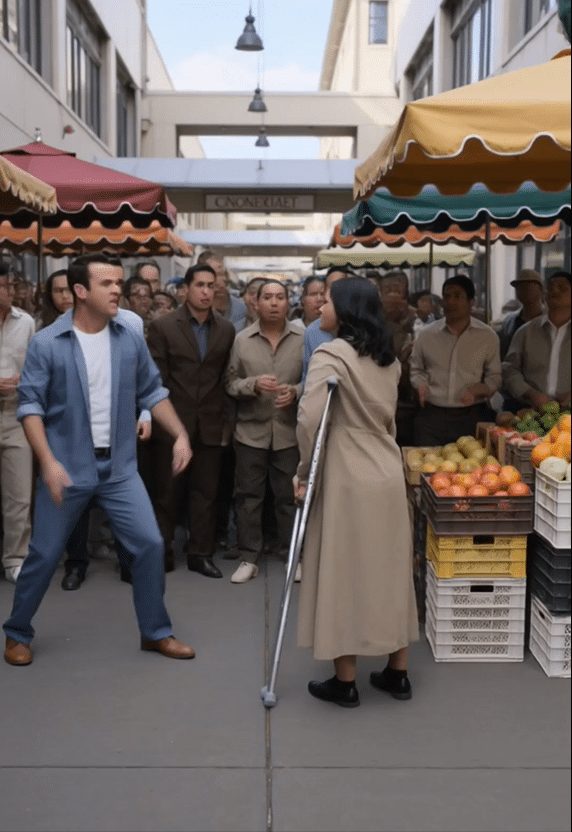
The midday sun beat down heavily on the bustling open-air market, a labyrinth of garish tarps—pinks, yellows, and blues—that filtered a suffocating light over the narrow aisles. The air was thick with the dense aroma of dried chilies, fresh cilantro, ripe fruit, and the unmistakable smell of lard from the nearby carnitas stands. It was a typical day at the Mexican tianguis, a boiling pot of shoppers, vendors hawking their bargains at the top of their lungs, and the incessant murmur of daily life.
In the center of this organized chaos stood the stall of a white man in his forties, known locally as “El Güero.” His real name didn’t matter; what everyone knew was his arrogant attitude. His stand was impeccably organized with exotic, imported fruits—a brilliant and expensive anomaly amidst the rustic wooden crates of the other merchants. El Güero looked down on everyone, with a poorly concealed disdain for the local people, whom he considered inferior.
In front of his ostentatious stall, a woman in her fifties, of undeniable indigenous roots, was trying to make her way through. She wore deeply worn clothes, a threadbare shawl over her shoulders, and relied on two heavy wooden crutches to support her mobility-impaired body. Her progress was slow, made clumsy by the unevenness of the loose and broken cobblestones that paved that section of the market.
While trying to dodge a porter who was rushing by carrying sacks of onions, the woman stumbled slightly, losing her balance and grazing the edge of a perfect pyramid of imported apples at El Güero’s stand with the base of one of her crutches. A single apple, round and glossy, fell to the dusty floor.
The reaction was disproportionate, irrational, and brutal.
El Güero, his face flushed with sudden rage, came out from behind his counter like a rabid beast, snorting through his nose.
“Don’t touch my things! Get out of my sight, you filthy beggar!” he roared, spitting the words in rapid Spanish laden with venomous disgust.
Without even giving the woman time to stammer an apology, the man launched a lateral kick, direct and ruthless, that landed squarely on her hip. The dry crack of the blow echoed above the market’s noise. The brutal force of the impact lifted her in the air for a fraction of a second before throwing her violently to the side.
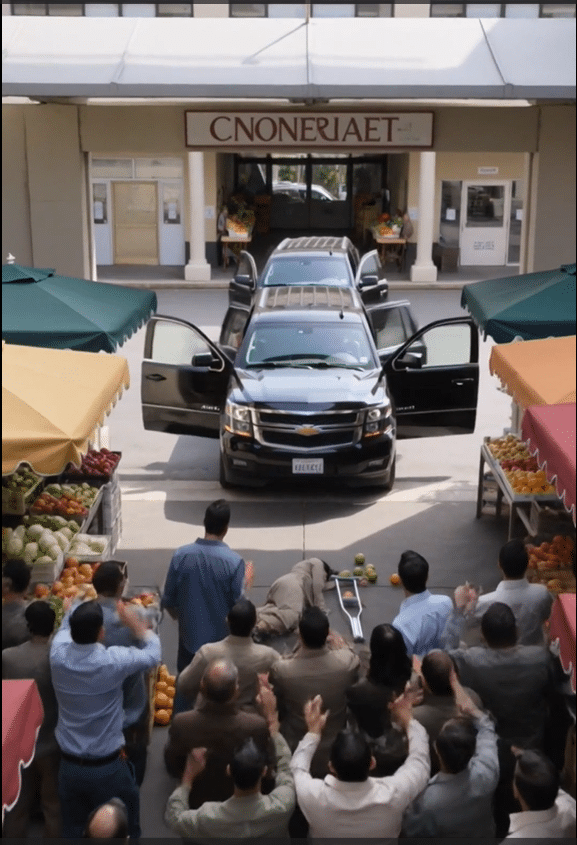
The crutches flew from her hands. Her back slammed brutally against the fragile wooden display of the adjacent stall, completely tearing down the structure. A cascade of mangoes, oranges, and papayas rolled across the dirty floor, mixing with the splintered wood of the destroyed crates. The woman fell heavily among the ruined fruit, letting out a dull moan of unbearable pain, trapped in the debris.
The surrounding crowd was petrified. Cries of “¡Dios mío!” (My God!) and “¡No puede ser!” (It can’t be!) erupted from the throats of the women who witnessed the atrocious attack. However, in a reflex conditioned by helplessness, no one dared to step forward. The fear of retaliation from this man, famous for his dark connections, was too heavy a chain.
CHAPTER TWO: THE ARRIVAL OF POWER
El Güero stood over the fallen woman, his chest heaving violently from adrenaline, a cruel and sadistic smile curving his lips. He immensely enjoyed the submission, the absolute power he believed he exercised over the most vulnerable in that space. Down on the ground, stained with sticky juice and dust, the Mexican woman struggled desperately to sit up. Her weathered face was contorted in suffering; her trembling hands reached out uselessly, trying to grasp one of the crutches that lay meters out of her reach.
The silence in that narrow market aisle had become thick, almost suffocating. The tension cut through the air, interrupted only by the faint sound of a few loose fruits still rolling until they stopped against the worn shoes of the paralyzed spectators.
Suddenly, the sharp, aggressive screech of tires burning rubber broke the tension like a whip.
At the main entrance of the aisle, just a few meters away, a caravan of three imposing, gleaming, armored black SUVs stopped abruptly, completely blocking the adjacent street. The doors of the vehicles opened simultaneously with a military coordination that chilled the blood of those present.
Six towering, imposing men, dressed in impeccably tailored black suits, dark sunglasses, and discreet earpieces, descended from the vehicles. They didn’t walk; they swept through the area like a force of nature. In a matter of seconds, they advanced into the market, pushing aside the gathered crowd without physical violence but with an absolute, intimidating firmness, creating a perfectly clear human corridor leading straight to where the woman lay.
From the central SUV stepped a man in his sixties. He wore a custom dark suit that screamed old money and unquestionable authority. His posture was straight, his gaze cold as polar ice. He was the Chairman of the Board, known in corporate power spheres as Licenciado Arturo.
Arturo didn’t look at El Güero. He didn’t spare a single glance for the frightened and curious crowd. His eyes immediately fixed—with an alarm hidden beneath layers of professionalism—on the woman lying among the fruit debris.
The elegantly suited man crossed the remaining space in long strides. He stopped in front of her, carefully creased the trousers of his expensive designer suit, and dropped to one knee in the middle of the smashed fruit, mud, and garbage. He bowed his head in a gesture of profound respect and submission before extending his pristine hands to help her with extreme delicacy.
“Madam President, forgive me for being late,” Arturo said. His voice was deep, serene, but with a cutting edge that silenced the entire market in a sepulchral hush.
CHAPTER THREE: THE TERROR IN THE TYRANT’S EYES
El Güero literally froze in his tracks. The smug smile was wiped from his face as fast as if it had been slapped off. A cold, thick, betraying sweat began to pour profusely from his forehead, sliding quickly down his temples. He stumbled half a step backward, clumsily bumping hard against the edge of his own wooden counter.
His lips trembled uncontrollably; his face suddenly took on a cadaverous pallor that contrasted with his previous flushed anger. His eyes widened enormously, unable to process the unreality of the scene unfolding before him. His jaw dropped, hanging slack and pathetic as an unintelligible babble escaped his completely parched throat. Primal terror seized his guts.
“P-President…?” he managed to articulate, his voice shattering like trampled glass, barely a whisper drowned by panic.
The woman in humble clothes ignored the vendor as if he were an insignificant insect. With the careful help of Arturo and two of the gigantic bodyguards who had strategically positioned themselves at her sides, she stood up. They handed her the crutches with reverence. She gripped them with renewed strength, her knuckles turning white. She no longer looked like a defenseless victim; as she straightened up, despite her physical disability and her threadbare attire, she emanated an aura of absolute, crushing power.
She was Doña Carmen Elena Rojas, the visionary founder, majority owner, and CEO of the largest and most influential Agricultural and Real Estate Consortium in all of Latin America. Her vast corporation not only controlled complex agricultural supply chains nationwide, but was the legal and absolute owner of the extensive lands where that gigantic market and hundreds of other commercial tianguis across the country sat.
Carmen brushed a little dust off her worn skirt with slow, calculated movements. She adjusted her shawl with a regal dignity and finally turned her neck to fix her dark, cold, and penetrating eyes on the white man who had humiliated her.
She didn’t yell. She didn’t raise her voice a single decibel. In Doña Carmen’s sophisticated and cruel world, hysterical screaming was exclusively for the weak, the mediocre, and the desperate. Her silence was her most lethal weapon.
CHAPTER FOUR: THE UNAPPEALABLE SENTENCE
“You must be the new tenant of lot forty-two,” she said. Her tone possessed a chilling calm that echoed in the reverential silence enveloping the tianguis. “The same one who has been systematically extorting my local vendors, charging illegal protection fees, and monopolizing the best spaces through threats and beatings. The thick reports reached my corporate office in Santa Fe. The numbers didn’t lie, but I wanted to come and see it with my own eyes. I wanted to walk my own market incognito to feel it in my own flesh. And boy, have I felt it.”
El Güero raised his trembling hands in a gesture of cowardly surrender, shaking like a leaf at the mercy of a hurricane.
“M-ma’am… I… I swear to God I didn’t know… it was a terrible mistake, I beg you to listen to me, it was a misunderstanding. You… look at your clothes… I thought that…” he stammered, pathetically trying to find justification in the impoverished appearance of the woman, digging his own grave with every stupid syllable he uttered.
“My clothes,” Carmen interrupted, raising a thick eyebrow with glacial disdain. “Do you think worn cotton justifies brutality? Do you think the lack of a stupid silk suit grants you the divine right to beat a vulnerable human being as if they were a stray dog getting in your way?”
The man shook his head frantically. Thick, childish tears of pure terror began to well up and slide down his cheeks. He knew perfectly well who she was now. Every single individual in wholesale commerce knew of President Rojas’s unbreakable empire. She could destroy his entire financial life with a single ten-second phone call; she could make sure he could never sell a single box of matches in the vast Mexican territory ever again.
Arturo, ever efficient, stepped half a pace forward. His posture was protective of his boss and lethally threatening toward the vendor.
“What are your specific orders, Madam President?” he asked, without taking his glaring eyes off the cowardly aggressor for a second.
Carmen sighed deeply, resting the weight of her aching body on the wooden crutches. She looked slowly around her, absorbing the faces of the humble merchants, the apron-stained female vendors, the stoic, sweat-covered porters. She could clearly see in their eyes the chronic fear that this individual and other parasites like him had established on her property.
“Arturo,” she spoke, her voice clear, strong, and without a trace of hesitation. “Cancel the commercial lease for lot forty-two with immediate effect. Cite flagrant violation of good conduct clauses and severe physical assault. Confiscate absolutely all his merchandise immediately to generously cover the compensation for the massive damages he just caused to the neighboring stalls with his little scene. And, of course, personally ensure that our legal team guarantees this miserable individual faces criminal charges for aggravated assault, battery, and discrimination. Make sure the lawyers show him not a single drop of mercy.”
El Güero collapsed to his knees, sobbing shamelessly, crawling desperately across the dusty floor toward Arturo’s polished boots.
“No, by the Virgin, I beg you! You’ll ruin me! I’ll lose everything! I’m drowning in debt! Mercy, ma’am, mercy!” he screamed wildly, reaching out his hands to try and touch the hem of Carmen’s humble skirt.
Before his dirty fingers could even brush the fabric, two of the formidable bodyguards lifted him from the ground, grabbing him brutally by the armpits. They left him suspended in the air like a rag doll, kicking and squealing uselessly.
“Get him out of my market right now,” Carmen ordered without flinching or changing her facial expression. “And God help him if he ever sets foot on my land again.”
CHAPTER FIVE: JUSTICE FOR THE PEOPLE
As the imposing suited guards dragged the kicking Güero out of the tianguis, quickly disappearing into the crowd that now parted for them with undisguised expressions of astonishment and deep satisfaction, Carmen turned to the rest of the community.
The neighboring merchants—those whose fragile structures and fruit had been ruined by the violent crash—remained paralyzed. They looked at their destroyed products scattered on the ground with immense sadness, knowing it meant the loss of their entire week’s income, yet not daring to direct a complaint to the most terrifying and powerful woman they had ever seen in real life.
Carmen, leaning firmly on her crutches, approached an older man with dark skin, whose face was deeply furrowed with wrinkles formed by decades of sun and hard work. The old man was contemplating his smashed mangoes with watery eyes.
“Sir,” she said softly, pulling out from inside her humble shawl a state-of-the-art satellite phone that contrasted absurdly with her overall appearance. “Do not fret. My internal accounting team will come by stall by stall in less than five minutes. Every piece of bruised fruit, every splintered crate, every minute of valuable sales you have lost because of this coward’s tantrum will be paid in full at triple its wholesale market value. Consider it a personal apology for the negligence of my regional managers.”
The old man reverently took off his old straw hat, sincere tears spilling down his cheeks.
“Thank you very much, boss… May God always bless you and yours,” he murmured, bowing his head in a sign of absolute respect.
Carmen nodded with a slight smile and turned to face the expectant crowd packing the surrounding aisles.
“This market was built brick by brick for you. For the honest, hardworking people of our Mexico. Not for abusers, nor tyrants with delusions of grandeur who think they own our dignity,” she proclaimed, her voice projecting with an unexpected strength from her fragile frame. “I am Carmen Elena Rojas. And as long as I have breath in my lungs, no one will ever be humiliated, extorted, or trampled in these aisles again. Starting first thing tomorrow morning, major remodeling and sanitation works will begin. We are going to fix these treacherous cobblestones, we are going to put up real structural roofs to protect you, and we are going to install a top-tier private security system so you can work in absolute peace and prosperity.”
A deep and reverential silence followed her words for three long seconds, broken clamorously by deafening applause that made the tarps vibrate. People shouted with pure joy, sharp whistles of approval echoed against the tin roofs of nearby stalls. The woman dressed in rags and leaning on worn wooden crutches, who had been brutally kicked and trampled minutes before, now stood monumentally as the undisputed matriarch and monarch of the market.
CHAPTER SIX: RETURN TO THE EMPIRE
Flanked closely by Arturo and the remaining four relentless bodyguards, Carmen undertook with dignity the slow walk back to the main exit of the tianguis. Despite the sharp pain in her left hip and leg, which throbbed furiously with every step due to the brutal bone impact she had suffered, she kept her head held high and her posture impressively straight. The emotional crowd parted for her like the Red Sea, murmuring cascades of blessings, crossing themselves, and throwing excited words of eternal gratitude her way.
Upon reaching the wide cobblestone street, Arturo hurried ahead and opened the heavy armored rear door of the central SUV for her. The interior of the cabin smelled intensely of high-end new leather and the cold air conditioning of a luxury unattainable for most. Carmen sat down very carefully, letting out a very slight, repressed groan as she flexed her hip, and meticulously settled her crutches on the plush floor of the dark vehicle.
Arturo closed the heavy door with a dull thud that isolated all outside noise, and nimbly climbed into the passenger seat. The experienced driver, dressed in a dark uniform, started the powerful V8 engine, which roared to life with a deep, almost silent purr.
“I am so deeply sorry from the bottom of my heart that you had to physically go through that hell, Madam President,” Arturo said, twisting his torso in the comfortable seat to look her directly in the eyes through the rearview mirror. His tone was no longer the strict, icy one of public address, but that of a close, intimate, and fiercely loyal advisor.
Carmen leaned heavily back into the luxurious black leather seat, closing her eyes for a long, exhausting moment, finally allowing a visible grimace of physical pain to cross her features.
“It was a necessary evil, Arturo, and you know it,” she replied, slowly opening her dark eyes, which now shone with the predatory intelligence of an unreachable corporate hawk. “If the doctored desk reports showed us false red numbers and ignored complaints, buried in metal filing cabinets, I urgently had to find out why the local administration wasn’t doing its damn job. Someone high up in our own corporate office is covering up and protecting that scum, taking fat bribes under the table to let those disgusting thugs and extortionists operate in our facilities.”
“We will begin a witch hunt and a deep internal forensic audit this very afternoon, Ma’am,” Arturo affirmed immediately, pulling out a bright digital tablet and beginning to type frantically. “Executive heads are going to roll down the hallways, I guarantee it with my own life.”
“Let absolutely all the ones that need to roll, roll, without exceptions or hesitation,” Carmen sentenced with absolute coldness, watching through the dark tinted glass as the colorful and chaotic streets of the working-class neighborhood quickly faded away. “I want all the useless regional managers of this sector in my office’s boardroom at exactly six o’clock sharp. And get me the State Governor on the encrypted line; I’m going to explain to him extensively and personally why one of his supposed ‘honorable foreign investors’ is going to spend a very long and miserable season in the eastern maximum-security penitentiary.”
CHAPTER SEVEN: THE PRESIDENT’S LEGACY
The weeks passed swiftly after that transformative incident, and the unstoppable legal and financial machinery of the Rojas Consortium thoroughly proved to the entire country why it was considered relentless and terrifying.
El Güero, desperate in his holding cell, tried to pull his shady strings, tried to bribe ministerial police with large sums, and frantically called all his political contacts of dubious origin. But he soon crashed head-on into a crushing reality: he discovered in horror that President Rojas’s vast web of influence spanned unreachable spheres of power that he, a simple market bully, couldn’t even dream of touching. All his bank accounts were frozen and confiscated within forty-eight hours under serious charges of corporate tax evasion and federal irregularities in his customs permits. He ended up losing the battle before he started it, facing an extraordinarily fast and extremely painful judicial process. He was swiftly sentenced to prison, without any right to bail, for aggravated assault, battery against a disabled person, with all possible aggravating circumstances of premeditation, flagrant advantage, and hate crimes.
In the luxurious glass hallways of the Santa Fe corporate headquarters, the purge was legendary. Three high-ranking regional managers were summarily fired and criminally prosecuted for collusion of public servants, fraud, and corruption, cleaning out and uprooting the entrenched mafia that had taken over the administration of the urban markets.
Meanwhile, in the dusty neighborhood tianguis, Carmen’s pledged word and promise did not wither into empty words thrown to the wind to appease the masses. She delivered in spades.
At dawn on the Monday immediately following the incident, dozens of massive crews of construction workers, heavy machinery, and engineers arrived at the site. They relentlessly tore up the treacherous, broken old cobblestones, rushing to install a beautiful, industrial polished concrete floor that facilitated the safe transit of cargo dollies, wheelchairs, strollers, and elderly people with mobility issues. They replaced the dirty, smelly, and worn tarps with firm, aesthetic metal structures featuring translucent polycarbonate roofs, which perfectly protected from torrential rains and the scorching sun without taking away a shred of natural light from the environment.
The infamous lot forty-two, the former symbol of tyranny, contempt, and abuse, was rebuilt and converted into a modern, gleaming small community first-aid clinic and an efficient office for conciliation, complaints, and constant support for the merchants, administered transparently and directly by a local community board, without corrupt intermediaries.
The epic urban legend of the “Day of the Just President” quickly transformed into an inspiring story that elderly grandparents repeatedly told their enthralled grandchildren among the colorful stalls of fragrant fresh fruits and vegetables. They spoke with awe of how the most powerful woman, the unreachable owner of the commercial world, had come down from the skyscrapers disguised as a humble and vulnerable shopper, walking with difficulty on her old wooden crutches, solely and exclusively to test the true darkness or goodness in the hearts of men. They spoke fervently of the divine punishment that fell with the weight of a mountain upon disgusting arrogance, and of the relentless, cold corporate justice that descended like an exterminating angel to defend the most helpless and weakest in the system.
Doña Carmen Elena Rojas never visited or set foot in that particular market again, at least not physically in person or disguised anew. From the imposing height of her luxurious glass-walled office on the fiftieth floor of the gleaming corporate building in the city’s financial center, she scrupulously and with acute precision reviewed the extensive reports that now, finally, arrived clean, prosperous, and totally transparent on her heavy mahogany desk.
Sometimes, during the rare moments of peace at the end of a long, exhausting day of multimillion-dollar deals, as she stood watching the infinite immensity of the metropolis’s blinking lights at her feet, she delicately brushed her manicured fingertips against the rough wooden knot of one of her old, worn crutches. It now rested imposingly like a priceless museum piece illuminated inside an elegant bulletproof glass display case in the geometric center of her immense office. It was a visual, tactile, and constant reminder that the true, unbreakable power of a leader does not reside in mountains of gold in the bank, nor in exclusive custom silk suits imported from Europe, but lies deeply and exclusively in justice, pure empathy, and the unbreakable, indomitable, fierce willpower to protect one’s people with one’s own life.
And down there, far away from the silence of the financial heights, in the beating, hot heart of Mexico’s working-class neighborhood, the beloved market flourished every morning with renewed strength, enormously bustling, vibrant with colors and sounds, and, for the first beautiful time in many dark years, breathing an air completely and absolutely free of all fear.