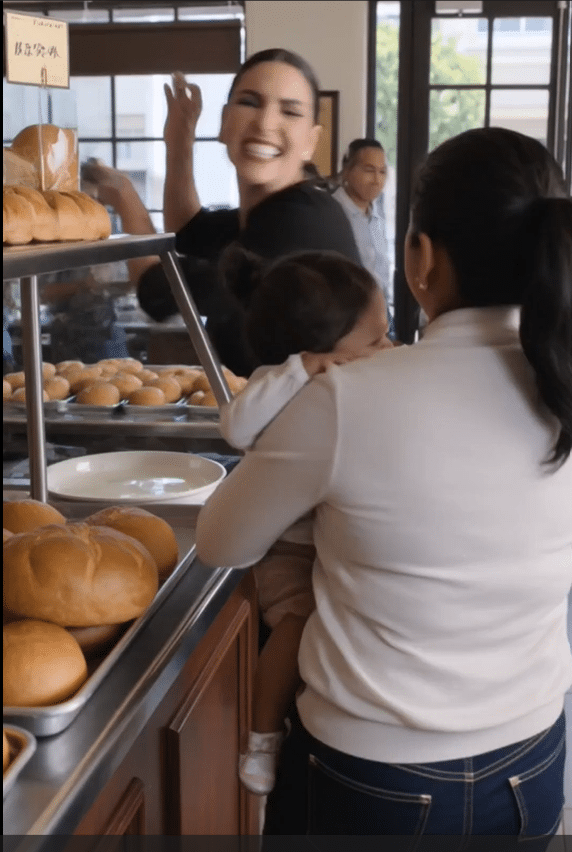
CHAPTER 1: THE ECHO OF A SLAP IN THE MORNING
The sun was just beginning to dawn over the busy streets of Mexico City, but the traditional bakery “La Espiga de Oro” was already a hive of activity. The aroma of vanilla, cinnamon, and freshly baked dough flooded the immense, high-ceilinged establishment. The wooden trays creaked under the weight of vanilla and chocolate conchas, sugar-dusted cuernitos, and steaming bolillos, giving off that scent of home and hard work that characterizes Mexican mornings. Natural light streamed through the large windows, illuminating the flour dust that floated in the air like tiny golden stars. The customers, a mix of hurried office workers, construction laborers, and neighborhood grandmothers, formed an orderly line, waiting their turn while the staff rushed behind the display cases, refilling baskets and ringing up sales at full speed.
In the midst of this everyday scene, tension erupted in the most violent way possible. A white woman of about thirty-eight, dressed in a tight haute couture dress and perched on stiletto heels that clacked arrogantly against the mosaic floor, lost her temper. Her flawlessly made-up face was disfigured by rage and classism. In front of her stood a young Mexican mother of about twenty-eight, dressed in simple denim jeans and a worn cotton blouse. The mother protectively held her little daughter in her arms, a two-year-old girl with large dark eyes.
Without warning, the arrogant woman’s bejeweled hand cut through the air. The sound of a brutal slap echoed throughout the bakery, paralyzing everyone present. The blow was so forceful that the young mother’s head was thrown to the side. Her body, losing its balance, spun sharply and crashed violently against the heavy solid wood counter. Out of pure maternal instinct, the woman hugged her baby tight against her chest to protect her from the impact, both falling heavily to the floor. Several trays were destabilized; a dozen sweet breads and bolillos fell to the ground, rolling across the tiles. Instantly, the little girl, frightened by the fall and the noise, broke into a sharp, heart-wrenching cry.
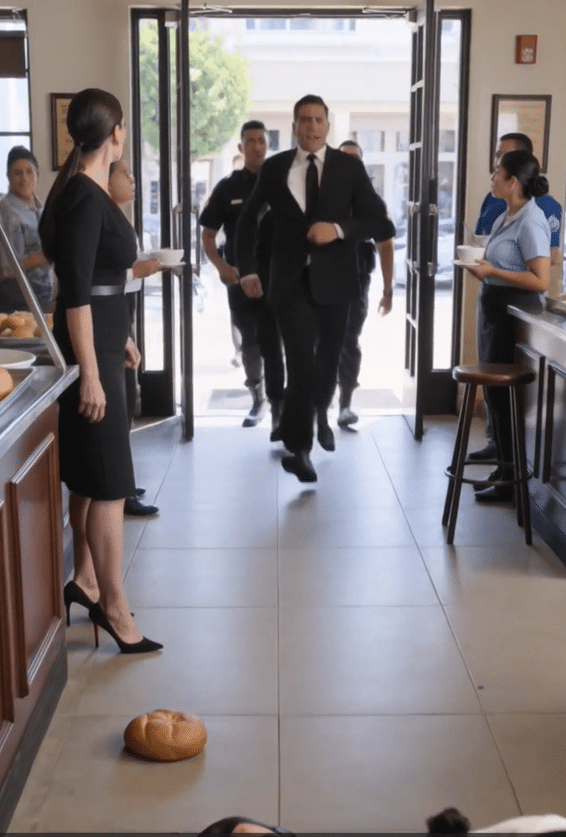
The rich woman, panting from the effort and with eyes injected with disdain, took a step forward, cornering them with her gaze from her height. She pointed at the fallen mother with the metal bread tongs she still gripped in her right hand.
“Go to the back of the line, you pauper! Don’t dirty my bakery!” the arrogant woman shouted, with a speed and venom that froze the blood of those present. The crowd let out a collective gasp, an “Oh!” of indignation and astonishment that hung suspended in the air.
But before anyone could intervene, the sound of the heavy glass front doors bursting open violently shook the place. The outside bustle penetrated for a second before the fast, coordinated footsteps of tactical boots echoed on the floor. The crowd immediately parted, creating an aisle as if the Red Sea itself were parting.
A man of about fifty, dressed in an impeccable custom-made black suit, radiating overwhelming authority, advanced with long strides. He was escorted by four imposing bodyguards who quickly secured the perimeter with hawk-like stares. The man in the black suit did not look at the arrogant woman or the frightened customers; his eyes were fixed on the fallen young mother. He ran the last few meters and, not caring about dirtying his expensive trousers, dropped to one knee in front of the humble woman and the crying child. He bowed his head in a gesture of profound reverence and absolute respect.
“Forgive me, Madam Owner. We are late,” said the Regional Director, with a deep voice that echoed in every corner of the silent establishment.
A deathly silence, thick and unreal, fell over the bakery. The arrogant woman was petrified, as if turned to stone. Her eyes widened enormously, to the point of almost bulging out of their sockets. Her jaw dropped in a gesture of pure terror, and her lips, painted carmine red, began to tremble uncontrollably. The metal tongs she held slipped from her lifeless fingers, falling to the floor with a metallic clink that sounded like a funeral bell.
“T-The owner…?” the arrogant woman stuttered, her voice breaking in a whisper of disbelief.
CHAPTER 2: THE WEIGHT OF THE SILENCE
The atmosphere in “La Espiga de Oro” was dense, almost suffocating. Following the rich woman’s words, no one dared to move a single muscle. The only sound breaking that stillness was the muffled crying of the little girl, who clung with her small hands to her mother’s blouse. The mother, still on the floor, took a deep breath, closing her eyes for a brief moment to process the stinging in her cheek and the pain from the impact against the wooden furniture.
The Regional Director, a man named Don Roberto, a business veteran who oversaw more than two hundred branches across the country, extended a firm hand toward the young mother. His face reflected a mix of genuine concern and contained fury threatening to unleash.
“Madam Elena, are you alright? Should I call the paramedics?” asked Don Roberto, maintaining a professional tone but with evident nervousness. He knew that the woman on the floor was not a simple customer; she was the majority heir and recent buyer of the entire food conglomerate that included this very bakery and hundreds of other factories throughout Mexico.
Elena, ignoring her director’s hand, leaned on the counter to stand up on her own. Her movements were slow but loaded with unshakeable dignity. She first checked on her daughter, Lupita, stroking her curly hair and kissing her forehead to calm her down.
“We are fine, Roberto. It was just a scare,” Elena replied with a serene voice, a voice that did not match someone who had just been publicly assaulted. Her accent was soft, deeply Mexican, without pretension or embellishments.
She brushed the flour dust off her denim jeans. Her face, now marked by a red patch rapidly turning into a bruise near her left cheekbone, turned toward the arrogant woman.
Patricia, the woman in the designer dress, had taken another half step back. Her brain was furiously trying to process the surreal scene unfolding before her eyes. How was it possible? She frequented the highest circles of Polanco and Lomas de Chapultepec. She knew the business owners, the conceited entrepreneurs in Italian suits. This girl did not fit into her narrow world of appearances.
“This… this is a joke, right?” Patricia managed to articulate, trying to recover a shred of her usual haughtiness, though her voice sounded shrill and pathetic. “This village Indian is the owner? Please! I know the real owner, engineer Carlos Villanueva. I dine with him and his wife almost every month! You are impostors.”
Don Roberto slowly stood up. His imposing six-foot-two height blocked the light shining on Patricia. The four bodyguards, hearing the racial slur, tensed their muscles, taking a step forward in unison, closing the circle around the aggressor.
CHAPTER 3: THE TRUTH BENEATH THE HUMILITY
Elena raised a hand, stopping the bodyguards’ advance dead in their tracks. With little Lupita now calmer, resting her head on her mother’s shoulder, Elena took a step toward Patricia. There was no hatred in her eyes, but a profound pity that wounded the rich woman’s pride more than any physical blow could.
“Engineer Villanueva is a great man, indeed,” said Elena, her voice resonating clearly in the silent bakery. “And an excellent businessman. So excellent, that he understood when it was time to retire. He sold me one hundred percent of his shares exactly three weeks ago. My name is Elena Morales, and yes, I am the absolute owner of ‘La Espiga de Oro’ and the entire Villanueva Group.”
A murmur rippled through the customers who were still crowded together. The employees behind the counter, from the flour-covered bakers to the cashiers, looked at each other in astonishment.
“I… I had no idea,” Patricia babbled, looking around for support but only finding faces full of reproach. “But look at yourself. You’re wearing flea market clothes. You’re dragging around a crying brat. You don’t have the bearing of a businesswoman! Anyone would have been confused. Besides, she got in my way. I am in a big hurry, I am an important woman.”
Elena sighed, adjusting the child on her arm.
“I am dressed like this because I came to work, not to a runway. I come to my branches like any other customer to see how my people are treated, how the quality of my bread is, how the managers operate when they think the bosses aren’t looking.” Elena swept her gaze over the employees, stopping at the branch manager, who was sweating profusely behind the cash register. “And today I have seen many things. I have seen that the bread in this bakery remains exceptional. But I have also seen that we allow classism and arrogance to trample over human decency.”
Patricia, feeling cornered and seeing that her status would not save her, decided to play her final card: commercial value.
“Look, little girl. I spend thousands of pesos here every week for my corporate events. I am a VIP client. If you give me a hard time, I’ll take my money elsewhere, and I’ll make sure all my acquaintances boycott your business. A misunderstanding shouldn’t cost you your best clients. I demand an apology for the scene your gorillas are causing.”
Patricia’s audacity was so overwhelming that Don Roberto let out a dry laugh, devoid of humor.
CHAPTER 4: THE COLLAPSE OF ARROGANCE
Elena did not flinch. She maintained her firm posture, the inheritance of a woman who had started from the bottom, kneading dough at three in the morning in a small shop in the Guerrero neighborhood before building her own empire from scratch.
“Madam, money is important for business, I won’t lie to you,” Elena began, taking another step toward Patricia, forcing her to back up until the rich woman’s back hit the sweet bread shelves. “But there is something money cannot buy in my company: the right to humiliate another human being.”
Elena looked down at the bread that had fallen to the floor during the altercation.
“You yelled at me not to dirty your bakery,” Elena continued, pointing to the floor. “But the only one who has dirtied this place with her presence is you. You dirtied the effort of my bakers who wake up at dawn to make these bolillos. You dirtied the peace of these people who just wanted to buy their breakfast. And the most unforgivable thing: you struck a mother holding her daughter, just because you thought having less money made us less than you.”
Patricia swallowed hard. All color had completely drained from her face. Her hands were trembling so much she had to grip her designer bag to keep from dropping it.
“My husband is a magistrate…” she tried to threaten, but her voice failed her.
“Your husband can be the president of the republic if he wants,” Elena interrupted, raising her voice slightly, showing for the first time the forged steel of her character. “On my properties, under my roof, my rules apply. And rule number one is respect. I don’t care how much money you leave in my cash register. You are no longer welcome here. Not today, not ever. You are banned for life from any of my establishments.”
The store manager, from behind the counter, nodded vigorously, making a mental note of his new top boss’s order.
“Roberto,” said Elena, without taking her eyes off the woman. “Please, escort her to the exit. Make sure she knows the way.”
CHAPTER 5: NEIGHBORHOOD JUSTICE
The Regional Director nodded with a slight smile of satisfaction. He gestured with his hand, and two of the bodyguards advanced toward Patricia. They didn’t touch her, but their imposing presence flanking her was enough for the woman to understand her time was up.
“Please, ma’am. The exit is that way,” said one of the security personnel, pointing to the glass door coldly.
Patricia, humiliated, with her pride shattered and her breathing ragged, looked around. She hoped to find a look of compassion, someone of her “class” to defend her, but she only found the weathered faces of hard-working Mexicans watching her with disdain.
As she walked toward the door, dragging her expensive heels, a construction worker in a reflective vest standing in line shouted:
“Have a good day, arrogant blondie! Go throw your tantrums somewhere else!”
The entire bakery erupted in applause and approving whistles. The accumulated tension was released in a collective catharsis typical of a Mexican neighborhood, where social justice, when it happens, is celebrated like a goal in a World Cup. Patricia practically ran out of the place, stumbling on the sidewalk, desperate to escape the public humiliation, disappearing into the city’s morning traffic.
Once the doors closed behind the aggressor, silence returned to the bakery, but this time it was a warm silence, full of expectation and respect. Elena, with Lupita still in her arms, turned to face her audience. Her left cheek was already clearly swollen, but she was smiling.
“To everyone present,” Elena said, raising her voice to be heard over the soft murmur. “I offer you my sincere apologies for the bad time you just witnessed. It’s not the way we want you to start your day. To make up for the scare and the lost time, all the bread and coffee you take today is on the house.”
A shout of joy flooded the branch. The customers cheered the bakery’s name and began applauding the young mother.
CHAPTER 6: THE LESSON FOR THE BAKERY FAMILY
While the happy customers returned to form the line and fill their trays with renewed enthusiasm, Elena addressed the employees. She walked behind the wooden counter, stepping between the baskets of fresh bread. The workers, from the apprentices to the master baker, Don Pancho—an old man with floured hands and a wise gaze—looked at her with a mix of awe and profound admiration.
The branch manager, a young man named Mario, stepped forward, in a cold sweat.
“Madam Elena… I didn’t know what to do. That woman is a frequent customer and always threatens to complain to management. I beg you to forgive me for not intervening when she hit you. I froze. I didn’t want to lose my job.”
Elena handed the little girl to Don Roberto, who, despite his rough top-executive appearance, held little Lupita with clumsy tenderness. Then, Elena approached the manager and placed a hand on his shoulder.
“Mario, listen to me carefully. The customer is not always right. Especially not when that reason attacks the integrity of another human being. If anyone ever walks through that door again and disrespects you, one of the bakers, the cashiers, or another customer unjustifiably, I want you to kick them out immediately. I don’t care if it’s the governor himself. I will always have your back, understood?”
Mario’s face lit up with profound relief, and he nodded vigorously.
“Yes, boss. Understood.”
Elena looked at Don Pancho, the old baker, who was smiling beneath his large white mustache.
“Don Pancho, the smell of your conchas was what convinced me not to change the original recipe when I bought the company,” Elena confessed with a wink. “They are the best I’ve tasted since my grandmother baked them in Michoacán.”
The old baker broadened his smile, feeling that decades of waking up at three in the morning were finally truly recognized by someone at the top.
“Thank you, my child. I mean… Madam Owner,” Don Pancho corrected clumsily.
“Elena is fine, Don Pancho. We are a bakery family now.”
CHAPTER 7: THE TASTE OF RESPECT
The morning continued its natural course, but the energy inside “La Espiga de Oro” had changed forever. The news of the altercation and the true identity of the owner would spread quickly through all the branches in the country. It would become clear that a new era had begun in the company; an era where a humble origin was not synonymous with weakness, and where wealthy arrogance had no place.
Don Roberto approached Elena, handing little Lupita back to her, who was now completely calm, happily nibbling on a piece of sugared cuernito that one of the bakers had given her.
“What do we do now, Elena?” asked the director, adjusting his tie, ready to follow the tight schedule of the day. “We have the shareholders’ meeting at eleven, and then the visit to the flour factory in the State of Mexico.”
Elena settled her daughter on her hip and took a pair of clean wooden tongs from the counter. She walked over to the tray where the vanilla conchas rested, fresh from the oven, with their cracked and perfect sugar coating.
“What we are going to do, Roberto, is have breakfast,” she replied with a serene smile, placing two warm conchas on a small tray. “We are going to sit at that corner table, like any other Mexican before going to work. And afterward, we are going to go to that shareholders’ meeting to remind them that the heart of this company is not in the numbers, but in the respect for our people.”
The man in the black suit smiled genuinely, took a cup of hot café de olla offered by one of the employees, and followed his boss toward the small table.
The morning sun illuminated the bakery even more brightly. The local radio music, which had previously been muted by the tension, began to play softly in the background. The place was filled with laughter, lively conversations, and the unmistakable sound of crusty bread. Elena, the owner of the empire, sat with her daughter in her arms, savoring the sweet taste of a vanilla concha, knowing that, beyond money and power, true wealth lay in never forgetting where you came from, and in having the courage to defend the dignity of those the world tried to diminish. True justice had been baked that morning, and it had the best taste of all.